
About Addie L. Wyatt
Lived 1924 – 2012 (aged 88). Addie L. Wyatt was an American trade unionist, union organizer, civil rights advocate and pastor.
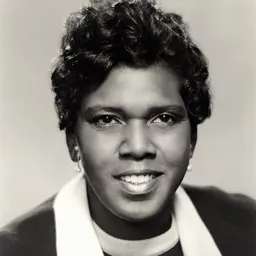
Addie L. Wyatt (née Cameron; March 8, 1924 – March 28, 2012) was a leader in the United States Labor movement and a civil rights activist. Wyatt is known for being the first African-American woman elected international vice president of a major labor union, the Amalgamated Meat Cutters Union. Wyatt began her career in the union in the early 1950s and advanced in leadership. In 1975, with the politician Barbara Jordan, she was the first African-American woman named by Time magazine as Person of the Year.
Family and early life Wyatt was born to Ambrose and Maggie (Nolan) Cameron in Brookhaven, Mississippi, on March 8, 1924. She was the second child and the oldest daughter of eight children. She moved with her family to Chicago in 1930 when she was six years old. The family relocated in hopes of finding better job opportunities during the Great Depression. However, obtainable jobs for African Americans at this time were hard to come by.
At 16 years old, she married Claude S. Wyatt, a postal finance clerk, on May 12, 1940. With Claude she had two sons, Renaldo Wyatt and Claude S. Wyatt III. She raised several of her younger siblings after her mother died at the age of 39 and her father was unable to care for them because of illness. Meatpacking industry and union work
After her marriage, Wyatt applied for a job as a typist for Armour and Company in 1941. On her first day of work, she discovered African American women were not hired as typists in the front office and instead was sent to the canning department to pack stew in cans for the army. In the early 1950s, Wyatt joined the United Packinghouse Workers of America upon discovering the union did not discriminate against its members. As the forefront leader of black women within unions, she and others took advantage of their union's antiracist and antidiscrimination bylaws and fought race-based and gender-based inequities at work as well as in their communities. In 1955, Wyatt worked full-time on staff for the UPWA, representing workers across a five-state region. She recognized the importance and effectiveness of interracial organization. Among other achievements, Wyatt and her union of black, white, and Latino laborers were able to win "equal pay for equal work" provisions in many union contracts well before the passing of the Equal Pay Act of 1963.
In 1953, Wyatt was "elected vice president of her branch, Local 56, becoming the first black woman to hold senior office in an American labor union." Wyatt was the director of the Women's Affairs and Human Rights departments of the Amalgamated Meat Cutters. By 1956, Wyatt was the Program Coordinator for District One of the UPWA. This was also the year the Wyatts began their work with Dr. Martin Luther King Jr, with whom they helped raise funds for the Montgomery Improvement Association. In the early 1960s, Eleanor Roosevelt recognized her leadership abilities and appointed her to a position on the Labor Legislation Committee of the United States Commission on the Status of Women. African American women, with Addie Wyatt at the helm, had the unparalleled experience of working on the floors of the meatpacking plants as well as being integral parts of building the unions.
During the 1970s she became a powerful figure in the United Food and Commercial Workers International Union. During this time, she worked harder to create unions that were more inclusive of minorities. In 1972, she became the founding member of the Coalition of Black Trade Unionists, which was formed to ensure that black workers could "share in the power of the labor movement at every level." As chair of CBTU's National Women's Committee, Wyatt helped ensure that AFL-CIO-affiliated unions opened leadership positions to women.
Don’t just read it —
keep it.
Full-length biographies made to live with: read them, listen on the way to work, watch them tonight.
- E-book
- Audio
- Video
Instant download · yours to keep · every purchase keeps this site free
Important facts
People in Addie L. Wyatt's life
Named in this biography and alive at the same time





Related people
Same field, nearest in time




Contemporaries
People whose lives overlapped Addie L. Wyatt's



Frequently asked questions
Who was Addie L. Wyatt?
American labor leader (1924–2012)
When was Addie L. Wyatt born?
Addie L. Wyatt was born on 8 March 1924 in Brookhaven.
When did Addie L. Wyatt die?
Addie L. Wyatt died on 28 March 2012 in Chicago.
What was Addie L. Wyatt's occupation?
Addie L. Wyatt was a trade unionist, union organizer, civil rights advocate and pastor.
What nationality was Addie L. Wyatt?
Addie L. Wyatt was American.
Sources & further reading
Cite this page
APA: Biography.guide. (2026). Addie L. Wyatt. https://biography.guide/addie-l-wyatt/
MLA: "Addie L. Wyatt." Biography.guide, https://biography.guide/addie-l-wyatt/.
Chicago: "Addie L. Wyatt." Biography.guide. https://biography.guide/addie-l-wyatt/.
Data last updated: 2026-09-22 · Spot an error? Report a correction.
Page generated 2026-09-27 05:33 UTC