
Adam Armour
Scottish builder
About Adam Armour
Lived 1771 – 1823 (aged 51). Adam Armour was a British.
Adam Armour (1771–1823) was the younger brother of Jean Armour and therefore the brother-in-law of the poet Robert Burns. In addition, being married to Fanny (Frances) Burnes, he was also related to the poet through his father-in-law (Robert Burnes) 'Poor Uncle Robert', who lived at Stewarton.
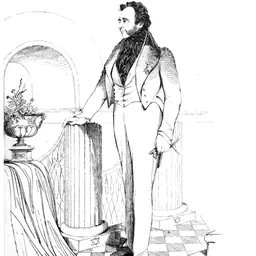
Life and background Fanny Burnes, Adam's wife, may have been born at Titwood farm where her father lived for a number of years whilst working at the nearby Lochridge limestone quarry. Baptised on 3 March 1771 at Mauchline Adam was a builder, as was his father, the master mason James Armour (15 January 1731 – 25 September 1798), father-in-law of the poet Robert Burns. His mother was Mary Smith (died 30 July 1805) who married at Mauchline on 7 December 1761 and his siblings were John Armour, Jean (Armour) Burns, James Armour, Robert Armour, Helen Armour, Mary Armour, Robert Armour, Mary Armour, Janet Armour and Robert Armour. He is thought to have been of small stature, alluded to by Burns in "Adam Armour's Prayer" where he has Adam say "Gude pity me, because I'm little!" His portrait is listed in 1962 as being in the National Burns Tower Museum in Mauchline. Adam was named for Adam Smith, James Armour's father-in-law.
Family Adam met Fanny Burnes at Ellisland Farm as her cousin Robert Burns had taken her and her brothers in after the death of her father Robert in 1789. Adam was for a time employed at the nearby Dalswinton House as a builder, lodging at Ellisland with his sister and brother-in-law and therefore sharing the house with Fanny amongst others. Adam is said to have married Fanny at Dalswinton that lies near Ellisland, however the wedding is also said to have taken place at Mauchline. Adam died on 8 January 1823 aged 51. It was said that Adam found Burns working at the plough however the day being a Sunday this is highly unlikely.
When the poet's Uncle Robert died he did what he could to help John, William and Fanny (Frances) Burnes, his cousins, to gain employment. In February 1789 Robert Burns wrote from Ellisland Farm to his cousin, James Burnes in Montrose from Ellisland, saying: "We have lost poor uncle Robert this winter .... His only daughter, Fanny, has been with me ever since her father's death and I purpose to keep her in my family til she be quite woman grown, and be fit for better service. She is one of the cleverest girls, and has one of the most amiable dispositions, that I have ever seen."
Robert paid Adam six shillings in November 1791 to return to Ellisland at the dead of night to smash every window in the farm upon which he had inscribed verses as an act of revenge upon James Morin, Laird of Laggan who was the new owner. Robert felt cheated over the price paid for a heap of manure, a valuable commodity before artificial fertilisers were available. No record of the verses has survived. Adam carried out the task and in 1813 he related the incident to a Dumfriesshire man. A record survives of the charges placed upon Burns for 'dilapidations' at Ellisland and is for 'Glass' six shillings!
The Agnes Wilson incident Adam Armour hid at Mossgiel Farm for a time after the Agnes Wilson affair. Agnes Wilson was a female servant or journeywoman who worked for George Simpson, the landlord of Poosie Nancie's. She had a reputation as a prostitute and Adam Armour at the age of 15 led a group of 'Auld Licht' adherents who decided to run her out of town. The gang obtained a rough pine tree pole, suspended it between horses and forced her to sit astride it. The experience caused her significant physical injury as Burns' poem describes. George (Geordie) Simpson and his wife Agnes (Poosie Nancie) greatly resented this cruel and lawless behaviour and proceeded to prosecute Adam and his group.
As a result of the affair Burns wrote 'The Prayer' or 'Adam Armours Prayer' that, although well known in Mauchline was not published until 1808 when it appeared in the Edinburgh Magazine.
This incident is related to the "Court of Equity" of which Burns was a member that in 1785 and 1786 met at the vinter John Dow's house in Mauchline where they debated the cases of scandal taking place in the village and –
"To punish contravening truants At instance of our constituents, And, under proper regulation, To purge the lists of forn—n."
Don’t just read it —
keep it.
Full-length biographies made to live with: read them, listen on the way to work, watch them tonight.
- E-book
- Audio
- Video
Instant download · yours to keep · every purchase keeps this site free
Important facts
Family & relationships
People in Adam Armour's life
Named in this biography and alive at the same time



Contemporaries
People whose lives overlapped Adam Armour's





Frequently asked questions
Who was Adam Armour?
Scottish builder
When was Adam Armour born?
Adam Armour was born on 27 February 1771 in Mauchline.
When did Adam Armour die?
Adam Armour died on 8 January 1823.
What nationality was Adam Armour?
Adam Armour was British.
Sources & further reading
· DBpedia: Adam Armour (Robert Burns)
Cite this page
APA: Biography.guide. (2026). Adam Armour. https://biography.guide/adam-armour-adam-armour-robert-burns-personfunction-1/
MLA: "Adam Armour." Biography.guide, https://biography.guide/adam-armour-adam-armour-robert-burns-personfunction-1/.
Chicago: "Adam Armour." Biography.guide. https://biography.guide/adam-armour-adam-armour-robert-burns-personfunction-1/.
Data last updated: 2026-09-22 · Spot an error? Report a correction.
Page generated 2026-09-27 05:10 UTC