
About Adad-guppi
Lived 650 BC – 546 BC (aged 103–104). Adad-guppi was a historian and priestess.
Adad-guppi (; c. 648-544 BC), also known as Addagoppe, was a devotee of the moon god Sîn in the northern Assyrian city of Harran, and the mother of King Nabonidus (ruled 556–539 BC) of the Neo-Babylonian Empire.
Life Background In her inscriptions, Adad-guppi claimed that Nabonidus was of the dynastic line of Ashurbanipal (669–631 BC), king of the Neo-Assyrian Empire. According to her inscriptions, Adad-guppi was born in Ashurbanipal's twentieth year as king. At the time of her birth, Harran had been a major Assyrian stronghold and when the Neo-Assyrian Empire fell in 609 BC, Harran was the capital of its government in exile.
On account of her claims in regards to Nabonidus being of Sargonid (Ashurbanipal's dynasty) ancestry, Stephanie Dalley considered it in 2003 "almost certain" that Adad-guppi was a daughter of Ashurbanipal.
Michael B. Dick opposed Dalley's conviction in 2004, pointing out that even though Nabonidus did go to some length to revive some old Assyrian symbols (such as wearing a wrapped cloak in his depictions, absent in those of other Neo-Babylonian kings but present in Assyrian art) and attempted to link himself to the Sargonid dynasty, there is "no evidence whatsoever that Nabonidus was related to the Sargonid dynasty".
According to Paul-Alain Beaulieu, that Adad-guppi did not explicitly claim any royal ancestors herself points to a humble origin. As inscriptions by female relatives of kings are relatively rare, it is however probable, according to Wilfred G. Lambert, that Adad-guppi was of some high status.
Influence Addagoppe's prediction that Sin would make her son king so that he could restore Harran seems to have been a major influence on Nabonidus, to the cost of his relationship with the priests of Babylon and their traditional gods, particularly Marduk. Other sources beyond Addagoppe's biography reveal that Nabonidus paid homage to Sîn during his reign as king of Babylon. He gave special attention to the temples of Sîn in Harran and Ur, and even considered turning the temple of Marduk in Babylon into a sanctuary for Sîn. This, says one inscription, caused unrest in many parts of the kingdom.
Autobiography Discovery Historians have discovered two copies of a pseudo-autobiography of Addagoppe. The first copy, discovered by H. Pognon in 1906, was written on a broken stele excavated at Harran. The second copy, uncovered fifty years later by D.S. Rice, was written on the pavement steps of the northern entrance to the Great Mosque at Harran.
Content The pseudo-autobiography starts out with a first-person account written from the perspective of Addagoppe herself and ends with a description of her burial. Because Addagoppe was buried with the honors of a queen, some scholars have suggested that she acted as a regent for Nabonidus when he abandoned Babylon and moved to the oasis of Teima starting in 552 BC. However, this theory is difficult to reconcile with the chronology Addagoppe presents in her autobiography. She mentions that she was born in the twentieth year of Assyrian King Assurbanipal (about 648 BC), and that she cared for the sanctuaries of the moon god Sîn for 95 years. She also mentions that she lived to see her son Nabonidus made king over Babylon, which took place in 556 BC, making her approximately 92 years old at his coronation, and 96 years old at his departure to Teima. She apparently died at the age of 104 (c. 544 BC), having lived with sound body and mind to see descendants to the fourth generation.
Addagoppe credited Nabonidus' call to kingship to the moon god Sîn, and her autobiography contains a prayer of praise and thanksgiving to Sîn. In response to this prayer, Addagoppe apparently received a prophecy from Sîn in a dream regarding future actions of her son as king:
Don’t just read it —
keep it.
Full-length biographies made to live with: read them, listen on the way to work, watch them tonight.
- E-book
- Audio
- Video
Instant download · yours to keep · every purchase keeps this site free
Important facts
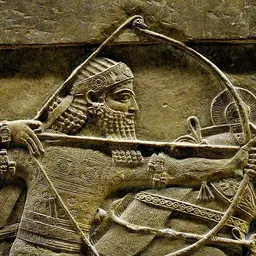
People in Adad-guppi's life
Named in this biography and alive at the same time

Related people
Same field, nearest in time



Contemporaries
People whose lives overlapped Adad-guppi's

Frequently asked questions
Who was Adad-guppi?
assyrian priestess of the moon god Sin
When was Adad-guppi born?
Adad-guppi was born in 650 BC in Harran.
When did Adad-guppi die?
Adad-guppi died in 546 BC in Babylonia.
What was Adad-guppi's occupation?
Adad-guppi was a historian and priestess.
Sources & further reading
Cite this page
APA: Biography.guide. (2026). Adad-guppi. https://biography.guide/adad-guppi/
MLA: "Adad-guppi." Biography.guide, https://biography.guide/adad-guppi/.
Chicago: "Adad-guppi." Biography.guide. https://biography.guide/adad-guppi/.
Data last updated: 2026-09-20 · Spot an error? Report a correction.
Page generated 2026-09-27 05:16 UTC