
Achaemenes
Possibly mythical apical ancestor of the Achaemenid dynasty, living in the 7th century BC and possibly a ruler of Parsumash, a vassal state of the Median Empire
About Achaemenes
Lived 800 BC – 700 BC. Achaemenes was a sovereign.
Achaemenes ( ; ; ) was the progenitor (apical ancestor) and eponymous founder of the Achaemenid dynasty of Persia.
Other than his role as an apical ancestor, nothing is known of his life or actions. It is quite possible that Achaemenes was only the mythical ancestor of the Persian royal house, but if Achaemenes was a historical person, he would have lived around 700 BC.
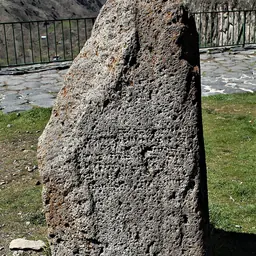
Name The name used in European languages ( , ) ultimately derives from Old Persian , as found together with Elamite (Ha-ak-ka-man-nu-iš or Hâkamannuiš) and Akkadian (A-ḫa-ma-ni-iš-ʾ) in the non-contemporaneous trilingual Behistun Inscription of Darius I. The Old Persian proper name is traditionally derived from "friend" and "thinking power", yielding "having a friend's mind." The name is spelled (Haxâmaneš) in Modern Persian.
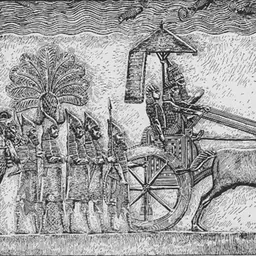
Historicity In the Behistun inscription (c. 520 BC), Darius I portrays Achaemenes as the father of Teispes, ancestor of Cyrus II (Cyrus the Great) and Darius I. Many scholars believe he was a ruler of Parsumash, a vassal state of the Median Empire, and that from there he led armies against the Assyrian king Sennacherib at the Battle of Halule in 681 BC.
Behistun inscription It may be that the Behistun inscription's claim of descent from Achaemenes was an invention of Darius I, in order to justify the latter's seizure of the throne. Cyrus II does not mention Achaemenes at all in the detailed genealogy given in the Cyrus cylinder. As such, Achaemenes could be a retrograde creation of Darius the Great, made in order to legitimize a dynastic relationship to Cyrus the Great. Darius certainly had much to gain in having an ancestor shared by Cyrus and himself, and may have felt the need for a stronger connection than that provided by his subsequent marriage to Cyrus' daughter Atossa.
Greek writers The Greek writers of antiquity preserve several legends surrounding the figure: The Pseudo-Platonic dialogue First Alcibiades (120e), written in the late 4th-century BC, portrays Achaemenes as the hero-founder of the Persái in the same way that the Greeks are descended from Heracles, and that both Achaemenes and Hercules were descendants of Perseus, son of Zeus. Another version of the tale makes Achaemenes the son of Aegeus, yet another founder-hero of legend. The 3rd-century Aelianus (De nat. anim. 12.21) says Achaemenes was bred by an eagle.
Don’t just read it —
keep it.
Full-length biographies made to live with: read them, listen on the way to work, watch them tonight.
- E-book
- Audio
- Video
Instant download · yours to keep · every purchase keeps this site free
Important facts
Family & relationships
People in Achaemenes's life
Named in this biography and alive at the same time
Related people
Same field, nearest in time


Contemporaries
People whose lives overlapped Achaemenes's


Frequently asked questions
Who was Achaemenes?
possibly mythical apical ancestor of the Achaemenid dynasty, living in the 7th century BC and possibly a ruler of Parsumash, a vassal state of the Median Empire
When was Achaemenes born?
Achaemenes was born in 800 BC in Iran.
When did Achaemenes die?
Achaemenes died in 700 BC in Iran.
What was Achaemenes's occupation?
Achaemenes was a sovereign.
What nationality was Achaemenes?
Achaemenes's recorded nationality: Achaemenid Empire.
Sources & further reading
Cite this page
APA: Biography.guide. (2026). Achaemenes. https://biography.guide/achaemenes/
MLA: "Achaemenes." Biography.guide, https://biography.guide/achaemenes/.
Chicago: "Achaemenes." Biography.guide. https://biography.guide/achaemenes/.
Data last updated: 2026-09-20 · Spot an error? Report a correction.
Page generated 2026-09-27 05:01 UTC