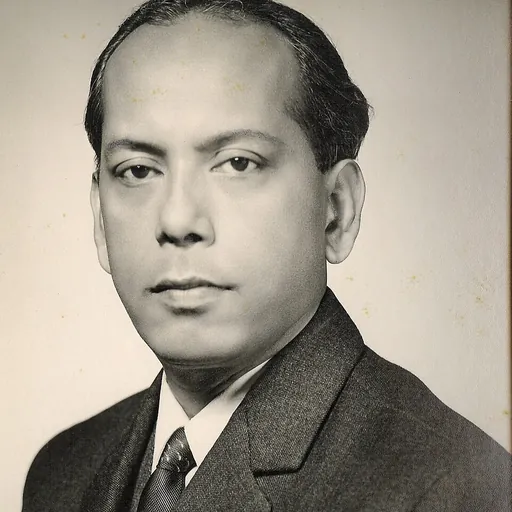
About Abul Fateh
Lived 1924 – 2010 (aged 86). Abul Fateh was a Bangladeshi, Indian and Pakistani diplomat and politician, known for Foreign Secretary of Bangladesh and Foreign Service Academy.
AFM Abul Fateh (16 May 1924 – 4 December 2010) was a Bangladeshi diplomat and statesman. He served as the founding director of the Foreign Service Academy of Pakistan
At about the same time, in July 1971, Fateh received a summons from the Pakistan Foreign Ministry to attend a conference in Tehran of regional Pakistani ambassadors. He chose to take his official car ostensibly to drive to Tehran, but as he and his driver approached the Iran–Iraq border, he feigned chest pains and ordered the driver to return him home, where he arrived that evening. Saying that he would take a plane the next day, he dismissed the driver. That night, he fled with his wife and sons across the border into Kuwait, where they were assisted by officials attached to the local Indian Embassy to take a plane to London. He was the first ambassador to defect from Pakistan. The news was received with fury by the military regime in Islamabad, duped by what was later described as a "cool and calculated James Bond-type adventure" It was a dramatic defection that created a sensation in diplomatic circles and greatly boosted the morale of those engaged in the war of liberation. The Yahya Khan military regime in Pakistan was furious and requested the British Government to extradite Abul Fateh from London, but the requests were rebuffed by the British government.
The Mujibnagar government made him ambassador-at-large, followed in August 1971 by the concurrent position of advisor to the acting president, a position he was to resign in January 1972 after the return to Bangladesh of Bangabandhu Sheikh Mujibur Rahman. He had a key role managing relations with the United States and India whilst heading the nascent country's diplomatic service. He was one of the first high officials to reach Dhaka after its liberation, and was quartered with other senior officials in Bangabhaban until January 1972. He was also the highest Bangladeshi official in Dhaka until the acting president and cabinet arrived after independence; on his arrival in Dhaka, he was driven under escort from the airport, becoming the first civilian official to lay a wreath at the ruins of the Shaheed Minar, an act planned to mark the first presence of the government in Dhaka. Already the effective head of the incipient foreign service, he became foreign secretary at the end of 1971, playing a key role
Bangladeshi ambassador
He then took up the position of Bangladesh's first ambassador in Paris (1972–1976). The early part of this posting involved extensive travel in Africa to persuade African governments to recognise the independence of Bangladesh. In 1973 he represented Bangladesh at a Commonwealth conference for youth ministers in Lusaka. In 1975 he went to Morocco and, at a time of a shortage in supply of phosphates, managed to secure a substantial phosphate shipment for Bangladesh.
In mid-1975 he was selected to be high commissioner in the UK, which post he took up in early 1976. His two years in London (1976–1977) saw him chairing the Commonwealth Conference on Human Ecology and Development, and the Bangladesh government approved his recommendation that dual citizenship be permitted. Many people from Bangladesh were settled in the UK, whose remittances into Bangladesh were an important source of foreign exchange. He pointed out that to oblige them to forgo Bangladesh citizenship if they took up the benefits of British nationality was not conducive to the continued maintenance of their ties to the mother country.
His last post was as ambassador in Algiers (1977–1982). He represented the Bangladesh government at conferences on Namibia in Algiers of the United Nations (1980) and the Non-Aligned Conference (1981). He retired from that post in 1982.
Personal life
On 5 January 1956, Fateh married Mahfuza Banu in Rangpur. Banu originated from Dhubri, Assam, daughter of Shahabuddin Ahmed, a lawyer, and Mashudaa Banu, a social campaigner. They had two sons, one of whom, Aladin Fate, is a strategy consultant, academic, artist, and editor emeritus of the Bangladeshi news organisation Bdnews24.com.
Retiring in 1982, Fateh lived with his wife in Dhaka for ten years before they settled in London to be near their sons.
Fateh died in London on 4 December 2010. He was buried with Bangladesh state honours at Hendon Cemetery, London, on 7 December.
Honours At the launch of his university's South Asia Centre in 2015, the president and director of the London School of Economics, Craig Calhoun, included Abul Fateh in a list of a dozen public figures of the 20th century who he felt represented "the greatest fruits" of the "close mutual relations between South Asia and the LSE". A former Carnegie Fellow in International Peace and Rockefeller Foundation Scholar and Research Fellow,
Carnegie Foundation Fellow in International Peace Rockefeller Foundation Scholar Queen Elizabeth II Silver Jubilee Medal (1975)
Don’t just read it —
keep it.
Full-length biographies made to live with: read them, listen on the way to work, watch them tonight.
- E-book
- Audio
- Video
Instant download · yours to keep · every purchase keeps this site free
Important facts
People in Abul Fateh's life
Named in this biography and alive at the same time




Related people
Same field, nearest in time

Contemporaries
People whose lives overlapped Abul Fateh's


Frequently asked questions
Who was Abul Fateh?
Pakistani diplomat (1924–2010)
When was Abul Fateh born?
Abul Fateh was born on 16 May 1924 in Kishoreganj District.
When did Abul Fateh die?
Abul Fateh died on 4 December 2010 in London.
What was Abul Fateh's occupation?
Abul Fateh was a diplomat and politician.
What was Abul Fateh known for?
Abul Fateh was known for Foreign Secretary of Bangladesh and Foreign Service Academy.
What nationality was Abul Fateh?
Abul Fateh was Bangladeshi, Indian and Pakistani.
Sources & further reading
Cite this page
APA: Biography.guide. (2026). Abul Fateh. https://biography.guide/abul-fateh/
MLA: "Abul Fateh." Biography.guide, https://biography.guide/abul-fateh/.
Chicago: "Abul Fateh." Biography.guide. https://biography.guide/abul-fateh/.
Data last updated: 2026-09-22 · Spot an error? Report a correction.
Portrait: Wikimedia Commons · author & licence
Page generated 2026-09-27 04:58 UTC