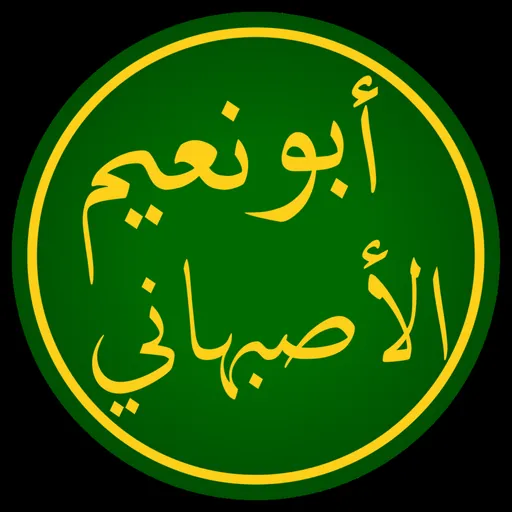
About Abu Nu`aym
Lived 948 – 1038 (aged 89–90). Abu Nu`aym was an Arab muhaddith, historian and theologian.
Abu Nuʿaym al-Isfahani (; full name: Ahmad ibn ʿAbd Allāh ibn Ahmad ibn Ishāq ibn Mūsā ibn Mahrān al-Mihrānī al-Asbahānī (or al-Asfahānī) al-Ahwal al-Ash`arī al-Shāfi`ī, died 1038 CE / AH 430) was a medieval Persian Shafi'i scholar and one of the leading hadith scholars of his time. His family was an offshoot of the aristocratic House of Mihran.
Biography
Birth and Education Born in Buwayhid era Isfahan, his first teacher was his grandfather who was a Sufi master, Sheikh Muhammad ibn Yusuf ibn Ma;dan al-Banna' (d. 365/976), who was the spiritual leader of a school of Sufism in Isfahan, which continued to flourish during the lifetime of Abu Nu'aym. Under his father's lead and guide, he began his scholarly career at an early age. As he got older, he would widely travel and visit Hejaz, Iraq, Syria, Khurazan and other places. He possessed ijaza in hadith from all major scholars of his time.
Teachers Abu Nu'aym had numerous teachers, his most famous ones include:
Students Abu Nu'aym had many students, his most famous ones include:
Reception In his lifetime, the hadith scholars would state: "Abu Nu'aym (Imam Asbahani) possessed chains of transmission that no one in the world possessed during his time". He was praised and famous for possessing very short chains of transmission for hadith. His benefit of studying very young and living almost near 100 years was highly valued by hadith scholars of his time as they saw shorter chain of transmission to be stronger and more authentic. According to Ahmad ibn Hanbal: "The pursuit of short transmission chains is a Sunnah (a way) taken from those who came before us".
Ibn al-Salah in his book entitled Manual of Hadith Science, lists Abu Nu'aym among his seven selected scholars for the highest excellence in authorship of books in Islam. He denounced Abu Nu’aym's creed as unorthodox and banished him from the Jami' mosque of Isfahan, that was dominated by Ibn Manda's Hanbali faction. Abu Nu'aym is unlikely to have been well trained in Ash'ari kalam himself however, but he did approve of it, calling it, "the kalam in accordance with the doctrine of the ahl al-sunnah". "Imam Asbahani was bestowed a miracle upon him from Allah (God) when he was being banished from the main Mosque of Isfahan (Asbahan) by a group of people against him there. The same people were also unhappy with their ruler, Sultan Mahmud bin Subktukin's appointment of a certain man as a governor over them, and as a result these people ambushed him and killed the governor. Later, the Sultan pretended to solve the issue, had this group reunited in the main Mosque from which Imam Asbahani was banned. Then the Sultan had them all executed down to the last man. And so Imam Asbahani was saved by the harming of such opponents any longer, whilst those against him were punished by Allah, the Exalted."
Works
Abû Nu`aym authored over a hundred works, among them: The Hilyat al-Awliya' is a substantial work in ten volumes, comprising a total of 695 biographies, amounting to about 4,000 pages in the printed edition. The work includes many biographies of early Islam. Most biographies of individuals that are directly involved with the development of Sufi mysticism are found in the tenth volume. Al-Arba`în `alâ Madhhab al-Mutahaqqiqîn min al-Sûfiyya, in print Dalâ'il al-Nubuwwa ("The Signs and Proofs of Prophethood"), devoted entirely to Muhammad, this large work - partly in print - was expanded by Al-Bayhaqi to seven volumes in a like-titled work. Dhikr Akhbâr Asbahân ("Memorial of the Chronicles of Ispahan"), in print Al-Du`afâ', in print Fadâ'il al-Khulafâ' al-Arba`a wa Ghayrihim, in print Fadîlat al-`Adilîn min al-Wulât, a collection of over forty narrations on just government and the duties of the governed towards the rulers. Al-Sakhawi documented each narration in detail and both the work and its documentation were published. Juz` fî Turuq Hadîth Inna Lillâhi Tis`atun wa Tis`îna Isman, in print Al-Mahdî. Ma`rifat al-Sahâba wa Fadâ'ilihim ("Knowing the Companions and Their Merits"), in print. This book was the basis of subsequent similar works by Ibn 'Abd al-Barr, Ibn al-Athir, and Ibn Hajar. Musnad al-Imâm Abî Hanîfa, in print Al-Mustakhraj `alâ al-Bukhârî ("Additional Narrations Meeting al-Bukhârî's Criterion"), in print Al-Mustakhraj `alâ Muslim ("Additional Narrations Meeting Muslim's Criterion"), in print Riyâdat al-Abdân, in print Al-Shu`arâ' ("The Poets"). Al-Sifât. Al-Suyûtî mentioned it in his commentary on Sûrat al-Nâs in his book al-Iklîl fî Istinbât al-Tanzîl. Sifat al-Janna ("Description of Paradise"), in print Tabaqât al-Muhaddithîn wal-Ruwât ("Biography-Layers of the Hadîth Scholars and Narrators"). Tasmiyatu mâ Intahâ ilaynâ min al-Ruwât `an al-Fadl ibn Dukayn `Aliyan, in print Tasmiyatu mâ Intahâ ilaynâ min al-Ruwât `an Sa`îd ibn Mansûr `Aliyan, in print Tathbît al-Imâma wa Tartîb al-Khilâfa, in print, a refutation of Shîasm. Al-Tibb al-Nabawî ("Prophetic Medicine").
Don’t just read it —
keep it.
Full-length biographies made to live with: read them, listen on the way to work, watch them tonight.
- E-book
- Audio
- Video
Instant download · yours to keep · every purchase keeps this site free
Important facts
People in Abu Nu`aym's life
Named in this biography and alive at the same time

Related people
Same field, nearest in time

Contemporaries
People whose lives overlapped Abu Nu`aym's

Frequently asked questions
Who was Abu Nu`aym?
Persian Islamic scholar (948–1038)
When was Abu Nu`aym born?
Abu Nu`aym was born in 948 in Isfahan.
When did Abu Nu`aym die?
Abu Nu`aym died on 23 October 1038 in Isfahan.
What was Abu Nu`aym's occupation?
Abu Nu`aym was a muhaddith, historian and theologian.
What nationality was Abu Nu`aym?
Abu Nu`aym was Arab.
Sources & further reading
· DBpedia: Abu Nu'aym al-Isfahani
Cite this page
APA: Biography.guide. (2026). Abu Nu`aym. https://biography.guide/abu-nu-aym/
MLA: "Abu Nu`aym." Biography.guide, https://biography.guide/abu-nu-aym/.
Chicago: "Abu Nu`aym." Biography.guide. https://biography.guide/abu-nu-aym/.
Data last updated: 2026-09-21 · Spot an error? Report a correction.
Portrait: Wikimedia Commons · author & licence
Page generated 2026-09-27 05:00 UTC