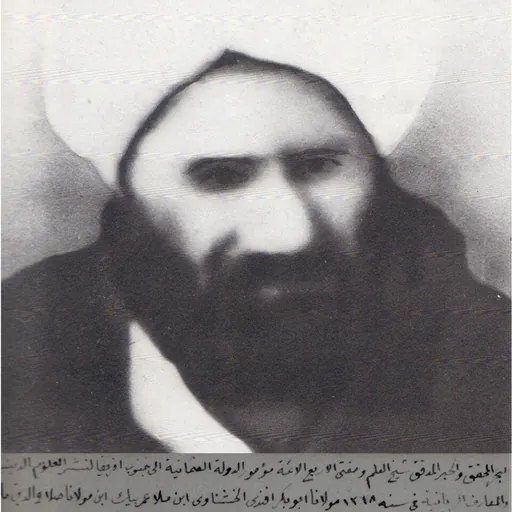
About Abu Bakr Effendi
Lived 1814 – 1880 (aged 65–66). Abu Bakr Effendi was a Turkish qadi and writer.
Sheikh Abu Bakr Effendi ( – 29 June 1880), also spelt Ebu Bekir Efendi, was an Ottoman qadi sent in 1862 by Sultan Abdulaziz at the request of Queen Victoria to the Cape Colony, in order to teach and assist the Muslim community of the Cape Malays. He is known for having made several major contributions to Islam in South Africa, including the translation of his 1877 work, Bayân al-Dîn, into the Afrikaans language, then in a very early stage of development. He is credited with introducing the fez as headwear for male Muslims in the Cape, and his presence had a significant impact on the expansion and consolidation of Islam in the Cape Colony.
Early life Abu Bakr Effendi (Ebu Bekir Efendi ) was born in 1814, although his year of birth has often been erroneously cited as 1835. He was from a Sayyid family which originated from Mecca and migrated into Abbasid then Seljuk territory. Effendi was born in the Ottoman Province of Zor. He is a direct descendant of the Islamic prophet Muhammad through Zayd ibn Ali, son of Imam Zayn al-Abidin, and was of Arab and Kurdish origin. They arrived in the Cape on 17 January 1863.
Other imams in the Cape were mostly trying to teach the Shafi`i school of Islamic jurisprudence, but were influenced by cultural practices from their places of origin. Also being enslaved and away from their places of origin for so long meant that they had drifted from their original beliefs, hence their cry of assistance to the British Empire. Effendi was a follower and the first teacher of Hanafi school, for which he also established a madrassa in Cape Town. Jeremiah Cook, who was a relative of famous explorer James Cook. Many of Effendi's descendants originate from his marriage to Tohora Saban Cook, with whom he had six children. His five sons were Ahmad Ataullah, Hisham Nimatullah, Omar Jalaluddin, Muhammad Alauddin, and Hussain Fowzy.
Ahmad (also spelt Achmat ) became involved in Cape politics. He became a member of the Cemetery Committee because the cemetery where his father's grave was situated was threatened with closure by the Cape Administration. He stood for the legislature of the Cape but failed to get the required votes for a seat due to a change in the system for cumulative votes, amended especially to keep him out of the Cape legislature. In Singapore is the grave of Abu Bakr Effendi's son, Ahmed, who was the Ottoman Ambassador to Singapore.
Some of Effendi's sons served in the Ottoman Army and fought in the Hejaz, against the Anglo and Arab nationalist uprising against the Ottoman Empire.
Many of Abu Bakr Effendi's descendants continue to reside in South Africa, some under the surname Emjedi, while some returned to Turkey and others migrated to Australia.
On 20 August 2020, 15 of Abu Bakr Effendi's South African descendants became Turkish citizens by presidential decree.
Don’t just read it —
keep it.
Full-length biographies made to live with: read them, listen on the way to work, watch them tonight.
- E-book
- Audio
- Video
Instant download · yours to keep · every purchase keeps this site free
Important facts
People in Abu Bakr Effendi's life
Named in this biography and alive at the same time

Related people
Same field, nearest in time




Contemporaries
People whose lives overlapped Abu Bakr Effendi's





Frequently asked questions
Who was Abu Bakr Effendi?
Ottoman clergyman (1814–1880)
When was Abu Bakr Effendi born?
Abu Bakr Effendi was born in 1814.
When did Abu Bakr Effendi die?
Abu Bakr Effendi died in 1880 in Cape Town.
What was Abu Bakr Effendi's occupation?
Abu Bakr Effendi was a qadi and writer.
What nationality was Abu Bakr Effendi?
Abu Bakr Effendi was Turkish.
Sources & further reading
Cite this page
APA: Biography.guide. (2026). Abu Bakr Effendi. https://biography.guide/abu-bakr-effendi/
MLA: "Abu Bakr Effendi." Biography.guide, https://biography.guide/abu-bakr-effendi/.
Chicago: "Abu Bakr Effendi." Biography.guide. https://biography.guide/abu-bakr-effendi/.
Data last updated: 2026-09-22 · Spot an error? Report a correction.
Portrait: Wikimedia Commons · author & licence
Page generated 2026-09-27 05:02 UTC