
About Abū ʿAbd Allāh Muḥammad ibn Saʿd ibn Mardanīsh
Lived 1124 – 1172 (aged 47–48). Abū ʿAbd Allāh Muḥammad ibn Saʿd ibn Mardanīsh was a monarch and fürst.
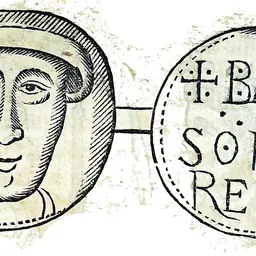
Abū ʿAbd Allāh Muḥammad ibn Saʿd ibn Muḥammad ibn Aḥmad ibn Mardanīsh, called al-Judhāmī or al-Tujībī (born AD 1124 or 1125 [AH 518], died AD 1172 [AH 568]) was the king of Murcia from AD 1147 (AH 542) until his death. He established his rule over the cities of Murcia, Valencia and Dénia as the power of the Almoravid emirate declined, and he opposed the spread of the Almohad caliphate. Christian sources refer to him as the "Wolf King" (Latin rex Lupus, Spanish rey Lobo or rey Lope).
Ibn Mardanīsh's full name was Abu ʿAbd Allāh Muḥammad ibn Saʿd ibn Muḥammad ibn Aḥmad ibn Mardanīsh al-Juḍāmī (or at-Tuȳībī), indicate he was the son of Saʿd, son of Muḥammad, son of Aḥmad, son of Mardanīsh. His tribal nisbas are no secure indication of Arab ancestry. He was a muwallad, a descendant of a native Iberian convert to Islam, and the name Mardanīsh is not of Arabic origin. The thirteenth-century Islamic scholar Ibn Khallikān derived it from an Ibero-Romance term for dung (via Latin merda), perhaps because of Ibn Mardanīsh's friendly relations with the Christians. It is more likely a corruption of Merdanix (today Merdancho), the name of a tributary of the river Najerilla, which was on the border between Christian and Islamic Spain in the early tenth century. This hydronym in turn derives from the Latin for dung, indicating dirty waters. This is consistent with Ibn Mardanīsh's family emigrating from the aṭ-Ṭaḡr al-Aʿlā (Upper March) around the Rioja, as told in Arabic sources.
In the first year of his rule (1147/8), Ibn Mardanīsh faced the rebellion of his relative, Yūsuf ibn Hilāl, based in the castle of Montornés. Yūsuf conquered the castles of al-Ṣujayra and al-Ṣajra, and defeated Ibn Mardanīsh before the walls of Moratalla, which he occupied. With a reduced following he attacked the fortress of Peñas de San Pedro and was captured. Ibn Mardanīsh threatened to gouge out his eyes unless he ordered the surrender of Moratalla. He refused and his right eye was removed. Ibn Mardanīsh then ordered Yūsuf's wife to surrender the castle or else see her husband blinded. She refused and Yūsuf's other eye was removed. Ibn Mardanīsh then sent his prisoner to Xàtiva, where he died shortly thereafter in 1148 or 1149.
In June 1149, after the republic of Genoa had established colonies at both Almería and Tortosa, Ibn Mardanīsh signed a ten-year truce with the republic, agreed to pay 15,000 Almoravid dinars (murābiṭūn) in tribute, exempted the Genoese from tariffs and permitted the establishment of Genoese funduqs at Valencia and Dénia. A payment of 5,000 murābiṭūn was due immediately: 3,000 in cash and 2,000 in equivalent silks. The remaining 10,000 was owed over two years. This treaty is preserved in the Genoese Liber iurium. According to the contemporary historian Caffaro, a similar treaty was signed in 1161. In January 1150, Ibn Mardanīsh signed a treaty with the republic of Pisa, promising funduqs and a general safe-conduct for Pisan merchants, but requiring no payment of tribute.
During Dhū l-Qaʿdah 560 (September–October 1165), Ibn Mardanīsh led a large army from Murcia to defend Lorca from an Almohad force advancing from the castle of Vélez. His troops were flanked by the Almohad force at a place called al-Fundūn in the valley of the Guadalentín. In the ensuing battle of Faḥṣ al-Jullāb they were routed.
Don’t just read it —
keep it.
Full-length biographies made to live with: read them, listen on the way to work, watch them tonight.
- E-book
- Audio
- Video
Instant download · yours to keep · every purchase keeps this site free
Important facts
Related people
Same field, nearest in time




Contemporaries
People whose lives overlapped Abū ʿAbd Allāh Muḥammad ibn Saʿd ibn Mardanīsh's





Frequently asked questions
Who was Abū ʿAbd Allāh Muḥammad ibn Saʿd ibn Mardanīsh?
Emir of Murcia
When was Abū ʿAbd Allāh Muḥammad ibn Saʿd ibn Mardanīsh born?
Abū ʿAbd Allāh Muḥammad ibn Saʿd ibn Mardanīsh was born in 1124 in Peníscola.
When did Abū ʿAbd Allāh Muḥammad ibn Saʿd ibn Mardanīsh die?
Abū ʿAbd Allāh Muḥammad ibn Saʿd ibn Mardanīsh died on 28 March 1172 in Murcia.
What was Abū ʿAbd Allāh Muḥammad ibn Saʿd ibn Mardanīsh's occupation?
Abū ʿAbd Allāh Muḥammad ibn Saʿd ibn Mardanīsh was a monarch and fürst.
Sources & further reading
· Wikipedia: Abū ʿAbd Allāh Muḥammad ibn Saʿd ibn Mardanīsh
· DBpedia: Abū ʿAbd Allāh Muḥammad ibn Saʿd ibn Mardanīsh
Cite this page
APA: Biography.guide. (2026). Abū ʿAbd Allāh Muḥammad ibn Saʿd ibn Mardanīsh. https://biography.guide/abu-abd-allah-muhammad-ibn-sad-ibn-mardanish/
MLA: "Abū ʿAbd Allāh Muḥammad ibn Saʿd ibn Mardanīsh." Biography.guide, https://biography.guide/abu-abd-allah-muhammad-ibn-sad-ibn-mardanish/.
Chicago: "Abū ʿAbd Allāh Muḥammad ibn Saʿd ibn Mardanīsh." Biography.guide. https://biography.guide/abu-abd-allah-muhammad-ibn-sad-ibn-mardanish/.
Data last updated: 2026-09-20 · Spot an error? Report a correction.
Page generated 2026-09-27 05:31 UTC