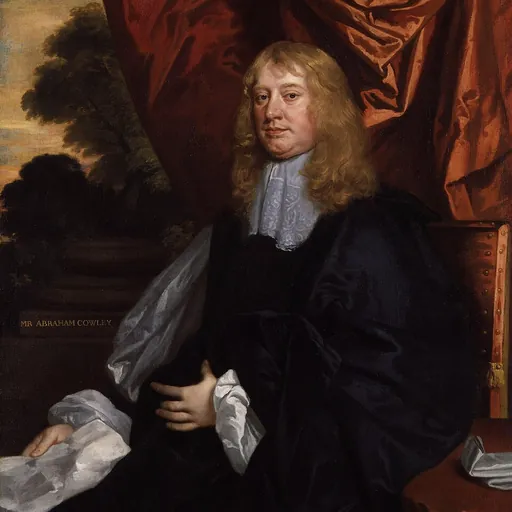
About Abraham Cowley
Lived 1618 – 1667 (aged 48–49). Abraham Cowley was an English poet, essayist, playwright, prose writer and writer.
Abraham Cowley (; 161828 July 1667) was an English poet and essayist born in the City of London late in 1618. He was one of the leading English poets of the 17th century, with 14 printings of his Works published between 1668 and 1721.
Early life and career Cowley's father, a wealthy Londoner, who died shortly before his birth, was a stationer. His mother was wholly given to works of devotion, but it happened that there lay in her parlour a copy of The Faerie Queene. This became the favourite reading of her son, and he had read it twice before he was sent to school.
As early as 1628, when he was only ten years old, he composed his Tragicall Historie of Piramus and Thisbe, an epic romance written in a six-line stanza, a style of his own invention. It has been considered to be a most astonishing feat of imaginative precocity; it is marked by no great faults of immaturity, and possesses constructive merits of a very high order. Two years later, Cowley wrote another and still more ambitious poem, Constantia and Philetus; around this time he was sent to Westminster School. At Westminster he displayed extraordinary mental precocity and versatility, writing when he was just thirteen the Elegy on the Death of Dudley, Lord Carlton. These three lengthy poems, and some smaller ones, were collected in 1633, and published in a volume entitled Poeticall Blossomes, dedicated to Lambert Osbaldeston, the headmaster of the school, and prefaced by many laudatory verses by schoolfellows. where he "betook himself with enthusiasm to the study of all kinds of learning, and early distinguished himself as a ripe scholar". It was about this time that he composed his scriptural epic on the history of King David, one book of which still exists in the Latin original. An English version of the epic in four books, called the Davideis, was published after his death. The epic deals with the adventures of King David from his boyhood to the smiting of Amalek by Saul, where it abruptly closes.
After the Battle of Marston Moor he followed the queen to Paris, where his exile lasted twelve years. This period was spent almost entirely in the royal service, "bearing a share in the distresses of the royal family, or labouring in their affairs. To this purpose he performed several dangerous journeys into Jersey, Scotland, Flanders, the Netherlands, or wherever else the king's troubles required his attendance. But the chief testimony of his fidelity was the laborious service he underwent in maintaining the constant correspondence between the late king and the queen his wife. In that weighty trust he behaved himself with indefatigable integrity and unsuspected secrecy; for he ciphered and deciphered with his own hand the greatest part of all the letters that passed between their majesties, and managed a vast intelligence in many other parts, which for some years together took up all his days, and two or three nights every week."
During his exile, Cowley wrote a history of the Civil War (which did not get published in full until 1973). In the preface to his 1656 Poems, Cowley mentioned that he had completed three books of an epic poem on the Civil War, but had left it unfinished after the First Battle of Newbury when the Royalist cause began to lose significant ground. In the preface, Cowley indicated that he had destroyed all copies of the poem, but this was not precisely the truth. In 1679, twelve years after Cowley's death, a shortened version of the first book of the poem, called A Poem on the Late Civil War was published. It was assumed that the rest of the poem had indeed been destroyed or lost until the mid-20th century when scholar Allan Pritchard discovered the first of two extant manuscript copies of the whole poem among the Cowper family papers. Thus, the three completed books of Cowley's great (albeit unfinished) English epic, The Civill Warre (otherwise spelled "The Civil War"), was finally published in full for the first time in 1973.
In 1647 a collection of his love verses, entitled The Mistress, was published, and in the next year a volume of wretched satires, The Four Ages of England, was brought out under his name, with the composition of which he had nothing to do. In spite of the troubled times, usually so fatal to poetic fame, his reputation steadily increased, and when, on his return to England in 1656, he published a volume of his collected poetical works, he found himself without a rival in public esteem. This volume included the Pindarique Odes, the Davideis, The Mistress and some Miscellanies. Among the latter are to be found Cowley's most vital pieces. This section of his works opens with the famous aspiration:
It contains elegies on Wotton, Vandyck, Falkland, William Hervey and Crashaw, the last two being among Cowley's finest poems, brilliant, sonorous and original; the amusing ballad of The Chronicle, giving a fictitious catalogue of his supposed amours; various gnomic pieces; and some charming paraphrases from Anacreon. The Pindarique Odes contain weighty lines and passages, buried in irregular and inharmonious masses of moral verbiage. Not more than one or two are good throughout, but a full posy of beauties may easily be culled from them. The long cadences of the Alexandrines with which most of the strophes close, continued to echo in English poetry from Dryden down to Gray, but the Odes themselves, which were found to be obscure by the poet's contemporaries, immediately fell into disesteem.
He died in the Porch House in Chertsey, in consequence of having caught a cold while superintending his farm-labourers in the meadows late on a summer evening. On 3 August, Cowley was buried in Westminster Abbey beside the ashes of Chaucer and Spenser, where in 1675 the Duke of Buckingham erected a monument to his memory. The poetry of Cowley rapidly fell into neglect.
Later compilations
The Complete Works in Verse and Prose, ed. Alexander B. Grosart (1881) Cowley's Essays, ed. Henry Morley (Cassell, 1886) Prose Works, ed. J. R. Lumby (1887) English Writings, ed. A. R. Waller, in two volumes (Cambridge, 1905–06) The Mistress with Other Select Poems, ed. John Sparrow (Nonesuch, 1926) The Crypto-Mistress: Love Poems (Golden Eagle Press, 1948) Poetry and Prose, ed. L. C. Martin (Oxford, 1949) The Collected Works, Volume 1, ed. Thomas O. Calhoun and Laurence Heyworth (University of Delaware Press, 1989) The Collected Works, Volume 2, Part 1, ed. Thomas O. Calhoun, Laurence Heyworth and J. Robert King (University of Delaware Press, 1993) Selected Poems, ed. David Hopkins and Tom Mason (Carcanet, 1994) Love Poems, ed. Anthony Astbury (Greville Press, 1995)
Don’t just read it —
keep it.
Full-length biographies made to live with: read them, listen on the way to work, watch them tonight.
- E-book
- Audio
- Video
Instant download · yours to keep · every purchase keeps this site free
Important facts
People in Abraham Cowley's life
Named in this biography and alive at the same time



Related people
Same field, nearest in time


Contemporaries
People whose lives overlapped Abraham Cowley's






Frequently asked questions
Who was Abraham Cowley?
British writer (1618–1667)
When was Abraham Cowley born?
Abraham Cowley was born in 1618 in City of London.
When did Abraham Cowley die?
Abraham Cowley died on 28 July 1667 in Chertsey.
What was Abraham Cowley's occupation?
Abraham Cowley was a poet, essayist, playwright, prose writer and writer.
What nationality was Abraham Cowley?
Abraham Cowley was English.
Sources & further reading
Cite this page
APA: Biography.guide. (2026). Abraham Cowley. https://biography.guide/abraham-cowley/
MLA: "Abraham Cowley." Biography.guide, https://biography.guide/abraham-cowley/.
Chicago: "Abraham Cowley." Biography.guide. https://biography.guide/abraham-cowley/.
Data last updated: 2026-09-24 · Spot an error? Report a correction.
Portrait: Wikimedia Commons · author & licence
Page generated 2026-09-27 05:08 UTC