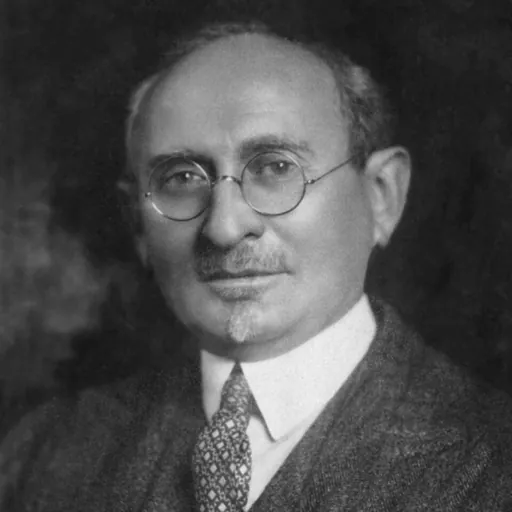
Abraham Brill
American psychiatrist & psychoanalyst
About Abraham Brill
Lived 1874 – 1948 (aged 73). Abraham Brill was an American and Austrian psychiatrist, psychoanalyst, translator and psychologist.
Abraham Arden Brill (; October 12, 1874 – March 2, 1948) was an Austrian-born American psychiatrist who spent almost his entire adult life in the United States. He was the first psychoanalyst to practice in the United States and the first translator of Sigmund Freud into English.
Education Brill was born in Kańczuga, Austrian Galicia, to Jewish parents. He arrived in the United States alone and penniless at the age of 15. Working continuously to finance his studies, he eventually graduated from New York University in 1901 and obtained his M.D. from Columbia University in 1903. and while the quality of his translations might at times be challenged, his overall contribution to the fostering of psychoanalysis in America cannot. He campaigned for academic recognition of his field, lectured at Columbia University, and became clinical professor of psychiatry at New York University. rather than split the International movement, in 1929 he made a tactical concession to Freud and, as head of the New York Psychoanalytic Society, sanctioned the limited introduction of lay analysts to the profession, which had previously restricted its ranks to medical professionals. During the 1930s he played a key role in finding employment for psychiatric professionals exiled from Nazi Europe.
Once sympathetic to homosexuals, he revised his views and wrote in 1940 that "even so-called classical inverts are not entirely free from some paranoid traits".
Edward Bernays consulted with Brill on the subject of women's smoking and borrowed the term "torches of freedom" from Brill.
One of his last pieces of writing - his preface to Eric Berne's 1947 study, The Mind in Action - commends Berne's ability to "expound the new psychology without the affectivity of the older Freudians", placing his tribute in the context of himself "having read everything written on Freud and psychoanalysis since I first introduced him here".
Publications Psychoanalysis: Its Theories and Practical Application (1912) Fundamental Conceptions of Psychoanalysis (1921)
Translations of Freud Selected Papers on Hysteria (1909) Three Contributions to the Theory of Sex (1910) The Interpretation of Dreams (1913) The Psychopathology of Everyday Life (1914) Selected Papers on Hysteria and other Psychoneuroses (1912) Leonardo da Vinci: A Psychosexual Study of an Infantile Reminiscence (1916) Wit and its Relation to the Unconscious (1917) Totem and Taboo (1919) Studies in Hysteria (1937)
Translations of Jung Psychology of Dementia Praecox (1909)
Don’t just read it —
keep it.
Full-length biographies made to live with: read them, listen on the way to work, watch them tonight.
- E-book
- Audio
- Video
Instant download · yours to keep · every purchase keeps this site free
Important facts
People in Abraham Brill's life
Named in this biography and alive at the same time

Related people
Same field, nearest in time


Contemporaries
People whose lives overlapped Abraham Brill's

Frequently asked questions
Who was Abraham Brill?
American psychiatrist & psychoanalyst (1874–1948)
When was Abraham Brill born?
Abraham Brill was born on 12 October 1874 in Kańczuga.
When did Abraham Brill die?
Abraham Brill died on 2 March 1948 in New York City.
What was Abraham Brill's occupation?
Abraham Brill was a psychiatrist, psychoanalyst, translator and psychologist.
What nationality was Abraham Brill?
Abraham Brill was American and Austrian.
Sources & further reading
Cite this page
APA: Biography.guide. (2026). Abraham Brill. https://biography.guide/abraham-brill/
MLA: "Abraham Brill." Biography.guide, https://biography.guide/abraham-brill/.
Chicago: "Abraham Brill." Biography.guide. https://biography.guide/abraham-brill/.
Data last updated: 2026-09-20 · Spot an error? Report a correction.
Portrait: Wikimedia Commons · author & licence
Page generated 2026-09-27 04:57 UTC