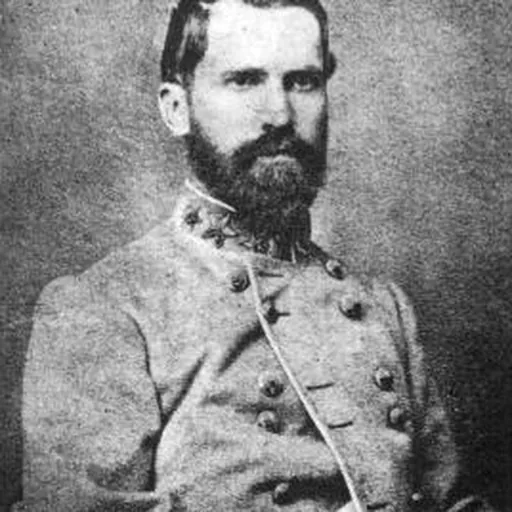
About Abner Monroe Perrin
Lived 1827 – 1864 (aged 37). Abner Monroe Perrin was an American lawyer and army officer.
Abner Monroe Perrin (February 2, 1827 – May 12, 1864) was an American lawyer who served as a senior officer of the Confederate States Army. He commanded infantry in the Eastern Theater of the American Civil War until killed in action at Spotsylvania Court House.
Early life and education Perrin was born in the Edgefield District, South Carolina. He fought in the Mexican–American War as a first lieutenant of infantry. Upon his return home, he studied law and was admitted to the bar in 1854.
American Civil War When the Civil War began, Perrin entered the Confederate service as a captain in the 14th South Carolina Infantry Regiment that was attached to Brigadier-General Maxcy Gregg's brigade of the famous "Light Division" of Major-General A.P. Hill.
Perrin saw service with Gregg's Brigade through all of its major battles, including the Seven Days, Cedar Mountain, Battle of Second Manassas, Antietam, and Fredericksburg. When Gregg's successor, Samuel McGowan, was wounded at Chancellorsville, Perrin took command of the brigade and led it at the subsequent Battle of Gettysburg in the division of Major General William D. Pender in Hill's new Third Corps. At Gettysburg, on July 1, 1863, Perrin's Brigade was involved in the Confederate attack that captured Seminary Ridge. On September 10, 1863, Perrin was promoted to the rank of brigadier-general. Upon the return of McGowan, Perrin was transferred to command the Alabama brigade previously led by Brigadier-General Cadmus Wilcox in the division of Major-General Richard H. Anderson (Wilcox had been appointed to command the division of Pender, who had died from a wound received at Gettysburg).
Perrin was conspicuously brave at the Battle of the Wilderness in May 1864. In the next battle, Spotsylvania Court House, he declared "I shall come out of this fight a live major general or a dead brigadier." When the "Mule Shoe" (or "Bloody Angle") was overrun and most of Major-General Allegheny Johnson's division was captured on May 12, 1864, units from the Third Corps—including Perrin's Brigade—were called in to help. Leading his troops in a spirited counterattack through a very heavy fire, with his sword in hand, Perrin was riddled with bullets and died instantly, shot seven times. He is buried in the Confederate Cemetery in Fredericksburg, Virginia.
Honors Camp No. 367, of the United Confederate Veterans, at Edgefield Court House, South Carolina, was named after him.
Don’t just read it —
keep it.
Full-length biographies made to live with: read them, listen on the way to work, watch them tonight.
- E-book
- Audio
- Video
Instant download · yours to keep · every purchase keeps this site free
Important facts
People in Abner Monroe Perrin's life
Named in this biography and alive at the same time
Related people
Same field, nearest in time




Contemporaries
People whose lives overlapped Abner Monroe Perrin's





Frequently asked questions
Who was Abner Monroe Perrin?
Confederate States Army officer (1827–1864)
When was Abner Monroe Perrin born?
Abner Monroe Perrin was born on 2 February 1827 in Edgefield County.
When did Abner Monroe Perrin die?
Abner Monroe Perrin died on 12 May 1864 in Spotsylvania County.
What was Abner Monroe Perrin's occupation?
Abner Monroe Perrin was a lawyer and army officer.
What nationality was Abner Monroe Perrin?
Abner Monroe Perrin was American.
Sources & further reading
· Wikipedia: Abner Monroe Perrin
· DBpedia: Abner Monroe Perrin
Cite this page
APA: Biography.guide. (2026). Abner Monroe Perrin. https://biography.guide/abner-monroe-perrin/
MLA: "Abner Monroe Perrin." Biography.guide, https://biography.guide/abner-monroe-perrin/.
Chicago: "Abner Monroe Perrin." Biography.guide. https://biography.guide/abner-monroe-perrin/.
Data last updated: 2026-09-21 · Spot an error? Report a correction.
Portrait: Wikimedia Commons · author & licence
Page generated 2026-09-27 04:59 UTC