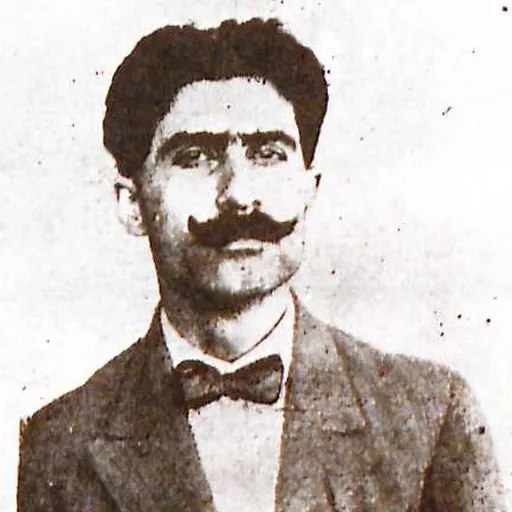
About Abílio de Nequete
Lived 1888 – 1960 (aged 71–72). Abílio de Nequete was a Brazilian politician.
Abílio de Nequete (Fih-el-Khoura, Lebanon, February 15, 1888 - Porto Alegre, August 7, 1960) was a Lebanese-Brazilian barber, teacher and political activist. Born into a family of Orthodox Christians, he immigrated to Brazil at the age of 14, in 1903, settling in the city of São Feliciano (now Dom Feliciano), a district of Encruzilhada do Sul. There he became a peddler, working together with his father, with whom he had a conflicting relationship, even politically, since his father was a federalist and Abílio joined the Republican Party.
He moved to Porto Alegre between 1907 and 1908, where he worked as a barber. In the Gaucho capital he converted to Spiritism and joined the labor movement. He stood out as one of the main leaders of the great general strikes of 1917 and 1919, besides having founded, in 1918, the Maximalist Union of Porto Alegre (União Maximalista de Porto Alegre), a group that would later be part of the foundation of the Communist Party of Brazil (Partido Comunista Brasileiro - PCB) in 1922, party of which Nequete was General Secretary until 1923.
Away from the PCB, Abílio de Nequete reconnected with republicanism and began to show an interest in technocracy, interpreting it through his own political theory and creating a corresponding religion, Evidentism. He became a professor at the Escola de Comércio and died in August 1960, victim of an illness.
First years Abílio de Nequete was born on February 15, 1888, in the village of Fih-el-Khoura, in northern Lebanon, under the name Abdo Nakat, into an Orthodox Christian family. His mother died some time after his birth, and at the age of two his father, Miguel Nakat, immigrated to Brazil. Nequete was left with an older sister, who would also immigrate a few years later. At the age of 14, in 1903, with no news of his father, he decided to travel in order to find him, boarding a cargo ship headed for Brazil.
Arriving in the city of Rio Grande, Nequete contacted the local Arab community and, with the information he obtained, headed to São Feliciano (now Dom Feliciano), a district of Encruzilhada do Sul. There, Abílio de Nequete became a peddler, working together with his father. Abílio had a conflictive relationship with his father, even politically, since Miguel was a federalist and Abílio joined the Republican Party. Between 1907 and 1908, Abilio moved to Porto Alegre, where he started working as a barber. In the Gaucho capital, Nequete went to live on Conde de Porto Alegre Street, located in the Fourth District: the city's industrial core where factory workers lived.
Militancy in the labor movement In 1917, Abílio de Nequete witnessed a series of mob violence against German immigrants in Porto Alegre, during the campaign for Brazil's entrance into the First World War. Such violence moved him and convinced him of the need to organize the population. In August of the same year, he played a central role in the Popular Defense League (Liga de Defesa Popular - LDP), which was articulated during the general strike.
Under the impact of the Russian Revolution, Nequete started to work with the anarchists of the International Workers Union (União Operária Internacional - UOI) in 1918, conflicting with them, because some of his conceptions, such as his Spiritist faith, clashed with the Atheism of the UOI militants. Due to these frictions, Nequete decided to leave the UOI to establish, with Francisco Merino and Otavio Hengist, the Maximalist Union, in November of the same year.
In 1919, the action of the Maximalist Union in the strike of carpenters and metallurgists made the association to gain new supporters, among them Carlos Tóffolo, President of the Porto Alegre Metallurgical Union (União Metalúrgica de Porto Alegre). In the same year, Nequete became involved in a violent strike started in September by the Força e Luz workers, which was soon joined by bakers, wagoners, and telephone company workers. The strikers organized a rally for the 7th, to be held in Montevideo Square, but the police prohibited it. The FORGS lawyer, in turn, consulted the Federal Constitution and considered the rally legal. When the number of the present rose to around 500, a conflict erupted between the strikers and the military brigade, which resulted in the death of a worker. On the 8th, troops of the military brigade, under the orders of the governor, invaded the headquarters of the FORGS, Force and Light Syndicate and Metallurgical Union. Their leaders were imprisoned, among them Abílio de Nequete.
After this episode, repression intensified on the organized workers of Porto Alegre. At this time, however, Abílio de Nequete and the Maximalist Union increased their presence in the FORGS. Nequete even wrote a column in the FORGS's periodical O Syndicalista, in which he wrote under the pseudonym Máximo Evidente. The movement did not spread, and Abílio took advantage of his trip to collect addresses of Argentine Marxist publications.
In 1920, Abílio de Nequete, together with Friedrich Kniestedt and Carlos Tófollo, participated in the 2nd Regional Workers Congress. In this Congress, Nequete presented a proposal for the FORGS to join the Communist International (Comintern), clashing with the anarchist Friedrich Kniestedt, who was against its approval. The proposal was rejected, so the Maximalist Union distanced itself from the FORGS and Abílio began to articulate with the communist groups that were being constituted in Brazil and the América Platina countries. Abílio de Nequete, center, with the other founders of the Communist Party of Brazil, in 1922. Between March 25 and 27, 1922, together with other nine delegates from Porto Alegre, Recife, São Paulo, Cruzeiro, Niterói and Rio de Janeiro, Abílio de Nequete participated in the foundation of the Communist Party of Brazil. According to Astrogildo Pereira, Nequete had made "a great contribution to the founding of the Party", so that he suggested his name for the post of General Secretary, considering the importance of his contacts with the Uruguayan communists and with the Propaganda Agency for South America of the Communist International.
Despite holding an important position within the Party, Nequete had a troubled relationship with its members: after the interruption of a PCB meeting by the police, Abílio resigned from his position. In his memoirs, he stated that he was disgusted with the rent paid for the Party's headquarters, the bankruptcy of its printing shop, the disappearance of the money to be sent to the victims of the Russian scourge, and mainly with the political orientation of his comrades, considering that a good part of the PCB members were, at that moment, former anarchists and still carried with them many of their libertarian conceptions. In 1923, when he had already left the post of General Secretary, the Communist Party of Uruguay asked him for a report on communism in Brazil, occasion in which he transcribed all these denunciations. In response, the executive commission of the PCB charged Octávio Brandão with preparing another report, about the attitude of Nequete, who was expelled as a traitor; Brandão even called him a "charlatan, coward and braggart", and affirmed that only after his expulsion from the Party there was progress in the organization in Porto Alegre. He supported Borges de Medeiros and joined the League of Republican Workers (Liga dos Operários Republicanos) in 1925. In this book, whose structure was similar to Karl Marx and Friedrich Engels' The Communist Manifesto, Nequete defended the idea of an evolution of humanity in five stages, starting with ancient civilizations, passing through the feudal phase, which would be surpassed by capitalism and this, in turn, by communism, which would finally be replaced by the technocratic state, in which technicians should be responsible for the reorganization of society.
Don’t just read it —
keep it.
Full-length biographies made to live with: read them, listen on the way to work, watch them tonight.
- E-book
- Audio
- Video
Instant download · yours to keep · every purchase keeps this site free
Important facts
People in Abílio de Nequete's life
Named in this biography and alive at the same time


Related people
Same field, nearest in time





Contemporaries
People whose lives overlapped Abílio de Nequete's



Frequently asked questions
Who was Abílio de Nequete?
Brazilian politician
When was Abílio de Nequete born?
Abílio de Nequete was born in 1888.
When did Abílio de Nequete die?
Abílio de Nequete died on 7 August 1960 in Porto Alegre.
What was Abílio de Nequete's occupation?
Abílio de Nequete was a politician.
What nationality was Abílio de Nequete?
Abílio de Nequete was Brazilian.
Sources & further reading
· Wikipedia: Abílio de Nequete
Cite this page
APA: Biography.guide. (2026). Abílio de Nequete. https://biography.guide/abilio-de-nequete/
MLA: "Abílio de Nequete." Biography.guide, https://biography.guide/abilio-de-nequete/.
Chicago: "Abílio de Nequete." Biography.guide. https://biography.guide/abilio-de-nequete/.
Data last updated: 2026-09-20 · Spot an error? Report a correction.
Portrait: Wikimedia Commons · author & licence
Page generated 2026-09-27 04:57 UTC