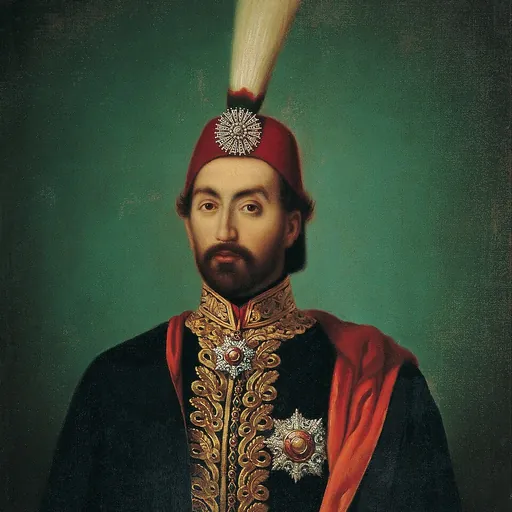
About Abdülmecid I
Lived 1823 – 1861 (aged 38). Abdülmecid I was a Turkish ruler.
Abdülmecid I (, ; 25 April 182325 June 1861) was the 31st sultan of the Ottoman Empire. He succeeded his father Mahmud II on 2 July 1839.
Abdulmejid's greatest achievement was the announcement of the Tanzimat Edict upon his accession, prepared by his then Foreign Minister Mustafa Reshid Pasha, which effectively began the Tanzimat era, or era of reorganization, in the Ottoman Empire. He was a mild-mannered monarch, giving the Sublime Porte the autonomy needed for its reform projects. One of the main goals of the Tanzimat was to encourage Ottomanism among the millets to stop rising nationalist movements within the empire, but despite new laws and reforms to integrate non-Muslims and non-Turks more thoroughly into Ottoman society, in the long term, the movement failed.
Abdulmejid forged alliances with the major powers of Western Europe, namely the United Kingdom and France, which fought alongside the Ottoman Empire in the Crimean War against Russia. During the Congress of Paris on 30 March 1856, the Ottoman Empire was officially included among the Concert of Europe. Abdulmejid suddenly died of tuberculosis and he was succeeded by his half-brother, Abdul Aziz.
Early life
Abdülmecid was born on 25 April 1823 at Beşiktaş Palace or at Topkapı Palace, in Istanbul. His mother was the Georgian consort Bezmiâlem Kadın.
Abdülmecid received a European education and was the first sultan to speak fluent French.
The 1840s saw the creation of the first banknotes and the establishment of the Ottoman lira. The financial system was reorganised after the French model. Tax farming was abolished and aşar was to be equally levied everywhere. Plans were also set to abolish slave markets. After the Imperial Reform Edict, further reforms towards equality between millets were implemented, including the abolition of a capitation tax which imposed higher tariffs on non-Muslims and the right to serve as soldiers in the Ottoman army. plans were made to send humanitarian aid of £10,000 ) to Ireland during its Great Famine, but later it was agreed to reduce it to £1,000
Crimean War and aftermath
On 16 October 1853, the Ottoman Empire entered another war against Russia that would be known as the Crimean War, where it was soon joined by France and Britain. The Ottomans successfully participated in the war and were winning signatories at the Treaty of Paris (1856). The Empire would be inducted into the Concert of Europe. In a compromise with the Great Powers, Abdul Mecid issued another reform edict in February 1856 known as the Imperial Reform Edict (Islâhat Hatt-ı Hümâyûnu), which was perceived by many subjects as relinquishing sovereignty. The Ottoman Empire received the first of its foreign loans on 25 August 1854 during the war. This major foreign loan was followed by those of 1855, 1858 and 1860, which culminated in default and led to the alienation of European sympathy from the Ottoman Empire and indirectly to the later dethronement and death of Abdülmecid's brother Abdülaziz. The opponents formed the , which sought to eliminate Abdülmecid and put Abdulaziz on the throne in order to prevent the European states from acting like a guardian. This revolt attempt, the Kuleli Incident, was suppressed before it even started on 14 September 1859. Meanwhile, the financial situation deteriorated and foreign debts, which were taken under heavy conditions to cover the costs of war, placed a burden on the treasury. All of the debts received from Beyoğlu consumers exceeded eighty million gold liras. Some of the debt securities and hostages were taken by foreign traders and bankers. The Grand Vizier Mehmed Emin Âli Pasha, who criticized this situation harshly, was dismissed by the sultan on 18 October 1859. 1856: Grand Cross of the Tower and Sword; 5 November 1856: Stranger Knight of the Garter; 20 March 1860: Grand Cordon of the Order of Leopold; Grand Cross of the Legion of Honour.
Garter emblem and arms
Family The türbe of Abdülmecid is located inside the Yavuz Selim Mosque in Fatih, Istanbul. Abdülmecid had one of the most numerous harems of the dynasty. He is known to be the first sultan whose harem was not composed of slave girls but, due to the progressive abolition of slavery in the Ottoman Empire, of girls of free birth, noble or bourgeois, sent to the sultan by the will of the families. He was also the first sultan whose harem assumed a defined hierarchical structure which included four Kadın, followed by four Ikbal, four gözde and a variable number of minor concubines.
Consorts Abdülmecid I had at least twenty-six consorts, but only two were legal wives: Servetseza Kadin (1823 - 24 September 1878). Başkadin (first consort), born Princess Temruko. She had no children because Abdülmecid was not attracted to her, but he respected and entrusted her to raise his children Mehmed V Reşad, Fatma Sultan and Refia Sultan when they lost their mother. Servetseza loved also Murad V as her own son. Hoşyar Kadin (1825 - 1849). Also called Huşyar Kadın. Second Kadın. She was daughter of the Georgian nobleman Zurab Bey Tuskia. She entered the harem in 1839. She had a daughter. Her sister was the third treasurer of the harem and was highly respected. She died in 1849 of turberculosis. Şevkefza Kadın (12 December 1820 - 17 September 1889). Second Kadın after Hoşyar's death. She was of Circassian origin and was raised by Nurtab Kadın, a consort of Mahmud II (father of Abdülmecid). She was mother and Valide sultan of Murad V and a daughter. Tirimüjgan Kadın (16 October 1819 - 3 October 1852). Third Kadın. She was a Circassian and worked as a palace servant when she was noticed by the sultan and taken as his consort. She was the mother of two sons, including Abdülhamid II, and a daughter. Verdicenan Kadın (1825 - 1889). Born Princess Saliha Açba, she married Abdülmecid for political purposes. Mother of a son and daughter and she adopted Mediha Sultan after her mother died. She was the aunt of the famous poet Leyla Açba, who was also her lady-in-waiting. Gülcemal Kadin (1826 - 1851). Fourth Kadın. Bosnian, she was the mother of Mehmed V and four daughters. Şayan Kadın (1829 - 1860). Fourth Kadın after Gülcemal's death. She was Circassian, born in Sochi, and her mother was a Kucba princess. As a consort she used her power to help the Caucasian refugees. She lived in the palace with her mother. She had no children, but she adopted Behice Sultan when she lost her mother. Gülistu Kadın (1830 - 1861). Fourth Kadın after Şayan's death. Called also Gülustu Kadin. Born Princess Fatma Çaçba. She was the favorite daughter-in-law of Bezmiâlem Sultan, Abdülmecid's mother. She was the mother of Mehmed VI and three daughters. Rahime Perestu Kadin (1830 - 1906). She was the adopted daughter of Esma Sultan, daughter of Abdülhamid I, and was the first of Abdülmecid's legal wives. Fourth Kadin after Gülistu's death. She had no children, but she was the adoptive mother of Abdülhamid II and Cemile Sultan. Bezmiara Kadin (? - 1909). Called also Bezmican or Bezmi. Fifth Kadın, an honorary title that was bestowed upon her as second legal wife. Adopted from a noble family, she never adapted to the harem and divorced the sultan, the first woman to do so. By sultan, she had a daughter who died as newborn. She later married twice more, and had a daughter with her second husband. Mahitab Kadin (1830 - 1888). Also called Mehtab Kadın. Chechen, she was one of Abdülmecid's favorite consorts, she was therefore conferred the honorary title of Fifth Kadın. She is the mother of a son and a daughter. Düzdidil Hanim (1826 - 18 August 1845). BaşIkbal or Third Kadin. Abkhaz, she had grown up at court under the tutelage of the chief treasurer. She was the mother of four daughters from whom she had to separate because she fell ill with tuberculosis and she had to be isolated and entrusted to her cousin Cican Hanim. Nükhetseza Hanim (2 January 1827 - 15 May 1850). BaşIkbal after Düzdidil's death. Abkhazian and Georgian, her true name was Hatice. She was the mother of two sons and two daughters. She died of tuberculosis. Neveser Hanim (1841 - 1889). BaşIkbal after Nükhetseza's death. Abkhaza, daughter of the noble Abazin Misost Bey Eşba, her true name was Esma Eşba. She had intense green eyes. She entered the palace in 1853 and was educated there for five years before becoming a consort. She had no children, but adopted Şehzade Mehmed Burhaneddin after his mother's death. A lover of horseback riding, the sultan built a pavilion for her behind the Dolmabahçe Palace where she could rest after her outings, and finally moved there permanently there, while during the reign of Abdülhamid II she occupied a pavilion of the Yıldiz palace. Her niece Şemsinur Hanım entered the service of Emine Nazikeda Kadın, First Consort of Mehmed VI. Zeynifelek Hanim (1824 - 20 December 1842). Second Ikbal. Also called Zerrinmelek. Born Princess Klıç, she was abaza. She grew up in the palace with her sister and cousins and was chosen as a consort by Bezmiâlem Sultan. She had a daughter. She died of tuberculosis. Nesrin Hanim (1826 - 2 January 1853). Second Ikbal after Zeynifelek's death. She was the daughter of the Georgian nobleman Manuçar Bey Asemiani, she was the mother of three sons and a daughter. She died of pain after three of them died. Ceylanyar Hanim (1830 - 27 December 1855). Second Ikbal after Nesrin's death. Circassian, her true name was Nafiye. She was the mother of a son. Serfiraz Hanim (1837 - 25 June 1905). Second Ikbal after Ceylanyar's death. Born Princess Ayşe Liah (or Lakh). One of Abdülmecid's favorite consorts, she fell out of favor after a scandal that saw her in love with an Armenian boy. She had two sons and a daughter. Nalandil Hanim (1823 - 1865). Third Ikbal or BaşIkbal. Circassian of the Ubuh tribe, she was the daughter of Prince Çıpakue Natikhu Bey. She is the mother of a son and two daughters. Her sister, Terbiye Hanim, was the treasurer of the harem. Navekimisal Hanim (1827 - 1854). Fourth Ikbal. Also called Navekivisal. Born Princess Biberd. She had a daughter. She died of tuberculosis. Nergizev Hanim (1830 - 26 October 1848/1858). Also called Nergizu Hanim or Nergis Hanim, she was a Circassian from the tribe of Natuhay. Mother of a son, she died of tuberculosis. Şayeste Hanim (1838 - 11 February 1912). Abkhaza, Princess Inalipa. She was the mother of a son and daughter, and the adoptive mother of Mehmed VI. She was known to be constantly in debt. Çeşmiferah Hanım. No information about her other than her name is kept. Princess Mülkicihan Achba described her as tall and blonde. Hüsnicenan Hanim (1818 - 1843). She was Abdülmecid's first concubine, when he was still Şehzade. He set aside her when he ascended the throne. She died of tuberculosis. Safderun Hanım (1845 - 1893). Daughter of a Circassian princess. One of her last consorts and one of Abdülmecid's favorites in his later years, fell out of favor after his death: Abdülaziz suspended her salary until 1877 and Abdülhamid II halved it. She died in her home in Kadıköy. Yıldız Hanım (1842 - 1880). One of the last consorts and one of Abdülmecid's favorites in his later years. She initially lived in a reserved wing of the Çırağan palace, and then in a reserved pavilion near the Dolmabahçe palace, because she refused to live with his other consorts. She was elder sister of Safinaz Nurefsun Kadın, second consort of Abdülmecid's son Abdülhamid II. The Yıldız Palace built by Abdülhamid II was named in her honor.
Sons Abdülmecid had at least nineteen sons:
Don’t just read it —
keep it.
Full-length biographies made to live with: read them, listen on the way to work, watch them tonight.
- E-book
- Audio
- Video
Instant download · yours to keep · every purchase keeps this site free
Important facts
more
Medjid, Sultan van Turkije Abdul, Abdulmejid I, Abd-ul-Medjid, Abdul Medjid, Abdul Mejid, Abdul Medjid I, Abdul Mejid IPeople in Abdülmecid I's life
Named in this biography and alive at the same time





Related people
Same field, nearest in time

Contemporaries
People whose lives overlapped Abdülmecid I's



Frequently asked questions
Who was Abdülmecid I?
31th Sultan of the Ottoman Empire (1839–1861)
When was Abdülmecid I born?
Abdülmecid I was born on 25 April 1823 in Istanbul.
When did Abdülmecid I die?
Abdülmecid I died on 25 June 1861 in Istanbul.
What was Abdülmecid I's occupation?
Abdülmecid I was a ruler.
What nationality was Abdülmecid I?
Abdülmecid I was Turkish.
Sources & further reading
Cite this page
APA: Biography.guide. (2026). Abdülmecid I. https://biography.guide/abdulmecid-i/
MLA: "Abdülmecid I." Biography.guide, https://biography.guide/abdulmecid-i/.
Chicago: "Abdülmecid I." Biography.guide. https://biography.guide/abdulmecid-i/.
Data last updated: 2026-09-22 · Spot an error? Report a correction.
Portrait: Wikimedia Commons · author & licence
Page generated 2026-09-27 05:01 UTC