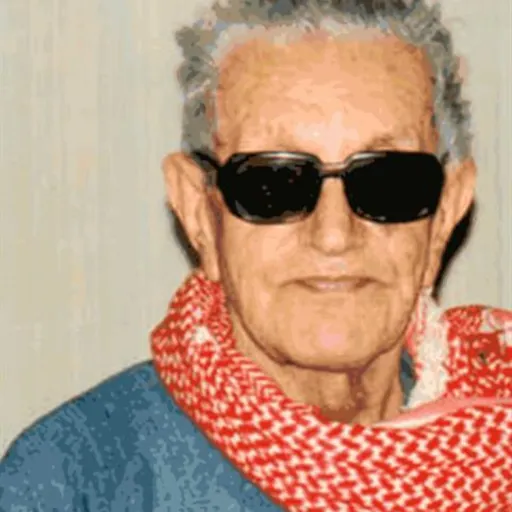
About Abdullah al-Qasemi
Lived 1907 – 1996 (aged 88–89). Abdullah al-Qasemi was a Saudi writer and philosopher.
Abdullah al-Qasemi (1907 – 9 January 1996; ) was a Saudi Arabian 20th-century writer. Once a prominent Salafist intellectual, he became critical of religion and was branded an atheist — pariah to much of the Arab world. His books were banned in some Arab countries and a death fatwa was issued against him for apostasy. He was subsequently targeted for assassination in Egypt and Lebanon.
Early life and education
Early life Abdullah al-Qasemi was born in 1907 in Khubb al-Hulwah, located to the west of the city of Buraidah, al-Najdiya in Saudi Arabia. A Saudi of Egyptian heritage, his father was one of the remains of the Egyptians who came with the army of Muhammad Ali Pasha to the invasion of Najd, and he who attributed himself to al-Qassim was famous for it.
Family Abdullah al-Qasemi's father is Sheikh Ali al-Saidi, who came from Hail and settled in Khubb al-Hulwah, and was deeply religious. He did not stop what he received from religious teachings in the city of Buraidah to move to Sharjah to increase the legal sciences and trade. Abdullah al-Qasemi's mother is (according to his son, Dr. Faisal bin Abdullah al-Qasemi) the Mrs. Moudi al-Rumai Almost four years, to call her and her child a migrant to Sharjah, but she was soon associated with another man from the al-Husayni family residing in the village of al-Ap, near Khubb al-Hulwah.
Abdullah al-Qasemi is linked with a number of Najdi families, such as the family of al-Muzaini, al-Muslim, al-Husayni and al-Jamuji. The Saudi historian Abdul Rahman al-Ruwaished stated that Sheikh Ibn Kamalah, who worked for King Abdul Aziz, is the uncle of Abdullah al-Qasemi. The historian Ibrahim al-Muslim said, when asked about the extent of the link and kinship between the two families: “We gathered nearly a link and a link!” The information was published for the first time - because it was information that al-Qasemi was not disclosed about for everyone who met him from writers, journalists and researchers - as his friends say that he was not speaking with his own affairs at all, and that Sheikh Ali al-Saidi had married a woman from Sharjah and Amman and had children there, and Faisal al-Qasemi stated that he was in constant contact with his cousins in Sharjah and visited him in Riyadh constantly.
Al-Qasemi grew up between Khubb al-Hulwah and the apartment. In addition to losing the tenderness of his parents, the living conditions were poor, the combination of which may have been why he left his village at the age of ten. Dr. Faisal al-Qasemi instead believes that the uncles of Sheikh Abdullah are the ones who pushed him to leave. The livelihood, and they insisted on leaving in front of his mother's insistence, and their argument was to search for his father to feed him and apply him after they were narrowed in these bad living conditions. In Cairo, a journey of long-standing and then intellectual research, which has become one of the most prominent actors at the level of the Arab world.
In Riyadh, where al-Qasemi studied Sheikh "Saad bin Atiq", he got to know a delegation from Sharjah who came to the visit of Riyadh, and it was a coincidence that the head of the delegation is a friend of his father and knew him completely, so I walked on his horizon signs of hope in meeting his father, and this was what happened on the coast of the Gulf of Amman, but the amazement hit the boy who was looking not only to meet his father, but that the tender He used to work as a merchant in pearls and strictly in his interpretation of many teachings of the Islamic religion, which he met with some softening and cruelty and imposed on him a very cruel education method.
This dry meeting must have its subsequent impact on the life of al-Qasemi. Al-Qasemi says, describing that meeting in one of his messages that he sent to Professor Ahmed al-Sibai:
Education Al-Qasemi enrolled in the Sheikh Ali al-Mahmoud School, then his father died in 1922, and he was released from those restrictions in which he was accompanied and he continued to teach him, so the merchant Sheikh Abdul Aziz al-Rashid al-Hamid, who took him with Iraq, India and Syria, admired him. He stayed with two years learning in one of the schools there is the Arabic language and the prophetic hadiths and the foundations of Islamic law, then he returned to Iraq and enrolled in the Kadhimiya school, then he went out to Damascus and then to Cairo, which witnessed the true birth of al-Qassimi.
Family Al-Qasemi belongs to the al-Saidi family, which is a deeply struck in Najd and spread between the areas of Hail and al-Qassim, and the name came in al-Saidi; At a time when Professor Abdul Rahman al-Buthi - a historian residing in Unaizah in al-Qassim - sees that one of the grandparents of the family was working in the minds between Egypt and we find centuries ago, so he attributed to the region to which he was going traded, and this is a habit spread in many Najdi cities, and it is supported by the researcher Yaqoub al-Rashid and the historian Ibrahim al-Muslim, but he states that the family of al-Saidi in Hail and Braidah who meet in Its origins are due to the Juhayna tribe and the homeland of his father and grandparents in Yanbu al-Nakhl, but he continues, saying: "Sheikh Hamad al-Jasser discussed the issue and reached a result, which is that the origins of al-Qasemi from Najd and that one of his ancestors has traveled to Egypt and returned again to Najd, so he knew the title of al-Saidi!"
In response to a question by lawyer Abdel-Rahman, who accompanied al-Qasemi for fifty years, that al-Qasemi must have spoken to him on this issue during this long time period, he said: “Never happened that Sheikh Abdullah spoke to me on this issue and no other, because he always refused to talk about all his personal issues!”.
Career Salafi Philosophy Al-Qasemi studied at the Al-Azhar University in Cairo in 1927, but he was soon expelled because of his book , which he had written in response to an article by Al-Azhar scholar , entitled "" published in the journal Nour Al-Islam in 1931. Subsequently Abdullah al-Qasemi wrote several books attacking the scholars of Al-Azhar.
Free Philosophy After his expulsion from al-Azhar, al-Qasemi changed his way of thinking, defending secularism and skepticism and criticizing religion to the point where his opponents labelled him "atheist". His most important books written after his rejection of Salafi ideology are These are the Cuffs, They Lie to See God Beautiful, and Arabs are a Sonorous Phenomenon. He survived two assassination attempts in Egypt and Lebanon and suffered imprisonment in Egypt under instigation from the Yemeni government, because of his great influence on Yemeni students who, because of their frequent meetings with him, were deeply influenced by his thoughts. Such influence was perceived by the Yemeni government as negative and not suitable to Islam.
Attempted Assassination and Death Assassination attempts The first attempt to assassinate al-Qasemi occurred in 1947, the year that followed the release of his controversial book These are the Cuffs. Al-Qasemi says about the assassination attempt: but he confirmed in a later dialogue with the program (in the photo) in 2022 that Al-Qasemi did not retract his ideas before his death at all.
On the other hand, the writer Abdullah al-Qafari quoted in his articles entitled for fifty years with al-Qasemi, in Al-Riyadh newspaper, he said:
However, Elaf electronic magazine conducted an interview with Mrs. Amal Othman, the administrative official for the elderly department in the Palestine Hospital in Heliopolis, in which the thinker al-Qasemi was dealt with and he spent his love, and I asked her about Al-Qasemi and said: "Uncle Abdullah al-Qasemi was a man like honey! He was a respectful good that addresses us the workers who serve him in a sophisticated, poetic language, and he used to make a lot of joke with us, and caress us with his kind words, and he used to tell me, that if you walk, then the earth calls you, and he was calling for us success, and we advised a lot to live in peace and harmony, and to raise the minor and grudges, and he said to us: that God is watching us from above The envy." Mrs. Amal added: "Sheikh Abdullah entered the hospital on 12/12/1995 and did not go out until 9/1/1996 a day that God died." In response to the question of Elaf magazine about how the thinker was spending his time if he did not have visitors, she said:"He was spending his time reading the Holy Qur'an, who was beside him throughout his stay in the hospital Sitilization !!" She added that Dr. Nadia Abdel Wahab, head of the department, was sitting at him sometimes and talking about many intellectual matters.
Also, the testimony of Ould al-Qasemi, Dr. Muhammad bin Abdullah al-Qasemi, who states that his father spent his last days in Palestine Hospital reads most of the time and also from the same source, which is the Elaf magazine. The two narratives are conflicting about his return from his atheism. Between the narration of his friend, the lawyer and the narration of Mrs. Amal Othman, the administrative official of the elderly department at Palestine Hospital in Heliopolis, which confirmed that he was reading the Qur’an, it is not possible to confirm and assert about the doctrinal end of the thinker Abdullah al-Qasemi. and according to his will, he was buried along with his wife in the "Bab Al-Wazir" cemetery in Egypt.
Works
Books Abdullah Al-Qasemi's works have rarely been translated. Here is a non-exhaustive list: The Najdi lightning Sweeping Al-Dajwi's Darkness, which is a response to Sheikh Youssef Al-Dajwi. (Arabic: البروق النجدية في اكتساح الظلمات الدجوية) Al-Azhar sheikhs and increase in Islam, which is also a response to Al-Dajwi. (Arabic: شيوخ الأزهر والزيادة في الإسلام) The decisive chapter between the Wahhabis and their violators, (Arabic: الفصل الحاسم بين الوهّابيين ومخالفيهم) Problems of prophetic hadiths and their statement, (Arabic: مشكلات الأحاديث النبوية وبيانها) Criticism of the book of Muhammad's life for Heikel, (Arabic: نقد كتاب حياة محمد لهيكل) The Universe Tries God The Pride of History Is in Crisis The Wahhabist Revolution What Is This Universe’s Conscience? These are the Cuffs They Lie to See God Beautiful Arabs Are a Sonorous Phenomenon Humans Disobey to Build Civilizations O Reason! Who Saw You? The Conflict Between Islam and Idolatry Pharaoh Writes the Book of Exodus In Order That Harun al-Rashid Does Not Come Back
Quotes Men find their religions as they find their homelands, their lands, their homes and their fathers. They just find them, they do not search for them, do not understand them, do not choose them either. Religions triumph in the battles they avoid, they don't fight against reason nor through reason. They never go in free fights against reason. And that is why they are triumphant. Man does not want the knowledge that would hurt his will. He prefers to be silly but happy than intelligent and poor. Whoever commits suicide with or without an idea, is nobler and more courageous than any martyr in any war. We wanted, then imagined, we believed, and in the end, we were convinced. Those who do not know how to smile finally institutionalize tears and call to consider this as an adoration. The occupation of our brains by gods is the worst form of occupation. What is the nature of the creator who forces his creatures to need misery, pollution, sadness. To be in the end a happy creature.
Don’t just read it —
keep it.
Full-length biographies made to live with: read them, listen on the way to work, watch them tonight.
- E-book
- Audio
- Video
Instant download · yours to keep · every purchase keeps this site free
Important facts
People in Abdullah al-Qasemi's life
Named in this biography and alive at the same time





Related people
Same field, nearest in time




Contemporaries
People whose lives overlapped Abdullah al-Qasemi's

Frequently asked questions
Who was Abdullah al-Qasemi?
Saudi Arabian writer and intellectual
When was Abdullah al-Qasemi born?
Abdullah al-Qasemi was born in 1907 in Khibb Al Hilwah.
When did Abdullah al-Qasemi die?
Abdullah al-Qasemi died on 9 January 1996 in Cairo.
What was Abdullah al-Qasemi's occupation?
Abdullah al-Qasemi was a writer and philosopher.
What nationality was Abdullah al-Qasemi?
Abdullah al-Qasemi was Saudi.
Sources & further reading
· Wikipedia: Abdullah al-Qasemi
Cite this page
APA: Biography.guide. (2026). Abdullah al-Qasemi. https://biography.guide/abdullah-al-qasemi/
MLA: "Abdullah al-Qasemi." Biography.guide, https://biography.guide/abdullah-al-qasemi/.
Chicago: "Abdullah al-Qasemi." Biography.guide. https://biography.guide/abdullah-al-qasemi/.
Data last updated: 2026-09-20 · Spot an error? Report a correction.
Portrait: Wikimedia Commons · author & licence
Page generated 2026-09-27 04:57 UTC