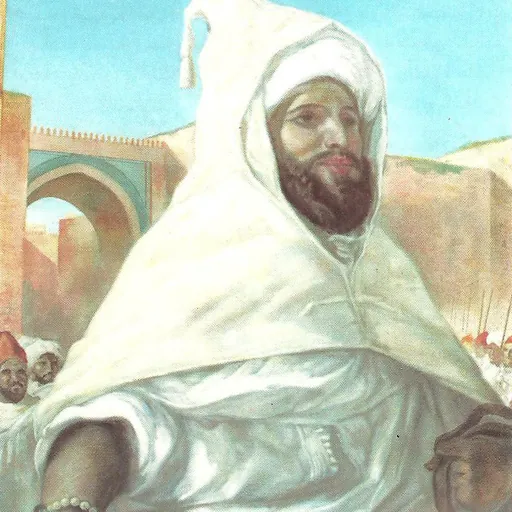
About Abd al-Rahman of Morocco
Lived 1779 – 1859 (aged 79–80). Abd al-Rahman of Morocco was a Moroccan politician.
Reign
Early reign
Upon ascension, the sultan's finances were in shambles. With the country in disarray, the central government (the Makhzen) was unable to collect much customary taxation. Abd al-Rahman turned to foreign trade, which had been cut off by the prior sultan, as a way to reap in customs revenue, and began to negotiate a series of trade treaties with various European powers.
Moulay Abd al-Rahman was an enthusiastic advocate of foreign trade. As governor of Essaouira he had encouraged European merchants, and after he became sultan, consul after consul trekked down to Marrakesh; the Portuguese in 1823, the British in 1824, the French and the Sardinian in 1825. Each signed a trade treaty, although Morocco had little to export because in 1825 the country began another cycle of poor rainfall and famine.
To recoup his expenses Moulay Abd al-Rahman decided to revive the institution of Barbary piracy and reestablish his corsairing fleet. In 1828 it captured some British ships and an Austrian one. This created confrontations with the British as they blockaded Tangier, and the Austrians bombarded Larache, Asilah and Tetouan He was always successful at placating the nobles and malcontents though.
Franco-Moroccan War (1844), and aftermath
The French then demanded that Morocco cease its support of Abd al-Qadir and cede its eastern frontier lands to French control and, in 1844, launched the First Franco-Moroccan War. The war did not go well for the sultan. The French navy bombarded Mogador (Essaouira) and Tangier, while the Moroccan army, under Abd al-Rahman's son Moulay Muhammad, was defeated by the French at the Battle of Isly in August 1844. Abd al-Rahman consented to the Treaty of Tangier in October 1844, withdrawing support for al-Qadir, and reducing border garrisons.
This prompted the eventual surrender of Abd el-Qadir to the French on the 20th of December 1847.
Bombardment of Salé (1851)
On 25 November 1851, French ships anchored off Rabat and Salé. Moroccan soldiers in those cities prepared to repel the French attack and armed themselves with artillery. At 10:00 a.m, the French fleet opened fire on the forts of Salé, while the Moroccans retaliated instantly with forty batteries of artillery weapons. An hour later, the batteries in Salé were destroyed, while the artillery in Rabat were damaged to the point where they became almost useless, however Moroccan reinforcements arrived. The damaged batteries were removed from the cities by Moroccan forces who continued to resist. By the end of the bombardment, the Moroccans had 18 to 22 men killed and 47 of them wounded, with many fortifications damaged. On the other hand, the French had losses of 4 killed and 18 wounded, as well as two of their battleships damaged. Both sides claimed victory, as the bombardment ended in a French military victory but also in a Moroccan political victory.
Anglo-Moroccan Treaty (1856)
In 1856, Britain persuaded the sultan to sign a treaty in Tangier on 9 December 1856, after long negotiations between John Hay Drummond Hay, a representative of Queen Victoria, and Muhammad al-Khatib, a representative of the sultan Abd al-Rahman. Moroccan trade was freed from almost all its monopolies, custom duties were reduced to ten percent of value, Morocco's door was opened to a larger volume of overseas trade, and British subjects could own property in Morocco.
Construction
Royal ceremony taking place in front of Bab Mansour in 1920, with Moulay Abd al-Rahman's 19th-century loggia visible in the back. In 1856, Moulay Abd al-Rahman established the souk of Zraqten on the north side of the High Atlas, adding to territory in southern Morocco controlled by the Glaouis, who were Caids ruling various southern areas from the 18th century until Moroccan independence in 1956, after originally settling in Telouet to establish a souk. They would tax caravans travelling from the Sahara and Tafilalt regions as well as taxing goods sold locally.
The Agdal Gardens of Marrakesh, an irrigated garden, originally established by the Almoravids in the 12th century and enlarged in the days of the Saadians was revamped, reforested and encircled by ramparts during the reign of Moulay Abd al-Rahman.
Armed Forces
Moulay Abd al-Rahman's son and successor, Sidi Muhammad IV (1868). When Moulay Abd al-Rahman bin Hicham ascended the throne on 30 November 1822, Morocco was an undefeated power with a modern army made up of four main armed forces: The Guich military tribes or Makhzen tribes which provided the regular contingents. The Black Guard or the Abid al-Bukhari who were of Sub-Saharan origin. The contingents provided by tribes who paid taxes or provided some contingents of recruits. The Holy warriors or the Mujahideen who provided massive levies in case of extreme danger.
Death
Abd al-Rahman died in Meknes on August 28, 1859, and was buried in the Mausoleum of Moulay Ismail. Immediately upon Sidi Muhammad's ascension to throne in August 1859, Spain declared war on Morocco, culminating into the Hispano-Moroccan War in which Spain sent troops to Ceuta in order to capture Tetuan.
Don’t just read it —
keep it.
Full-length biographies made to live with: read them, listen on the way to work, watch them tonight.
- E-book
- Audio
- Video
Instant download · yours to keep · every purchase keeps this site free
Important facts
People in Abd al-Rahman of Morocco's life
Named in this biography and alive at the same time

Related people
Same field, nearest in time



Contemporaries
People whose lives overlapped Abd al-Rahman of Morocco's

Frequently asked questions
Who was Abd al-Rahman of Morocco?
Sultan of Morocco from 1822 to 1859
When was Abd al-Rahman of Morocco born?
Abd al-Rahman of Morocco was born in 1779 in Fez.
When did Abd al-Rahman of Morocco die?
Abd al-Rahman of Morocco died on 28 August 1859 in Meknes.
What was Abd al-Rahman of Morocco's occupation?
Abd al-Rahman of Morocco was a politician.
What nationality was Abd al-Rahman of Morocco?
Abd al-Rahman of Morocco was Moroccan.
Sources & further reading
· Wikipedia: Abd al-Rahman of Morocco
· DBpedia: Abd al-Rahman of Morocco
Cite this page
APA: Biography.guide. (2026). Abd al-Rahman of Morocco. https://biography.guide/abd-al-rahman-of-morocco/
MLA: "Abd al-Rahman of Morocco." Biography.guide, https://biography.guide/abd-al-rahman-of-morocco/.
Chicago: "Abd al-Rahman of Morocco." Biography.guide. https://biography.guide/abd-al-rahman-of-morocco/.
Data last updated: 2026-09-22 · Spot an error? Report a correction.
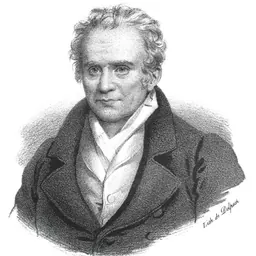
Portrait: Wikimedia Commons · author & licence
Page generated 2026-09-27 05:01 UTC