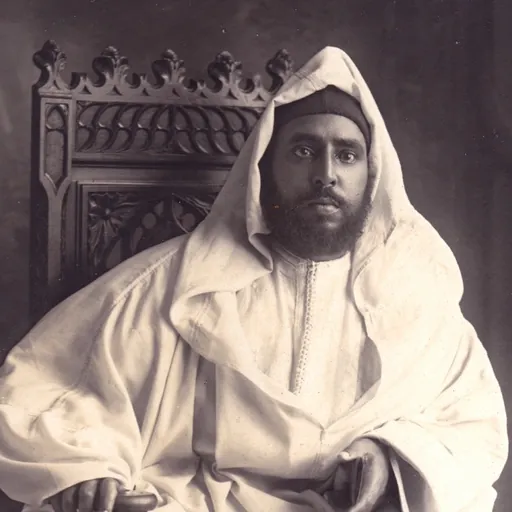
About Abd al-Hafid of Morocco
Lived 1875 – 1937 (aged 61–62). Abd al-Hafid of Morocco was a Moroccan sultan, politician, islamic jurist and literary scholar.
Abd al-Hafid ibn al-Hasan (between 1875 and 1880 – 4 April 1937) was the Sultan of Morocco from 1908 to 1912 and a member of the Alaouite Dynasty. His younger brother, Abdelaziz of Morocco, preceded him. While Abd al-Hafid initially opposed his brother, finally deposing him in a coup, for giving some concessions to foreign powers, he himself became increasingly backed by the French and finally signed the protectorate treaty giving de facto control of the country to France.
Early life Abd al-Hafid ibn al-Hasan was born in Fez (Fes) between 1875 and 1880 to Moulay Hassan I of Morocco and Aliya al-Settatiya, who was the daughter of the governor Salah ibn al-Ghazi and granddaughter of al-Ghazi ibn al-Madani, governor of Rabat, Chaouia and Tadla under Slimane of Morocco. She was from the rural gentry of the Arab confederation of Chaouia. He was the fourth son of Hassan. He studied religious science under him receiving an ijaza (diploma) from him in 1904. At this point, Abdelaziz was becoming less popular with the tribes weakening his rule over Morocco. When he attempted to send Ibn al-Ghazi to become pasha of Marrakesh after the murder of Émile Mauchamp, the tribes of the Haouz revolted with the Rahamna demanding Abd al-Hafid to become sultan. After the invasion of Chaouia, the tribes of Chaouia gathered and were led by Abu Azzawi who sent a letter to Abd al-Hafid calling him to "take action to restore Islam from the low estate into which it had fallen".
In February 1908, Abd al-Hafid was proclaimed the Sultan of Fez. For a brief period, Abdelaziz reigned from Rabat while Abd al-Hafid reigned in Marrakesh and Fez. In August 1908 Abdelaziz was defeated in battle.
Foreign relations After Abd al-Hafid took over, European countries still saw Abdelaziz as the legitimate sultan and the income from customs went to him. As long as he did not accept the controversial Act of Algericas, they refused to recognise his government depriving him from the customs revenue. During the Hafidiya, relations between Abd al-Hafid and the French deteriorated with the French seeing him as a bloodthirsty tyrant while seeing Abdelaziz as more legitimate. They assisted Abdelaziz with military advice and armament because they thought that Abdelaziz's weakness would make a French takeover easier while Abd al-Hafid could lead an effective jihad against European influence. Abd al-Hafid was faced with the dilemma of accommodating foreign pressure without alienating and losing his political base which he relied on for his survival. In order to appease the Europeans, Abd al-Hafid would have had to make compromises amounting to both a rejection of the Conditioned Bay'ah imposed on him and the principles of the Hafidiya. had a resurgence in 1908 with Abd al-Hafid naming him Friend and Counselor of the Makhzen Abd al-Hafid sought diplomatic relations with European countries so he could receive the customs receipts that were piling up in the State Bank of Morocco.
After the defeat of Bou Hmara, Abd al-Hafid's rule in central Morocco became much more stable allowing for his approach to France to become bolder. He became increasingly more anti-French which appeased militants in Fez. He sought relations with powers like Germany, Italy and the Ottoman Empire. Abd al-Hafid was most successful with the Ottoman Empire which was run by the Young Turks who adopted a policy of supporting other Muslims outside the Ottoman Empire who resisted the West. Abd al-Hafid similarly had pan-Islamist beliefs. In 1909, the Young Turk government sent a 12-man military mission to Morocco. This mission was attached to the makhzen army as advisors and accompanied the troops in manoeuvrers against dissident tribes north of Fez. It was commanded by Captain Arif Bey and was made up of Turkish, Syrian and Egyptian officers. While the mission was there, they founded the pan-Islamist youth organisation "Young Maghreb" which also had members in other North African countries like Egypt and Algeria.
Abd al-Hafid's attempts to break out diplomatic isolation and find allies were ultimately a failure. According to the historian Edmund Burke III, "the French position was unassailable".
Despotism Before his exile, Abd al-Hafid destroyed the royal parasol and the imperial seal, emblems of the sultan's authority, as a symbolic act of defiance. Mawlay Mahammad, the brother of Abd al-Hafid, attempted to become sultan with the support of the Zaër in 1908. He was quickly recaptured and paraded in rags in the city of Fez before disappearing. He did survive this, but his secretary died after being publicly tortured with his head shaved, beard plucked and hands disabled by salt torture. Muhammad al-Kattani, the influential Sufi poet and anti-French activist from Fez, was captured, tortured, and beaten to death in front of his wives and children in 1909. Abd al-Hafid's opposition to al-Kattani was not only because of their dispute over resisting the West but due to Abd al-Hafid's Salafist beliefs. The tribe who gave protection to al-Kattani were punished brutally by Abd al-Hafid. Initially, he demanded an indemnity of 100,000 douros. After they refused and were defeated in battle, they were given even harsher terms including the payment of the fine, acceptance of qaids appointed by the makhzen and a supply of 300 men to serve in the Sharifian army marking the first time a Middle Atlas tribe was forced to supply men to the Sharifian army. In 1909, when he captured Bou Hmara, Abd al-Hafid fed Bou Hmara to his lions. Punishments like mutilation were applied to his servants.
In May 1910, the pasha of Meknes and governor of Fez, Hajj Ibn Aissa ibn Hammu, and his family were arrested. He was accused of supporting Abdelaziz and inciting the Zemmour tribe to rebel. She was chained to the wall in a crucifixion position, completely naked with her breasts seized in a vice, and whipped and interrogated about the whereabouts of her husband's fortune under the direct supervision of Abd al-Hafid. This allowed her to eventually be released even though her husband was not.
These punishments appalled humanitarians in Europe but Abd al-Hafid dismissed them as he saw these punishments as not just a way of punishing his enemies but also as proof of his sovereign power. The Ibn Aissa affair in particular alarmed the European community in Morocco and they saw it as proof of their perception of Abd al-Hafid as a tyrant. Because of the pressure, Abd al-Hafid freed members of Ibn Aissa's family but despite this, the affair justified increased French intervention in Morocco.
Treaty of Fes, abdication, retirement and death
An illustration of Abd al-Hafid signing his act of abdication, on the front page of Le Petit Journal's weekly Supplément illustré, printed 25 August 1912.
In 1911, rebellion broke out against the Sultan. This led to the Agadir Crisis, also known as the Second Moroccan Crisis. These events led Abd al-Hafid to sign the Treaty of Fes on 30 March 1912, which made Morocco a French protectorate.
A few months later, Resident-General Hubert Lyautey persuaded Abd al-Hafid to abdicate against the payment of a massive pension, part of which was used to build the opulent Abdelhafid Palace in Tangier, completed in 1914. His brother Yusef was proclaimed Sultan by the French administration on 13 August 1912. Yusef was chosen by dignitaries of Rabat,
Religion Abd al-Hafid had a reputation as a scholar in Islamic theology and law Despite being a Salafist, he did not break away completely from the Moroccan Sufi tradition. In May 1906, he started talks with Abu Azzawi who was the head of a Sufi order known for resistance against the French. In 1907, he did a pilgrimage at the brotherhood of Tameslouht and also visited the shrine of the saint Sidi Bel Abbes. This helped prove his legitimacy in the eyes of the Moroccan tribes. Despite this, he did attempt to implement Salafist doctrines and thought that the brotherhoods had a negative effect of the country.
Personality Unlike Abd al-Aziz, Abd al-Hafid was an intellectual and experienced administrator. He was a poet and wrote a number of books. Furthermore, he was a regular subscriber to the Arabic press from Egypt and the French-backed Arabic newspaper Es-Saada. He had a keen interest in the affairs of the Arab East and also was interested in the rivalries between the European powers. He would also get European newspapers regularly translated to keep up with foreign opinion with Morocco. Being khalifa of Marrakesh meant he learnt how to handle tribal politics and earned the respect of the merchants and religious leaders of Marrakesh. He was capable of being forceful and was dignified and reserved in his public demeanour. However, he had a cruel streak, was greedy, engaged in private self indulgence and was extremely nervous. His negative qualities were exacerbated by the pressure of leadership.
Legacy
Later Moroccan nationalists had a negative view of Abd al-Hafid because of his bargaining with the French over the terms of his abdication and willingness to sign the Treaty of Fes.
Marriages and children Abd al-Hafid married 4 women from influential families in one night. Some of the women he married included:
Lalla Rabia, daughter of Madani el Glaoui. She died in 1924. Together, they had two sons and one daughter including: Lalla Mina. In her first marriage, she married Moulay Hassan ben Yusef and in her second marriage, she married Moulay Lafchar el Alaoui. Lalla Ruqiya, daughter of Mohammed al-Moqri. Later married Sultan Yusef. Together they had: Moulay Slimane Hafidi.
Honors Grand Cross of the Legion d'Honneur of France (1909)
Don’t just read it —
keep it.
Full-length biographies made to live with: read them, listen on the way to work, watch them tonight.
- E-book
- Audio
- Video
Instant download · yours to keep · every purchase keeps this site free
Important facts
Family & relationships
People in Abd al-Hafid of Morocco's life
Named in this biography and alive at the same time

Related people
Same field, nearest in time

Contemporaries
People whose lives overlapped Abd al-Hafid of Morocco's
Frequently asked questions
Who was Abd al-Hafid of Morocco?
Sultan of Morocco (1875-1937)
When was Abd al-Hafid of Morocco born?
Abd al-Hafid of Morocco was born in 1875 in Fez.
When did Abd al-Hafid of Morocco die?
Abd al-Hafid of Morocco died on 4 April 1937 in Enghien-les-Bains.
What was Abd al-Hafid of Morocco's occupation?
Abd al-Hafid of Morocco was a sultan, politician, islamic jurist and literary scholar.
What nationality was Abd al-Hafid of Morocco?
Abd al-Hafid of Morocco was Moroccan.
Sources & further reading
· Wikipedia: Abd al-Hafid of Morocco
· DBpedia: Abd al-Hafid of Morocco
Cite this page
APA: Biography.guide. (2026). Abd al-Hafid of Morocco. https://biography.guide/abd-al-hafid-of-morocco/
MLA: "Abd al-Hafid of Morocco." Biography.guide, https://biography.guide/abd-al-hafid-of-morocco/.
Chicago: "Abd al-Hafid of Morocco." Biography.guide. https://biography.guide/abd-al-hafid-of-morocco/.
Data last updated: 2026-09-25 · Spot an error? Report a correction.
Portrait: Wikimedia Commons · author & licence
Page generated 2026-10-04 09:23 UTC