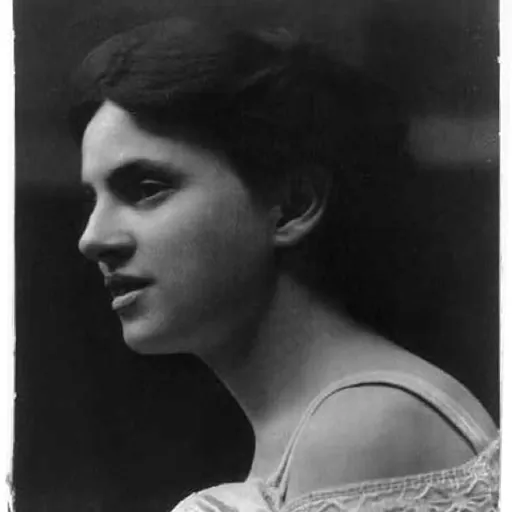
About Abastenia St. Leger Eberle
Lived 1878 – 1942 (aged 63). Abastenia St. Leger Eberle was an American sculptor and artist.
Abastenia St. Leger Eberle (April 6, 1878 – February 26, 1942) was an American sculptor known for her energetic, small bronze sculptures depicting poor immigrants on New York's City's Lower East Side. As an artist, Eberle had strong beliefs and felt a need for artists to create politically and socially conscious works of art that reflected contemporary issues. Eberle spent much of her life working toward equal rights for American women and a widespread push for equality. Her most famous piece, The White Slave, representing child prostitution, caused controversy when exhibited at the 1913 Armory Show.
Early life Born on April 6, 1878, in Webster City, Iowa, Mary Abastenia St. Leger was the daughter of a mother who was a musician and father who was a doctor in the US Army. Her family later moved to Kansas, then Missouri, before settling in Canton, Ohio. She initially studied to become a professional musician, but her father noticed her talent for modeling. He showed some interest in her development, but never offered Eberle much financial backing during her lifetime.
Eberle's mother offered piano lessons and encouraged her to pursue her musical talent, which she displayed at a young age. Eberle pursued cello professionally, until one day her father was so impressed with a clay mask Eberle worked out that he acquired some modeling wax for her from a patient who made busts. Confident that she would quickly achieve talent in sculpture, Eberle stated, "I knew it [sculpture] was my work." She received lessons from this patient before enrolling at the Art Students League in New York.
Early career
Once Eberle had obtained the wax from her father's patient, she began copying tombstones and memorials in her community. This was the only type of sculpture available in Canton for her to study at that time. After a while, Eberle became so desperate to receive some art training that she took it upon herself to get other locals registered to fill spots when she learned that sculptor Frank Vogan would come to Canton, Ohio to teach a class. Eberle continued to study with Vogan for two years, which she said was very useful to her developments as an artist. In 1899, twenty-one-year-old Eberle would begin training under George Grey Barnard at the Art Students League in New York. In 1920, she was elected to the National Academy of Design as an Associate Academician. St. Leger Eberle worked in a style related to Art Nouveau and the New Sculpture movement. She produced mainly portrait sculpture and decorative work for fountains.
Later career
In May 1907, Eberle went to Naples, Italy, to oversee the casting process of her bronzes. Initially the foundry workmen were spiteful and jealous towards Eberle, finding it difficult to believe she had done them. Eventually they came around when they noticed Eberle's eye for detail and began taking her orders. When locals would look in the studio where Eberle's bronzes were being cast, locals would exclaim "Dio Mio" (meaning "my God") at a woman doing men's work. Eberle loved Neapolitan people and had good interest in the workmen and their families. When realizing that her men were sustaining themselves off only a hunk of bread all day, Eberle made sure they all had a substantial breakfast. Several of her sculptures are on display at the Kendall Young Library, in Webster City, Iowa, where she was born.
Eberle believed that art should have a social function, writing that artists "had no right to work as an individualist with no responsibility to others. [Artists] must see for people—reveal them to themselves and each other." Some of her work is in the collection of the Metropolitan Museum of Art. However, she is best known for figurative works that combined realism with emphasis on the flow of drapery and movement.
Exhibitions
"Girl Skating" Smithsonian American Art Museum, 2011–Present.
"White Slave" Armory Show, A Turning Point, 1913, NYC Knoxville Museum of Art, American Women Artists: The 20th Century, Oct. 26, 1989–Feb. 4, 1990 Queensboro Community College Art Gallery. March 11, 1990–Apr.5, 1990 The Discovery Museum, Bridgeport, CT, They Earned Their Keep/ The Struggles and Successes of American Women Artists, Apr. 10, 1993 – May 30, 1993 Parrish Art Museum, Southampton, NY Feb. 20, 1994–Apr. 10, 1994 Los Angeles County Museum of Art, Figure in American Sculpture, Feb. 23, 1995 – May 14, 1995 Montgomery Museum of Fine Arts, June 22, 1995–Sept. 10, 1995 Wichita Art Museum, Oct. 19, 1995–Jan. 7, 1996 National Academy of Design, Feb. 15, 1996 – May 5, 1996 Whitney Museum of American Art, NYC: Part 1: The American Century Art and Culture, 1900–2000, Apr. 23, 1999–Aug. 22, 1999 Museum of Sex, NYC Inaugural Exhibit: New York City Sex: How NY Transformed Sex in America, Sept. 2, 2003–Feb.15, 2004 Curator, Grady T. Turner,
Don’t just read it —
keep it.
Full-length biographies made to live with: read them, listen on the way to work, watch them tonight.
- E-book
- Audio
- Video
Instant download · yours to keep · every purchase keeps this site free
Important facts
People in Abastenia St. Leger Eberle's life
Named in this biography and alive at the same time
Related people
Same field, nearest in time
Contemporaries
People whose lives overlapped Abastenia St. Leger Eberle's



Frequently asked questions
Who was Abastenia St. Leger Eberle?
American artist (1878-1942)
When was Abastenia St. Leger Eberle born?
Abastenia St. Leger Eberle was born on 6 April 1878 in Webster City.
When did Abastenia St. Leger Eberle die?
Abastenia St. Leger Eberle died on 26 February 1942 in New York City.
What was Abastenia St. Leger Eberle's occupation?
Abastenia St. Leger Eberle was a sculptor and artist.
What nationality was Abastenia St. Leger Eberle?
Abastenia St. Leger Eberle was American.
Sources & further reading
· Wikipedia: Abastenia St. Leger Eberle
· DBpedia: Abastenia St. Leger Eberle
Cite this page
APA: Biography.guide. (2026). Abastenia St. Leger Eberle. https://biography.guide/abastenia-st-leger-eberle/
MLA: "Abastenia St. Leger Eberle." Biography.guide, https://biography.guide/abastenia-st-leger-eberle/.
Chicago: "Abastenia St. Leger Eberle." Biography.guide. https://biography.guide/abastenia-st-leger-eberle/.
Data last updated: 2026-09-24 · Spot an error? Report a correction.
Portrait: Wikimedia Commons · author & licence
Page generated 2026-10-03 09:34 UTC