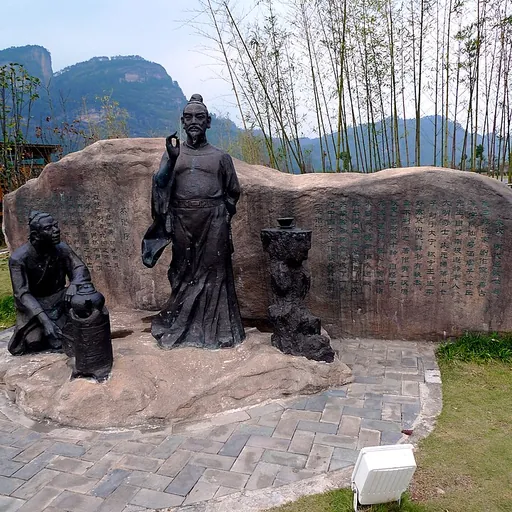
About Zhu Quan
Lived 1378 – 1448 (aged 69–70). Zhu Quan was a Chinese writer, playwright, painter, poet, aristocrat and historian.
First page / leaf of volume 3 of Zhu Quan's Shenqi Mipu. From right to left: Full title of tablature collection 臞仙神奇秘譜 with volume number 下卷 (lower or third) plus seals of the owner of this copy (if any), title of the volume 霞外神品, the tuning and method of tuning 黃鐘調, name of the 'modal preface' 調意, the tablature (shorthand) of the modal preface, [next page] title of the piece, description of the piece's origins, and the tablature of said piece.
Zhu Quan (; 1378–1448 ), the Prince of Ning , was a Chinese historian, military commander, musician, and playwright. He was the 17th son of the Hongwu Emperor of the Ming dynasty. During his life, he served as a military commander, feudal lord, historian, and playwright. He is also remembered as a great tea connoisseur, a zither player, and composer.
Other names In addition to Prince of Ning, Zhu Quan was also known as the Strange Scholar of the Great Ming (, Da Ming Qi Shi). As part of his Taoist attempts to avoid death, he adopted the aliases the Emaciated Immortal (, Qúxiān), the "Master who Encompasses Emptiness" (, Hánxūzi), "Taoist of the Mysterious Continent" or "Taoist of the Mysterious Island" (, Xuánzhōu Dàoren), and "Perfected Gentleman of the Marvelous Way of the Unfathomable Emptiness of the Southern Pole" (, Nánjí Chōngxū Miàodào Zhēnjūn).
From that point, Zhu Quan assisted his brother in his uprising, with the History of Ming recording that the Prince of Yan offered to split the entire empire between them. After his elevation as the Yongle Emperor in 1402, however, he swiftly reneged and refused to appoint his brother to lordship over Suzhou or Qiantang, instead giving him a choice only of backwater appointments. He settled upon Nanchang, the capital of Jiangxi. After a scare where he was accused of practicing wugu sorcery, Zhu Quan essentially retired from any interference with the realm, devoting his time instead to cultural pursuits.
Meeting daily with local or visiting scholars and Taoists, he pursued immortality. He treasured and revised his Secret Book of Origins (, Yuánshǐ Mìshū), a text which survived the fire of Daning and sharply attacked Buddhism as a foreign "mourning cult" at odds with Chinese culture and proper governance. His encyclopedia of Taoism, the Most Pure and Precious Books on the Way of August Heaven (, Tiānhuáng Zhìdào Tàiqīngyù Cè), was so esteemed it joined the Taoist canon. His brother ordered him to complete the Comprehensive Mirror of Extensive Essays (Tongjian Bolun) and was also credited with writing Family Advice (Jia Xun), Ceremonial Customs of the Country of Ning (Ningguo Yifan), The Secret History of the Han and Tang (, Hàn-Táng Mìshǐ), History Breaks Off (Shi Duan), a Book of Essays (, Wén Pǔ), a Book of Poetry (, Shī Pǔ), and several other annotated anthologies. His most successful was his Tea Manual (, Chá Pǔ). In addition, he personally funded the publication of many rare books and composed several operas.
Zhu Quan is an important figure in the history of the Chinese zither, or guqin, for his compilation of the important Manual of the Mysterious and Marvellous (, Shénqí Mì Pǔ) in 1425. This is the earliest known large scale collection of qin scores to have survived to the present day.
Family Consort: Lady Zhang , Commander of the Wardens Zhang Tai's daughter, died before his own death.
Sons: Zhu Panshi (; 16 October 1395 – 23 February 1437), Hereditary Prince of Ning , first son Married Commander of the East City Wardens Yu Sheng's daughter as Hereditary Princess of Ning in March 1417 Second son, died young Zhu Panye , third son Married Deputy Commander of the North City Wardens Huang Fu's daughter (d. January 1440) in August 1426, later married Company Commander Wang Xing's daughter in May 1455. Zhu Panyao (; October 1414 – July 1492), Prince Anjian of Yichun , fourth son Married Jinwu Rear Guard Commander Liu Xun's daughter in October 1430 Zhu Panzhu (; October 1419 – 1459), Prince Anxi of Xinchang , fifth son Married Xiaoling Guard Commander Ge Tan's daughter in March 1437 Zhu Panmou (; 1420 – January 1439), Prince Daohui of Xinfeng , sixth son
Daughters: Princess Yongxin , first daughter Married Jinxiang Guard Drafter Gao Heling Princess Yushan , second daughter Married Chief Commissioner Drafter Fang Jingxiang Princess Qingjiang , third daughter Married Xi'ning Guard Commander Chen Tong's younger brother Chen Yi Princess Fengxin , fourth daughter Married Wang Shuang Princess Jinxi (; d. August 1449), fifth daughter Married the Right Army Commissioner Han Guan's younger brother Han Fu Princess Taihe , sixth daughter Married Wang Yencheng of Poyang County's son Wang Zhanran Princess Pengze , seventh daughter Married Longxiang Guard Commander Wang Gang's nephew Wang Zhi Princess Luling , eighth daughter Married Qizhou Guard Commander Tian Sheng's younger brother Tian Yu Princess Xinyu , ninth daughter Married Ganzhou Prefecture Record Keeper Hu Yu's son Hu Guangji Princess Xincheng , tenth daughter Married Regent (Liushou) Central Guard Commander Li Jun's son Li Huan Princess Fuliang , 11th daughter Twelfth daughter, died young, no title Princess Nanfeng , 13th daughter Married Jiangxi Military Commissioner Zhang Xiang's son Zhang Wen Princess Yongfeng , 14th daughter
Descendants Zhu Quan's descendant, Zhu Chenhao, the Prince of Ning, rebelled against the Zhengde Emperor in what is known as the Chenhao rebellion. It was only forty-three days before it was put down by Wang Yangming, the Governor of Nan'gan, resulting in the abolition of the Prince of Ning's fiefdom. The famous painter Bada Shanren was his seventh-generation grandson, and Lin Shiyi (林時益), one of Yitang Jiuzi (易堂九子), was his eighth-generation grandson.
Don’t just read it —
keep it.
Full-length biographies made to live with: read them, listen on the way to work, watch them tonight.
- E-book
- Audio
- Video
Instant download · yours to keep · every purchase keeps this site free
Important facts
more
Ningxianwang, Ningwang, ShenyinFamily & relationships
People in Zhu Quan's life
Named in this biography and alive at the same time

Related people
Same field, nearest in time



Contemporaries
People whose lives overlapped Zhu Quan's



Frequently asked questions
Who was Zhu Quan?
Ming dynasty prince (1378-1448)
When was Zhu Quan born?
Zhu Quan was born in 1378 in Nanjing.
When did Zhu Quan die?
Zhu Quan died in 1448.
What was Zhu Quan's occupation?
Zhu Quan was a writer, playwright, painter, poet, aristocrat and historian.
What nationality was Zhu Quan?
Zhu Quan was Chinese.
Sources & further reading
Cite this page
APA: Biography.guide. (2026). Zhu Quan. https://biography.guide/zhu-quan/
MLA: "Zhu Quan." Biography.guide, https://biography.guide/zhu-quan/.
Chicago: "Zhu Quan." Biography.guide. https://biography.guide/zhu-quan/.
Data last updated: 2026-09-22 · Spot an error? Report a correction.
Portrait: Wikimedia Commons · author & licence
Page generated 2026-09-27 05:03 UTC