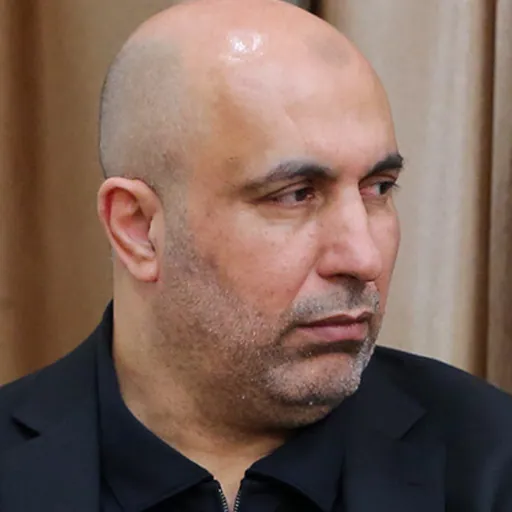
Zaher Jabarin
Palestinian politician, one of the leaders of Hamas
About Zaher Jabarin
Born 1968. Zaher Jabarin is a politician, author and translator.
Early life and family Jabarin was born on 18 September 1968,
Hamas activities Founding of the Qassam Brigades Jabarin joined Hamas in 1987 and helped to found the Qassam Brigades, Hamas's military wing, leading its expansion into the northern West Bank.
Jabarin was exiled to Damascus, Syria, and spent years living between Qatar and Turkey, ultimately settling in Istanbul, where he assumed leadership of the Hamas Financial Bureau. In Istanbul, Jabarin was a deputy to Saleh al-Arouri, who lived in Turkey until 2016. In 2021, Jabarin was elected as the deputy to Saleh al-Arouri as leader of Hamas in the West Bank. Jabarin called on the Palestinian people to prepare for the battle with the occupier. and the Likud-led coalition government of Israel.
Financial management In the 1980s and 1990s Jabrin and other members of Al-Qassam's leadership funded attacks from their own pockets, Hebrew media allege that some of the money was borrowed from his mother. and managing the group's investment portfolio estimated at over $500 million, including in Turkish real estate and stock markets, and overseeing revenue streams including private donations that exceed tens of millions of dollars per year. According to The Wall Street Journal and The Times of Israel, the financial network Jabarin oversees raises, invests, and launders money destined for Hamas militant activities in the West Bank and Gaza via networks in Turkey, Lebanon, and the Persian Gulf.
According to the United States Office of Foreign Assets Control Jabarin oversees Hamas's financial relationship with the Islamic Revolutionary Guard Corps' Qods Force, as the relationship between the Qods Force and Hamas focused on increasing funding from Iran. According to The Wall Street Journal and The Times of Israel, Jabarin's financial network operated with the tacit approval of Turkish president Recep Erdogan, and Jabarin himself has holdings in Turkish companies. cult who declared war on Hamas the previous year, and killed two Hamas government border guards in a bombing at Rafah Crossing the year before. Hamas responded to that bombing with a crackdown on followers of the "deviant ideology".
Israeli sources told Reuters that Hamas' military budget was between $100 million to about $350 million per year, 98% to 99% lower than Israel's budget of $19 to $27 billion per year, which is 4.5% of Israel's GDP.
Funding of Hamas' civilian government in the Gaza Strip was unstable due to the three-way conflict between Israel, Hamas (in Gaza), and Fatah (led by President Abbas in Ramallah). For example, in 2017 President Abbas withheld taxes collected in the Gaza Strip and pressured Israel to further reduce the already limited electricity supply. and the Fatah–Hamas conflict also caused instability in this funding, and in provision of basic services such as electricity. Jabarin succeeded him as Hamas's commander in the West Bank.
As of early 2024, Jabarin managed Hamas's prisoner portfolio and was involved in indirect negotiations over the Gaza war hostage crisis.
In late August 2023 Jabarin threatened Israeli extremist Minister for National Security Itamar Ben-Gvir. He was angry about Ben-Gvir's allegedly provocative behaviour at Al-Aqsa. Hamas, the United States Government, and the United Nations have all called for Ben-Gvir to stay away from Al-Aqsa. The Israeli opposition said that Ben-Gvir (then Israeli National Security Minister) risked the nation's security and the safety of its citizens. Hamas and Al-Qassam specifically cited these provocations, and Israeli settler violence in the West Bank, which was also exacerbated by Ben-Gvir, as motives for the 7 October attacks.
According to the Times of Israel, Jabarin was to blame for the resurgence of Hamas' use of suicide bombings in late August 2023, and Jabrin was responsible for dispatching the perpetrator of the Lehi Street bombing from Nablus to Tel Aviv.
According to the Times of Israel, Jabarin was to blame for the resurgence of Hamas' use of suicide bombings in late August 2023 as the group's capabilities in Gaza diminished. People in nearby buildings also did not expect that the explosion was a suicide bomber because those attacks were more typical of twenty years ago.
The bombing in Tel Aviv occurred less than three weeks after the assassination of Hamas' top political leader, Ismail Haniyeh. Haniyeh was a relative moderate within Hamas and had repeatedly offered a place deal in exchange for a fully sovereign Palestinian state on the land that Israel did not occupy until 1967.
Suicide bombings were always a controversial tactic that many Palestinians object to, even members of Hamas disagreed with each other about suicide bombings. In 2006, while Jabarin was still in Prison, Hamas announced that they planned to stop suicide bombings. Palestinian defectors who had joined ISIS in the Sinai declared war on Hamas the following year, demanding Hamas release ISIS militants held in Gaza's prisons. Three police officers were killed, allegedly all three of whom were members of Hamas,
After a speech on 29 August by former Hamas leader Khaled Meshaal declaring the group's intention to revive the use of suicide bombings, Hamas conducted four bombings against Israeli settlements in the West Bank and Jerusalem. The Times of Israel said that Hamas' return to bombings came amid perceptions within the militant group that Palestinians in the West Bank had not joined the fight against Israel. In the propaganda video in which Mohammed Deif – the leader of the Qassam Brigades, based in the Gaza Strip – announced the 7 October attacks he called for others outside Gaza to join the attack against Israel, he gave a long list of suggestions that did not include explosives, and the speech did not directly encourage intentionally suicidal attacks. but many of the earlier suicide bombings were attributed to Deif by pro-Israel sources.
2025 Qatar airstrike
On September 9, 2025, it was reported that Jabarin was present in the Hamas headquarters building in Doha, Qatar when it was struck by Israeli air strikes. Hamas stated that its entire leadership survived the attack.
Don’t just read it —
keep it.
Full-length biographies made to live with: read them, listen on the way to work, watch them tonight.
- E-book
- Audio
- Video
Instant download · yours to keep · every purchase keeps this site free
Important facts
People in Zaher Jabarin's life
Named in this biography and alive at the same time


Related people
Same field, nearest in time


Contemporaries
People whose lives overlapped Zaher Jabarin's




Frequently asked questions
Who is Zaher Jabarin?
Palestinian politician, one of the leaders of Hamas
When was Zaher Jabarin born?
Zaher Jabarin was born on 11 September 1968 in Salfit.
What is Zaher Jabarin's occupation?
Zaher Jabarin is a politician, author and translator.
What nationality is Zaher Jabarin?
Zaher Jabarin's recorded nationality: Palestine.
Sources & further reading
Cite this page
APA: Biography.guide. (2026). Zaher Jabarin. https://biography.guide/zaher-jabarin/
MLA: "Zaher Jabarin." Biography.guide, https://biography.guide/zaher-jabarin/.
Chicago: "Zaher Jabarin." Biography.guide. https://biography.guide/zaher-jabarin/.
Data last updated: 2026-09-21 · Spot an error? Report a correction.
Portrait: Wikimedia Commons · author & licence
Page generated 2026-09-27 04:59 UTC