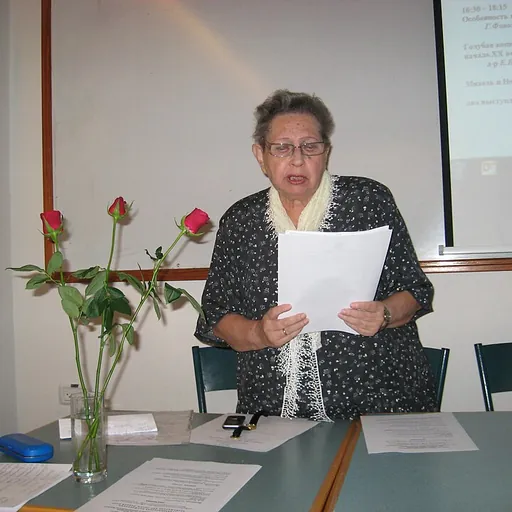
About Yulia Sister
Born 1936. Yulia Sister is an Israeli chemist.
Yulia Sister (, ; born September 12, 1936, in Chișinău, Bessarabia, Romania) is a Soviet Moldavian and Israeli analytical chemist engaged in chemical research with the use of polarography and chromatography, a science historian, and a researcher of Russian Jewry in Israel, France, and other countries. She holds the position of Director General of the Research Centre for Russian Jews abroad and in Israel.
Biography
Early childhood and schools Yulia Sister was born in 1936 in Chișinău (Russian: Kishinev), at the time in the Kingdom of Romania, a city which later became the capital of the Moldavian SSR and since 1991 is the capital of Moldova. Her parents and paternal grandparents were also born in this city. The grandparents were there and survived the pogrom of 1903.
David Iosifovich, Yulia's father, was a doctor educated in Prague at Charles University. He used to tell his daughter about his student years, the Bessarabian association of fellow-countrymen in Prague and his meetings with famous people. Yulia's mother Yevgenia (Bathsheba) Moiseevna copied for her by hand children's verses and Yulia learned to read quite early. Among the first poems was "What Is Good and What Is Bad" by Mayakovsky.
Yulia's grandparents stuck to traditions and spoke Yiddish, and grandfather Yosef (Iosif) even wrote Yiddish poetry. But Yulia could hardly remember them. Her grandfather Moshe (Moisei) died before she was born; her parental grandparents lost their lives in the Kishinev Ghetto in the Holocaust and her grandmother Sarah died during the World War II in evacuation.
During the 2nd World War Bessarabia was reclaimed and then occupied by the Soviet Union in June 1940. A year later in July 1941 it was reconquered by Germany and Romania, and in August 1944 reoccupied by the Soviet Union. In her memoirs Yulia recalled the day when the Red Army entered Kishinev. She also remembered the German bombing of the city and the air raids on the roads, by which her family escaped to the East from the Nazis. Since her second year at the university she became a member of the student scientific society and was engaged in the research of compounds called heteropolyacids.
Through 25 years of research at the Institute of Chemistry Sister dealt with a wide range of topics. Her ecology oriented research included analysis of pesticides in environmental samples, food items and biological mediums. She participated in research and analysis of suspensions and was involved in analyzing new organic compounds. Sister made a substantial contribution to the development of such methods as the second harmonic ac polarography, the difference polarography with magnetic recording, the chromatopolarography. For about 20 years Yulia Sister served as a consultant on the use of the polarographic method in biology at the Department of Human and Animal Physiology of the University of Kishinev.
In 1991 Sister began to write for the Shorter Jewish Encyclopedia (SJE) as a non-staff editor. She served as a research fellow covering the field of history of science and wrote about 90 articles for the encyclopedia. Yulia is the author of the articles "Chemistry" (jointly with P. Smorodnitsky), "Veniamin Levich", "Frederick Reines", "Moise Haissinsky", "Yuri Golfand" and many others.
Yulia Sister's activities in the House of Scientists and Experts of Rehovot started in 1991. Within this forum she organizes lectures, seminars and scientific conferences. She leads the scientific seminars of the House of Scientists that are regularly held at the Weizmann Institute of Science. In 2008, and then in 2014 she organized conferences devoted to the Bilu movement and to the First Aliyah. She also maintains friendly contacts with foreign colleagues, such as the Club of Russian-speaking scientists of Massachusetts.
In 1997 Mikhail Parkhomovsky initiated creation of the Research Center for Russian Jewry Abroad, which aimed to collect and publish information on Jews, who emigrated from the Russian Empire, Soviet Union or Post-Soviet states and made a contribution to world civilization. Parkhomovsky became the Scientific Director and Chief Editor and Yulia Sister Director General of the Center. From 2012 the Center changed its name to Research Centre for Russian Jews abroad and in Israel (Erzi). The collection, processing and publication of materials related to Russian Jewry are organized by Sister. By 2015 the Center published about 30 volumes of collections, including books devoted to Jews in England, France, U.S., Israel and other countries. In addition to her executive functions, Sister is a frequent editor and author of the Center's collective monographs. She is the editor of the 17th volume ("Let Us Build the Walls of Jerusalem. Book 3"), a coeditor of the 11th volume ("Let Us Build the Walls of Jerusalem. Book 1") and of the monograph "Israel, Russian Roots", and a participant in the editing of the 10th volume. More than 200 scientists from all over the country participated at the tenth-anniversary of the Center conference in 2007. The 2012 conference was devoted to the 130th anniversary of the First Aliyah and the event was covered by the House of Scientists of Rehovot.
Yulia Sister lives with her family in Kiryat Ekron. Her husband, Boris (Bezalel) Iosifovich Gendler, is a physician with an extensive experience in medical practice and education. After his repatriation from Kishinev Bezalel Gendler worked as a doctor in one of the Israeli hospitals and published several articles, some of them in collaboration with Yulia.
Selected publications
Chemistry Yulia Sister is the author or co-author of more than 200 scientific publications.
History of science in Erzi publications
History of science in other publications
Russian Jewry in Israel
Other publications
Don’t just read it —
keep it.
Full-length biographies made to live with: read them, listen on the way to work, watch them tonight.
- E-book
- Audio
- Video
Instant download · yours to keep · every purchase keeps this site free
Important facts
People in Yulia Sister's life
Named in this biography and alive at the same time



Related people
Same field, nearest in time





Contemporaries
People whose lives overlapped Yulia Sister's




Frequently asked questions
Who is Yulia Sister?
Soviet Moldavian and Israeli chemist-analyst
When was Yulia Sister born?
Yulia Sister was born on 12 September 1936 in Chișinău.
What is Yulia Sister's occupation?
Yulia Sister is a chemist.
What nationality is Yulia Sister?
Yulia Sister is Israeli.
Sources & further reading
Cite this page
APA: Biography.guide. (2026). Yulia Sister. https://biography.guide/yulia-sister/
MLA: "Yulia Sister." Biography.guide, https://biography.guide/yulia-sister/.
Chicago: "Yulia Sister." Biography.guide. https://biography.guide/yulia-sister/.
Data last updated: 2026-09-20 · Spot an error? Report a correction.
Page generated 2026-09-27 05:10 UTC