
Yuanzhao
Scholar-monk and Vinaya master of the Vinaya school during the Song dynasty
About Yuanzhao
Lived 1048 – 1116 (aged 67–68).
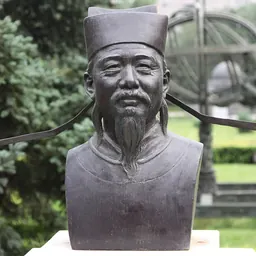
Yuanzhao (Chinese: 元照, 1048–1116), styled Zanran Yuanzhao and Lingzhi Yuanzhao (靈芝元照) was a distinguished scholar-monk and Vinaya master of the Vinaya school during the Song dynasty (960–1279 CE). He also taught and wrote on Pure Land Buddhism and Tiantai. After a period of illness later in life, he became a staunch Pure Land Buddhist, composing commentaries on the Amitabha Sutra and the Contemplation Sutra. By 1078, he had received the Bodhisattva Precepts and devoted himself to restoring the Nanshan tradition of the Four-Part Vinaya (Dharmaguptaka Vinaya), emphasizing strict adherence to monastic discipline and alms-begging practices. He also wrote commentaries to the works of Daoxuan (7th century), the Vinaya master who founded the Nashan tradition. This commitment aligned with his broader aim to revive and systematize the Vinaya tradition, which had suffered setbacks due to prior political persecutions during the Tang and Five Dynasties periods. Initially a critic of Pure Land Buddhism, Yuanzhao had a deep conversion experience to Pure Land later in life after a serious illness during which he also read the Jingtu shiyi lun (淨土十疑論), a Tiantai Pure Land text attributed to Zhiyi (an unlikely attribution).
Yuanzhao argued that to be able to practice contemplation or guan (觀), one needed to practice the three pure acts taught in the Contemplation Sutra. The three pure acts (which include keeping precepts and reciting sutras) evoked the Buddha's blessings (fuye 福業) which supported the practice of contemplation. Thus, to practice correct guan (zheng guan 正觀) one must thus keep precepts. Yuanzhao compares the three pure acts to a shipload of treasures and contemplation to the ship's mast. He also links them with phenomenon (shi 事) and principle (li 理) respectively.
Yuanzhao also connects the three minds of faith taught by Shandao to the three clusters of bodhisattva precepts, writing:An earnest mind means earnestly observing the restraining precepts to end all evildoing. A profound mind means doing all good dharmas to deepen one's mind. A mind wishing for rebirth in the Pure Land as one transfers one's merits to other sentient beings means benefiting all in their deliverance. As such, Yuanzhao's Pure Land commentaries provide a holistic approach to Pure Land practice which includes meditation (guan), oral recitation, keeping precepts, vows and devotion.
Yuanzhao's commentaries also make use of the Tiantai teaching which argued that “the Mind is the Pure Land” (weixin jingtu 唯心淨土). This teaching is based on Tiantai's teaching of the three thousand realms being included in a single moment of thought.
In spite of his reliance on Shandao, Yuanzhao disagrees with the master on one important issue. Yuanzhao does not agree with Shandao that the first thirteen contemplations taught in the Contemplation Sutra are "meditative goods" while the three pure acts and the last three contemplations are "non-meditative goods". For Yuanzhao, the Contemplation Sutra is clearly teaching sixteen contemplations, and each of them is a kind of meditation.
Regarding the practice of meditative contemplation (or visualization, guan) and oral recitation of the Buddha's name (nian), Yuanzhao sees both of these as interconnected practices which focus on seeing the Buddha in one's mind. Due to this they are unique practices different from the contemplation of the mind (guanxin). Some authors of the Tiantai school like Siming Zhili had argued that the Contemplation Sutra was teaching a kind of contemplation of the mind similar to that taught in Tiantai. But according to Yuanzhao, the sutra's meditation "aims at delivering the mind to another realm" (songxin tajing 送心他境) and at "protection through the power of a holy being" (shengde huchi 聖德護持). This is thus a different kind of method than the Tiantai practice of meditating on one's thoughts.
In his commentary on the Contemplation Sutra, Yuanzhao also answers various critiques of Pure Land common in his time. One of these was that the practice of Pure Land contemplation amounts to an “attachment to characteristics” (zhaoxiang 著相). In response, Yuanzhao argues that the practice of nianfo has no characteristics to which one could be attached, since contemplating nianfo is contemplating the Buddha.
Works His major works include:
Commentary to the [Dharmaguptaka] Four-Part Vinaya (四分律行事鈔資持記 Sifen Lü Xingshi Chao Zichi Ji) – 42 scrolls Karmavacana Notes for the Four-Part Vinaya (Sifen Lü Jiemojiao Ji Yuan Ji) – 22 scrolls Annotated Precept Text of the Four-Part Vinaya (Sifen Lü Han Zhu Jieben Shu Xingzong Ji) – 21 scrolls Commentary on the Contemplation Sutra of Infinite Life (Guan Wuliangshou Jing Yi Shu) – 3 scrolls Commentary on the Amitabha Sutra (Amituo Jing Yi Shu) – 1 scroll Collection of the Lingzhi Garden (Zhi Yuan Ji) – 2 scrolls Supplementary Collection of the Lingzhi Garden (Bu Xu Zhi Yuan Ji) – 1 scroll Remaining Writings of the Lingzhi Garden (Zhi Yuan Yi Bian) – 3 scrolls Record of Abiding Dharma (Fazhu Ji), a commentary on the Sutra of Bequeathed Teachings – 1 scroll Record of Repaying Gratitude (Baoen Ji), a commentary on the Ullambana Sutra – 1 scroll Record of Manifestation and Transformation (Yinghua Ji), a commentary on Daoxuan's Monastic Regulations and Attire – 1 scroll Illustrated Guide to the Six Essentials for Monks (Fozhi Biqiu Liuwu Tu) – 1 scroll Ode to Monastic Implements (Daoju Fu) – 1 scroll
Don’t just read it —
keep it.
Full-length biographies made to live with: read them, listen on the way to work, watch them tonight.
- E-book
- Audio
- Video
Instant download · yours to keep · every purchase keeps this site free
Important facts
Contemporaries
People whose lives overlapped Yuanzhao's




Frequently asked questions
Who was Yuanzhao?
scholar-monk and Vinaya master of the Vinaya school during the Song dynasty
When was Yuanzhao born?
Yuanzhao was born in 1048.
When did Yuanzhao die?
Yuanzhao died in 1116.
Sources & further reading
Cite this page
APA: Biography.guide. (2026). Yuanzhao. https://biography.guide/yuanzhao/
MLA: "Yuanzhao." Biography.guide, https://biography.guide/yuanzhao/.
Chicago: "Yuanzhao." Biography.guide. https://biography.guide/yuanzhao/.
Data last updated: 2026-09-20 · Spot an error? Report a correction.
Page generated 2026-09-27 05:29 UTC