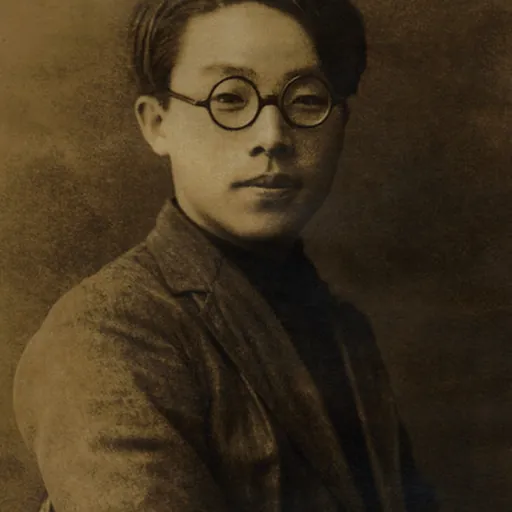
About Yu Chi-hwan
Lived 1908 – 1967 (aged 58). Yu Chi-hwan was a South Korean poet.
Yu Chi-hwan (; 1908–1967), also known by his art name Cheongma , was a leading twentieth-century Korean poet.
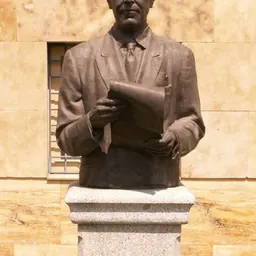
Biography Yu was born in South Gyeongsang Province. He published at least ten volumes of poetry. The poet collaborated with the occupation forces during Japanese colonial years. In 2005, a plaza with a bust of the poet and five monuments, each inscribed with a poem he wrote, were dedicated at the poet's tomb in Bangha-ri, Dundeok-myon, Geoje, South Gyeongsang Province.
Yu attended Toyoyama Middle School in Japan for four years, then returned to Korea to graduate from Dongrae High School. He entered the Humanities Division of Yonhi College (now Yonsei) in 1927 but withdrew after a year. In 1937 he managed the coterie journal Physiology (Saengni). In April 1940 he moved to Manchuria. He returned to Korea in June 1946, at which time he established the Tongyeong Cultural Association (Tongyeong munhwa hyeophoe) and joined several other groups as well and. In 1952 he joined the Poetry and Poetics (Siwa siron) circle in Daegu, and in 1955 he oversaw the publication of Green Barley (Cheongmaek), a journal produced by a circle of Gyeongsangnam-do writers. In 1957, he founded the Society of Korean Poets.
His awards include the Seoul Culture Award, Korean Academy of the Arts Distinguished Service Award (Yesurwon gongnosang), and Busan Culture Award. He died on February 13, 1967.
The poet’s works are colored by a will to overcome death and nothingness, the fundamental fate of human existence. This will is linked with the poet's own spiritual pilgrimage and thus has a variety of connotations in his poetry. On one hand, within the historical dimension represented by the extreme circumstances of the late years of Japanese Imperialism, there appears a masochistic rage and a savage will, while on the other we find, within the death predestined for humanity, a compassion and pathos for existence. These parallel portraits of the life-force and pathos are aptly illustrated in one of his best-known poems, “Flag” (Gitbal). The flag is the sentimental mind that, by simultaneously encountering compassion for humanity and a longing for a utopia, symbolized by the image of a blue sea, cannot in the end arrive at this Utopia. Because of his endeavor, based on this violent love of the life-force, to overcome by strong force of will the essence of nothingness, Yoo Chihwan is known as a poet of the "life-force" or "life" schools; and because of his poems' smooth recitation of sublime poetic themes, the critics see in his works a masculine poetic world rarely viewed in modern Korean poetry.
Works in translation Imágenes del tiempo, translated by Kim Hyun Chang. Verbum: Madrid, 2005 The Wind and the Waves: Four Modern Korean Poets; Translated and Introduced by Sung-Il Lee. Asian Humanities Press: Berkeley, Cal., 1989. Blue Stallion: Poems of Yu Chi-whan, translated by Sung-Il Lee. Homa & Sekey Books, 2011. Korean Literature Today: "Yu Chi-Hwan Poems: 'Evening Glow'" etc. Vol. 2. No. 2 P. 11; Yu Chi-Hwan Poems: 'Daffodil'" etc. Vol. 4. No. 4 P. 6; "Yu Chi-Hwan Poems: 'Cliff'" etc. Vol. 6. No. 1 P. 11
Works in Korean (partial) Poetry collections Poems of Yoo Chihwan (Cheongmasicho, 1939) The Chapter of Life (Saengmyeong-ui Seo) The Isle of Ulung (Ulleungdo) Journey of a Dragonfly (Cheongnyeong ilgi) Assorted How Happy to Have Loved (Saranghaesseumeuro haengbokhayeonnera), published posthumously, is a selection of two hundred love letters that he wrote to the sijo poet Lee Yeongdo.
Awards Seoul Culture Award Korean Academy of the Arts Distinguished Service Award (Yesurwon gongnosang) Busan Culture Award
Don’t just read it —
keep it.
Full-length biographies made to live with: read them, listen on the way to work, watch them tonight.
- E-book
- Audio
- Video
Instant download · yours to keep · every purchase keeps this site free
Important facts
Related people
Same field, nearest in time


Contemporaries
People whose lives overlapped Yu Chi-hwan's



Frequently asked questions
Who was Yu Chi-hwan?
South Korean poet (1908–1967)
When was Yu Chi-hwan born?
Yu Chi-hwan was born on 14 July 1908 in Geoje.
When did Yu Chi-hwan die?
Yu Chi-hwan died on 13 February 1967.
What was Yu Chi-hwan's occupation?
Yu Chi-hwan was a poet.
What nationality was Yu Chi-hwan?
Yu Chi-hwan was South Korean.
Sources & further reading
Cite this page
APA: Biography.guide. (2026). Yu Chi-hwan. https://biography.guide/yu-chi-hwan/
MLA: "Yu Chi-hwan." Biography.guide, https://biography.guide/yu-chi-hwan/.
Chicago: "Yu Chi-hwan." Biography.guide. https://biography.guide/yu-chi-hwan/.
Data last updated: 2026-09-22 · Spot an error? Report a correction.
Portrait: Wikimedia Commons · author & licence
Page generated 2026-09-27 05:03 UTC