
About Yoshiharu Habu
Born 1970. Yoshiharu Habu is a Japanese professional shogi player and chess player.
is a professional shogi player and a chess FIDE Master. He is a former holder of the Ryūō, Meijin, Ōi, Ōza, Kiō, Ōshō and Kisei major titles. He was the first person to simultaneously hold seven major professional shogi titles at the same time and is the only person to qualify as a lifetime title holder for seven major titles. In January 2018, Habu became the first professional shogi player to be awarded Japan's People's Honour Award. Habu is also a former president of the Japan Shogi Association (JSA).
Early life, amateur shogi and apprenticeship Yoshiharu Habu was born in Tokorozawa, Saitama in 1970 and moved to Hachioji, Tokyo before entering kindergarten. Habu first encountered shogi in his first year of elementary school, when his classmates taught him how the shogi pieces move. He was so fascinated by the game that his mother entered him in a shogi tournament held at the Hachioji Shogi Club in the summer of 1978. Although Habu was eliminated during the preliminary rounds with a record of 1 win and 2 losses, his parents took him to the shogi club every weekend from October 1978. Habu improved so rapidly that he was promoted to amateur 5-dan in October 1981 at the age of eleven.
During his elementary school days, Habu regularly participated in regional and national shogi tournaments, mainly for children. At these tournaments, Habu played against several children of the same age who also became professional players, including Toshiyuki Moriuchi, Yasumitsu Satō and Manabu Senzaki. Those players born around 1970 are now known as the , not just because they were born in the same year, but also due to their outstanding achievements as players. He expressed his desire to become a professional player and asked advice from Katsuyasu Nakajima, the owner of the Hachioji Shogi Club and a student of Tatsuya Futakami. Habu applied for admission into the Japan Shogi Association's apprentice school as Futakami's student and was accepted as a member in 1982.
Shogi professional Habu became a 4-dan professional in 1985 at the age of 14. He was the third junior high school kid professional in shogi history following Hifumi Kato and Koji Tanigawa. In 1989, at the age of 19, Habu 6-dan won the Ryūō championship, defeating Akira Shima who led a 4-person shogi study group "Shimaken" in which Habu himself took part. This was the first time Habu won one of the seven major titles making him, at the time, the youngest titleholder ever. Although he lost the Ryūō title to Tanigawa the following year, Habu won the Kiō championship four months later in 1991.
In 1992 Habu won the Ōza championship defeating Bungo Fukusaki to hold two titles (Kiō and Ōza) simultaneously. He went on to hold the Ōza title for 19 terms in a row. In 1996 (February 14 to July 30), Habu became the first professional to ever hold seven major titles (Meijin, Ryūō, Kisei, Ōi, Ōza, Kiō, and Ōshō) at the same time.
In June 2014, Habu defeated the defending Meijin Toshiyuki Moriuchi 4 games to none to become the 72nd Meijin. Habu lost his Meijin title to Moriuchi in 2011 (69th Meijin match) and was unable to defeat Moriuchi and regain the title in both 2012 (70th Meijin match) and 2013 (71st Meijin match). By defeating Moriuchi, Habu not only moved into a tie with both Moriuchi and Yoshio Kimura for third place on the all time Meijin winner's list, he also became the first person the recapture the title for the third time.
In November 2014, Habu won his 1300 official game, becoming the fourth player to do so, the youngest player to do so (44 years and 1 month) and the fastest player to do since turning professional (28 years and 11 months). Habu's win came in his 1801 game as a professional and his winning percentage of 72.3 percent at the time is the all-time highest of any professional player to reach 1300 wins to date.
In December 2017, Habu defeated defending champion Akira Watanabe to win the 30th Ryūō title. It was Habu's seventh Ryūō title overall which qualified him for the title of Lifetime Ryūō. It also made Habu the first shogi professional to qualify for lifetime titles in seven major titles.
On January 5, 2018, Habu became the first shogi professional to be awarded Japan's People's Honor Award. In November 2018, it was announced that he was also awarded the Medal with Purple Ribbon.
On November 21, 2018, Habu became the seventh shogi professional to play 2000 official games. At age 48 years and 1 month, Habu is the youngest to achieve the feat. He also accomplished it in 32 years and 11 months since obtaining professional status, thus becoming the fastest to do so. Furthermore, his overall winning percentage of .709 is also the highest among those who have previously reached the milestone.
On December 21, 2018, Habu lost the 31st Ryūō title to challenger Akihito Hirose 4 games to 3. The loss of the Ryūō title marked the first time in 27 years that Habu was a not one of professional shogi's major titleholders. A few days after losing the Ryūō title, the Japan Shogi Association announced that Habu had expressed his desire to be officially referred to as "Habu 9-dan" instead of as "Ex-Ryūō Habu" , the way Ex-Ryūō champions can choose to be referred to as throughout the year following their loss of the title.
Habu defeated Masataka Gōda on March 17, 2019, to win the 68th NHK Cup tournament. It was the eleventh time Habu won the tournament, and also the 45th non-major title championship of his career, which broke the previous record of forty-four championships he shared with Ōyama.
On June 4, 2019, Habu defeated Takuya Nagase to become the shogi professional with the most victories of all time with 1,434 wins. Habu tied Ōyama's record of 1433 career wins a little over a week earlier on May 23, but then lost his next game and his first chance to break the tie on May 30. Habu's 1,434 win came in his 2,027 game as a shogi professional and gave him an overall winning percentage of 0.708.
In 2022, Habu was demoted to B1 class after 29 consecutive terms ranked A class or higher. On June 16, 2022, in the first round of the 81st Meijin B1 ranking league, Habu defeated Takayuki Yamasaki to become the first shogi professional with 1,500 wins, extending his record for most wins by a shogi professional and giving him an overall winning percentage of 0.696. For this achievement, Habu was awarded the newly created .
Habu won all six of his games in the 72nd Ōshō Challenger League (SeptemberNovember 2022) to earn the right to challenge Sōta Fujii for the later's Osho title in the 72nd Ōshō title match (JanuaryMarch 2023). It was the first meeting between the two in a major title match. The match was tied at two wins apiece after four games, but Fujii won the next two games to win the match 4 games to 2.
On November 26, 2025, Habu defeated Shōta Chida in a 19th Asahi Cup Open game to become the first professional shogi player to win 1600 official games. Habu's official win-loss record at the time was 1600 wins and 731 losses for a winning percentage of 0.686.
Habu's favorite piece is the silver, which he finds vital for both attack and defense. His winning percentage when dropping golds and silvers on the squares 23 and 83 (or at 87 and 27 when playing White) is said to be high even though winning after such drops is generally considered to be quite difficult. For this reason, these squares are referred to by some in the shogi world as "Habu's zone".
He is well known for playing superb moves in disadvantageous positions in the endgame, with peculiar brinkmate sequences that other players seem unable to come up with, a characteristic that many young players called "Habu's magic", a label under which he has published a series of books.
His long time rival Toshiyuki Moriuchi said of him: "His greatness lies in that as those around him get stronger, he also gets stronger. He is completely obsessed with not letting there be any big difference in playing strength between himself and other shogi professionals."
Promotion history The promotion history of Habu is as follows: )
Major titles and other championships
Major titles There are eight major titles in shogi. Below is a list of number of times and years Habu has won each title. "Other awards" includes those awarded by the JSA for career accomplishments and those awarded governmental organizations, etc. for contributions made to Japanese society. 45th Annual Shogi Awards (April 2017 — March 2018): Player of the Year, Game of the Year 46th Annual Shogi Awards (April 2018March 2019): Game of the Year 50th Annual Shogi Awards (April 2022March 2023): Fighting-spirit, Game of the Year
Other awards 1994: Tokyo Resident Culture Honor Award (Awarded by the Governor of Tokyo in recognition of cultural achievements by a Tokyoite) 1996: Prime Minister's Award (Awarded by then Japanese Prime Minister Ryūtarō Hashimoto in recognition of becoming the first person to hold all seven major shogi titles at the same time. 1999: Shogi Honor Award (Awarded by the JSA in recognition of winning 600 official games as a professional) 2003: Shogi Honor Fighting-spirit Award (Awarded by JSA in recognition of winning 800 official games as a professional) 2007: Special Shogi Honor Award (Awarded by the JSA in recognition of winning 1,000 official games as a professional) 2008: 56th Kikuchi Kan Prize (Awarded by the publishing company Bungei Shunju in recognition of cultural achievements) 2010: 25 Years Service Award (Awarded by the JSA in recognition of being an active professional for twenty-five years) 2018: People's Honor Award 2018: Medal with Purple Ribbon 2022: Special Shogi Honor Fighting Spirit Award (Awarded by JSA in recognition of winning 1,500 official games as a professional)
Year-end shogi prize money rankings Since 1993, Habu has finished at the top of the year-end prize money rankings a total of 24 times (1993–96, 1998–2012, 2014–16, 2018), second twice (1997 and 2013), third once (2017), fifth three times (2019, 2021 and 2023), sixth once (2020), ninth once (2025) and tenth once (2024). All amounts are given in Japanese yen and consist of tournament winnings and other game fees received during the calendar year (January 1 to December 31).
1993: ¥100,630,000 1994: ¥112,970,000 1995: ¥165,970,000 1996: ¥161,450,000 1997: ¥101,820,000 1998: ¥114,660,000 1999: ¥78,720,000 2000: ¥105,950,000 2001: ¥115,190,000 2002: ¥110,480,000 2003: ¥129,100,000 2004: ¥112,720,000 2005: ¥103,910,000 2006: ¥93,760,000 2007: ¥81,320,000 2008: ¥107,110,000 2009: ¥112,780,000 2010: ¥115,760,000 2011: ¥98,860,000 2012: ¥91,750,000 2013: ¥72,810,000 2014: ¥114,990,000 2015: ¥119,000,000 2016: ¥91,500,000 2017: ¥50,070,000 2018: ¥75,520,000 2019: ¥39,990,000 2020: ¥24,910,000 2021: ¥32,360,000 2023: ¥26,040,000 2024: ¥16,220,000 2025: ¥15,030,000
JSA president On April 4, 2023, then JSA president announced that he would not seek re-election when his term expired in at the beginning of June 2023. Later that same day, Habu released a statement through the JSA stating that he had submitted his application to be a candidate for the JSA board of directors scheduled to be selected at the next general meeting in June 2023. In the statement, Habu also stated that he decided to be a candidate for the first time because he wanted to "do all he could to help the JSA as it prepared to celebrate its 100th anniversary in 2024". and he was formally elected to the JSA board of directors and then subsequently selected to be JSA president by the other members of the board at the 74th JSA general meeting held on June 9, 2023.
On April 1, 2025, Habu made it clear that he had decided to not seek re-election as JSA president when his term ended in June 2025. He stated that he accomplished what he set out to do during the previous two years regarding the opening of the JSA's new headquarters in Tokyo and new branch office in Kansai as well as its 100th anniversary celebrations, but now he wants to just focus on playing shogi.
Chess professional
Habu is also one of the best chess players in Japan. He achieved the title of FIDE Master in 2004, and had a peak Elo rating of 2415 in February 2014.
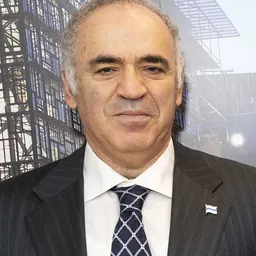
In November 2014, he played former World Chess Champion Garry Kasparov in an exhibition match sponsored by the Japanese company Dwango. The two played two 25-minute rapid games with Habu losing both.
Personal life In March 1996, Habu married actress and singer at Hato no Mori Hachiman Shrine in Sendagaya, Tokyo, not far from the head office of the Japan Shogi Association. The two had met for the first time in September 1994 and officially announced their engagement in July 1995. It was reported that 80 police officers were assigned to the ceremony due to the popularity of the two. , they have two daughters.
Don’t just read it —
keep it.
Full-length biographies made to live with: read them, listen on the way to work, watch them tonight.
- E-book
- Audio
- Video
Instant download · yours to keep · every purchase keeps this site free
Important facts
People in Yoshiharu Habu's life
Named in this biography and alive at the same time


Related people
Same field, nearest in time

Contemporaries
People whose lives overlapped Yoshiharu Habu's

Frequently asked questions
Who is Yoshiharu Habu?
Japanese shogi and chess player
When was Yoshiharu Habu born?
Yoshiharu Habu was born on 27 September 1970 in Hachiōji-shi.
What is Yoshiharu Habu's occupation?
Yoshiharu Habu is a professional shogi player and chess player.
What nationality is Yoshiharu Habu?
Yoshiharu Habu is Japanese.
Sources & further reading
Cite this page
APA: Biography.guide. (2026). Yoshiharu Habu. https://biography.guide/yoshiharu-habu/
MLA: "Yoshiharu Habu." Biography.guide, https://biography.guide/yoshiharu-habu/.
Chicago: "Yoshiharu Habu." Biography.guide. https://biography.guide/yoshiharu-habu/.
Data last updated: 2026-09-20 · Spot an error? Report a correction.
Page generated 2026-09-27 05:20 UTC