
About Yi Su-gwang
Lived 1563 – 1628 (aged 64–65). Yi Su-gwang was a Korean calligrapher and writer.
Yi Sugwang (; 1563–1628), also known as Lee Soo-kwang, was a Korean sarim, a military official, and a diplomat of the Joseon period. He was also an academic and an encyclopedist who compiled the Jibong Yuseol, the earliest Korean encyclopedia.
Early life Yi Sugwang was born to a wealthy, aristocratic family in 1563, and was offered the finest education his parents could afford. In 1585, he passed the civil service exam and became a military officer.
Military career In the wake of Seven-Year War, he was stationed in Jogyeong, Gyeongsang province, where he was given command of a small army contingent. He encountered a Japanese expeditionary contingent in Yongin, Gyeonggi province and lost. His superiors restationed him in Uiju, Hamgyong province, where he encountered more Japanese forces. His actions during this period were sufficiently successful for him to be promoted.
In 1614, he would write about his military experience, noting that the Joseon forces had "too many sajok (families of yangban or scholar officials), idlers, vagrants and too few people liable for service." The book is considered to be the foundation of the Silhak school.
Career as an emissary
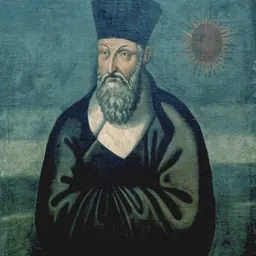
After the war, he was dispatched as an emissary to the Ming Dynasty. In Ming China, he acquired several books written on Catholicism by an Italian priest, Matteo Ricci, who was living in China at this time. He brought them back to Korea, which was the first time Western literature had been brought into Korea. He took great interest in the Western world. From the research he developed during his three missions to China, he was able to create a 20-volume encyclopedia, with the title Jibong Yuseol.
The Jibong Yuseol contained not only information on Catholicism and China, but also on Japan, Vietnam, and Thailand. It also contained basic information on the Western world, including the geography and weather of England, western food, and western weapons. He also wrote about the knowledge of astronomy that he had acquired from an Italian priest staying in China at the time. He visited China several times, and even met Thai (known then to Koreans as Seomra people) emissaries in China. Taking a great interest in the Thais, he closely recorded the customs of the Thai people. He also had contact with emissaries from Vietnam and the Okinawan Islands.
Government official When he came back to Korea, he became the high-ranking government official of Ijo (吏曹, Ministry of Personnel), the Ijo Panseo . In his later works - Jibong Jib and Chaesin Jamnok - he placed less emphasis on Confucianism and emphasized adopting western knowledge to strengthen the nation. His work also dealt with the subject of moderate political and economic reforms to improve the living standards of the peasants, which had deteriorated following the Seven-Year War, and the bureaucracy. He also implemented welfare policies, believing that the Way of Heaven was found among the people and the most noble endeavour was to feed and clothe the poor. His idea of a welfare state was inspired by both Confucianism and Catholicism. These books were stored in Changsu Seowon (Changsu Confucian Academy) in Suwon, Gyeonggi province.
Those whom he is said to have influenced include the early 17th century thinkers, Yu Hyeong-won (1622–1673) and Yun Jeung (尹拯, 1629–1714).
He died in 1628. He was given the posthumous official title Yeonguijeong, the Chief State Councillor of the State Council.
Don’t just read it —
keep it.
Full-length biographies made to live with: read them, listen on the way to work, watch them tonight.
- E-book
- Audio
- Video
Instant download · yours to keep · every purchase keeps this site free
Important facts
People in Yi Su-gwang's life
Named in this biography and alive at the same time

Related people
Same field, nearest in time

Contemporaries
People whose lives overlapped Yi Su-gwang's





Frequently asked questions
Who was Yi Su-gwang?
Korean writer
When was Yi Su-gwang born?
Yi Su-gwang was born in 1563.
When did Yi Su-gwang die?
Yi Su-gwang died in 1628.
What was Yi Su-gwang's occupation?
Yi Su-gwang was a calligrapher and writer.
What nationality was Yi Su-gwang?
Yi Su-gwang was Korean.
Sources & further reading
Cite this page
APA: Biography.guide. (2026). Yi Su-gwang. https://biography.guide/yi-su-gwang/
MLA: "Yi Su-gwang." Biography.guide, https://biography.guide/yi-su-gwang/.
Chicago: "Yi Su-gwang." Biography.guide. https://biography.guide/yi-su-gwang/.
Data last updated: 2026-09-20 · Spot an error? Report a correction.
Page generated 2026-09-27 05:11 UTC