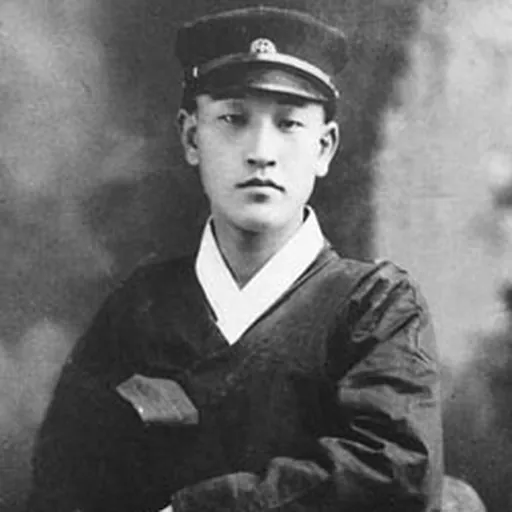
About Yi Sang-hwa
Lived 1901 – 1943 (aged 42). Yi Sang-hwa was a Korean poet.
Yi Sang-hwa (; also Lee Sang-hwa; 1901–1943) was a Korean nationalist poet active in the resistance to Japanese rule.
Biography Yi Sang-hwa, who sometimes published under the names Muryang, Sanghwa, and Baega, was born April 5, 1901, in Daegu, Joseon. He graduated from Jungdong High School in Seoul. He then went to Japan, where he studied French literature. In 1923, he returned to Korea and taught English and French in a Daegu high school. According to Choe Chong-dae, "His reputation grew as a young promising poet after composing the poem entitled 'Does spring come to these stripped lands?' in 1926, which was published in the 70th edition Magazine of Kaebyuk, the contents of which led to the magazine being suspended by the authorities. Yi worked as a teacher for the Kyonam School (now the Daeryun Junior High School) and as a Director of the Daegu Choson Ilbo.
Yi participated in the March 1st Movement of March 1, 1919 in Daegu, which sought to restore Korean sovereignty. In 1921, wishing to study in France, Yi went to Japan to study French language and literature, but ended up returning to Korea in 1923 after the Great Kanto earthquake. In the early twenties, he joined the White Tide (Baekjo) circle along with Hong Sayong, Park Jonghwa, Park Yeonghui, Kim Gijin, and others, and began his career in poetry with the publication of the poems "Joy of the Corrupt Age" (Malseui huitan), "Double Death" (Ijungui samang), and "Toward my bedchamber" (Naui chimsillo) in the journal Torch (Geohwa).
In 1925, however, prompted by the growing concern that was the reality of Japanese imperialism in Korea, Lee made a sudden and decisive break with this poetic world. Assuming the identity of a nationalist poet, Lee began to write poems of defiance and resistance against colonial rule. Because the restrictions of The Times were such that he felt himself unable to express his political frustrations directly, his views tend to manifest themselves in nature symbols such as expressions of the homeland's natural beauty and depiction of the plight of individuals, such as Korean immigrants to Manchuria, deprived of everything by their oppressors. The series of poems from this late period that include "Does Spring Come to These Stolen Fields?" (Ppaeatgin deuredo bomeun oneunga?), for example, reveal Lee's spirit of resistance in just this way.
....What am I looking for? Soul, my blind soul, endlessly darting like children at play by the river, answer me: where am I going? Filled with the odor of grass, compounded of green laughter and green sorrow, limping along, I walk all day, as if possessed by the spring devil: for these are stolen fields, and our spring is stolen.
Legacy A monument was erected in memory of the poet in Daegu's Dalseong Park in 1948 and his collected poems were published in 1951. Yi's neglected house was restored and opened in 2005, with memorabilia pertaining to the poet and the resistance.
Don’t just read it —
keep it.
Full-length biographies made to live with: read them, listen on the way to work, watch them tonight.
- E-book
- Audio
- Video
Instant download · yours to keep · every purchase keeps this site free
Important facts
Related people
Same field, nearest in time



Contemporaries
People whose lives overlapped Yi Sang-hwa's


Frequently asked questions
Who was Yi Sang-hwa?
Korean poet (1901–1943)
When was Yi Sang-hwa born?
Yi Sang-hwa was born on 5 April 1901 in Daegu.
When did Yi Sang-hwa die?
Yi Sang-hwa died on 25 April 1943.
What was Yi Sang-hwa's occupation?
Yi Sang-hwa was a poet.
What nationality was Yi Sang-hwa?
Yi Sang-hwa was Korean.
Sources & further reading
Cite this page
APA: Biography.guide. (2026). Yi Sang-hwa. https://biography.guide/yi-sang-hwa/
MLA: "Yi Sang-hwa." Biography.guide, https://biography.guide/yi-sang-hwa/.
Chicago: "Yi Sang-hwa." Biography.guide. https://biography.guide/yi-sang-hwa/.
Data last updated: 2026-09-23 · Spot an error? Report a correction.
Portrait: Wikimedia Commons · author & licence
Page generated 2026-09-27 05:07 UTC