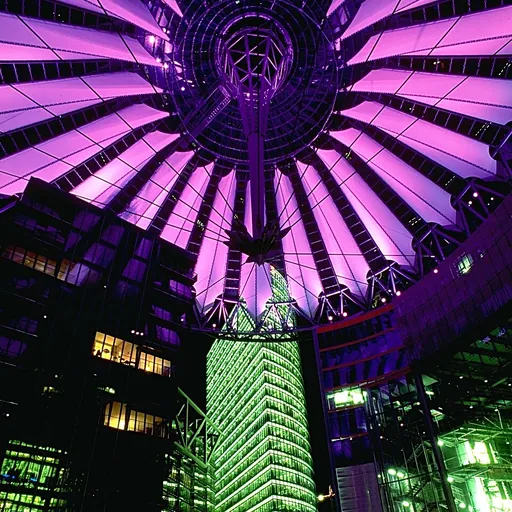
About Yann Kersalé
Born 1955. Yann Kersalé is a French visual artist.
Yann Kersalé (born 17 February 1955) is a French conceptual artist who works with light. His studio is in Vincennes.
Life and career Kersalé was born in Boulogne-Billancourt, a suburb of Paris, and spent part of his childhood in the Breton port town of Douarnenez. He graduated from the École des Beaux-Arts in Quimper in 1978. Beginning in 1984 at the Société métallurgique in Caen, He has worked with Helmut Jahn on the Sony Center in Berlin and the Bangkok and Chicago O'Hare airports and with Jean Nouvel on the Lyon Opera House, the Torre Agbar in Barcelona, the Musée du quai Branly, the Philharmonie concert hall in Paris, and the Abu Dhabi branch of the Louvre Museum. He has also been commissioned to design projects for numerous cities, including Nantes, Rennes, Saint-Nazaire, Le Havre, Cherbourg, Bordeaux, and Montpellier in France and Bangkok, Quebec City, Frankfurt, Berlin, Las Vegas, Washington, DC, Lisbon, Brussels, and St Petersburg in other countries. In 2007 alone, he worked in Luxembourg, Paris, and Korea. and in 2010 the Jallum lighting units for Baccarat, rechargeable and dimmable LED lights in cut crystal cylinders on anodised aluminium bases for indoor or outdoor use.
Artistic philosophy Kersalé rejects the label of either architect or light artist, preferring that of "project artist". He has chosen the night, "the locus of choice of what is perceived", to create "luminous fictions, a narrative work on the spirit and memory of cities." However, he "fights ceaselessly against artificial lighting that kills authentic nocturnality and masks the sky", which has led him to create innovative new forms of illumination. In 2011, a reviewer in Le Figaro called him "a passionate fan of chiaroscuro" who loves to plunge viewers into an "abyss" of total darkness to maximise their perception of the surprising narrative fantasies he constructs with light.
He regards his work for cities as a form of urban renewal, reclaiming areas where people can stroll safely at night, and saving industrial artifacts that might otherwise be destroyed. and his project at the submarine base in Saint-Nazaire transformed a liability that was to have been demolished into a civic asset. The base is now a cultural centre with shops and a museum, and Barcelona architect Manuel de Solà-Morales redesigned the surrounding area.
Selected works
Temporary installations Le songe est de rigueur, Pointe de la Torche, Finistère, 1986. Computerised projection of light patterns on the ocean in response to "the movements of the tides, the currents, the wind and so forth" against "a set of stranded, wide-eyed, steel megaliths". Kersalé describes it in an interview as intended as "a kind of encephalogram of the sea". Irréversibles lumières, Grand Palais, Paris, 1987. Blue fluorescent lighting inside the glass dome waxing and waning forty times a minute to produce the effect of a beating heart or a respiring lung, while the metal framing the glass was picked out in white. Convergence, Grand Place, Brussels, 2008. Illumination as part of the European Cultural Season, organised by invitation by the French government, using 2,209 LED modules (106,032 LEDs) to produce an inverted dome of lights over the square, to transform it into "an immense open-roofed ballroom".
Permanent installations
Nuit des docks, Saint-Nazaire, 1991. Night-time illumination of the docks, including a submarine base, in bright colours determined by analysis of the activity during the day. In Out, Sony Center, Berlin, 2000. Illumination of the atrium roof in a series of simulated sunsets approximately 21 seconds in duration from sunset to midnight; during the rest of the night the lighting is dark blue, except for bright white light preceding sunrise and also preceding sunset. Diffraction, Torre Agbar, Barcelona, 2005. Exterior illumination of the office tower built by Jean Nouvel causes it to "glow at night as a colorful monolith". Lighting patterns are created by 4,500 panels each containing 18 LEDs, which can create 255 degrees of intensity and over 16 million hues, each panel independently controlled by a computer responding to 20,000 inputs including weather conditions and building systems. The tower "vibrates in a play of primary and complementary colours." Kersalé has described the lighting as "a vaporous cloud of colour that seeks moiré". The lighting is installed between the building's façade and its glass skin; the lighted windows of people still at work contribute to the effect. Kersalé's intent was "to create a vault of calm blue suspended in the air, in opposition to the density of the activity on the ground".
Don’t just read it —
keep it.
Full-length biographies made to live with: read them, listen on the way to work, watch them tonight.
- E-book
- Audio
- Video
Instant download · yours to keep · every purchase keeps this site free
Important facts
People in Yann Kersalé's life
Named in this biography and alive at the same time


Related people
Same field, nearest in time



Contemporaries
People whose lives overlapped Yann Kersalé's

Frequently asked questions
Who is Yann Kersalé?
French artist
When was Yann Kersalé born?
Yann Kersalé was born on 17 February 1955 in Paris.
What is Yann Kersalé's occupation?
Yann Kersalé is a visual artist.
What nationality is Yann Kersalé?
Yann Kersalé is French.
Sources & further reading
Cite this page
APA: Biography.guide. (2026). Yann Kersalé. https://biography.guide/yann-kersale/
MLA: "Yann Kersalé." Biography.guide, https://biography.guide/yann-kersale/.
Chicago: "Yann Kersalé." Biography.guide. https://biography.guide/yann-kersale/.
Data last updated: 2026-09-20 · Spot an error? Report a correction.
Portrait: Wikimedia Commons · author & licence
Page generated 2026-09-27 04:58 UTC