
About Yagyū Munetoshi
Lived 1529 – 1606 (aged 76–77). Yagyū Munetoshi was a Japanese military commander.
Yagyū Sekishūsai Taira-no-Munetoshi (柳生石舟斎平宗厳 1527 – May 25, 1606) was a samurai in Japan's Sengoku period famous for mastering the Shinkage-ryū school of combat, and introducing it to the Tokugawa clan. He was also known as Shinsuke, or Shinzaemon.
Early life
Munetoshi was born Yagyū Shinsuke in 1529 in Yagyū village (present day Yagyū, Nara) in Yamato Province. His father, Ietoshi, was a minor landed lord. When Munetoshi was 12, Ietoshi joined a general named Kisawa Nagamasa in contesting the growing power of the warlord Miyoshi Chōkei. However, Kisawa was killed in battle, and the Yagyū found themselves on the defensive. With over half of Yamato Province under his control, Miyoshi left the rest of the conquest to his lieutenant, Tsutsui Junshō.
The Tsutsui and the Yagyū had feuded previously, and Junshō wasted no time. In 1544 he attacked the Yagyū at Yagyū Castle with some 10,000 men. According to the Tamon-in Nikki, a chronicle of the Kōfuku-ji temple, at first the Yagyū were caught by surprise, but Ietoshi rallied his troops for a defensive battle. Munetoshi, a young man of 15, ably led a small troop of his own. The Tsutsui troops surrounded the castle, burned the surrounding houses and villages, took control of the outer castle and cut off the water supply, but the main castle still held out. The Yagyū held out for three days, but they were greatly outnumbered, and had no choice but to capitulate, and submit to the Tsutsui. One message sent by Junshō's son Fujikatsu to Ietoshi singles out Munetoshi in particular for praise.
In 1559, the warlord Matsunaga Hisahide decided to attack the Tsutsui and take control of Yamato Province. He sent a message to Munetoshi promising to restore their old lands and position to the Yagyū in exchange for their service. The Tsutsui were overthrown, and the Yagyū grew prominent under Matsunaga. In particular, Matsunaga gave Munetoshi a citation for valor for his performance in a battle at To'unomine. Matsunaga's attempt to take the mountain was repulsed, and Munetoshi fought in the rearguard as the army retreated. He was wounded, but fighting with a spear he killed several of the enemy. Munetoshi almost did not survive the battle, but a retainer named Matsuda Muneshige sacrificed his life to save Munetoshi's. But "Kantori" may simply be a misreading of kanji meant to read “Katori”, thus signifying "Katori Shintō-ryū". An Edo Yagyū family record suggests that he studied Toda-ryū, a branch of Chūjō-ryū. All family records and Munetoshi's own surviving writings suggest that he was an enthusiastic student of the military arts from a young age, before he met Kamiizumi Hidetsuna. Munetoshi continued to teach Shinkage-ryū, in particular to his grandson Hyōgonosuke Toshitoshi, and Takeda Ujikatsu, the head of the Konparu-ryū school of Noh theater. In the Edo Yagyū line of Munenori, only Jūbei Mitsutoshi was given the 厳 character, but from the 5th head of the family on, the character 俊 was used, also read “toshi”.
When historians first came across the name 宗厳 they had no way to be sure how the name was read. The only suggestion for pronunciation in Yagyū family records was Songon, the Chinese-reading of the characters, which Munetoshi took upon taking the name “Sekishūsai”. One late 18th century record of family lineages, the Kansei Choshu Shokafu, noted “Muneyoshi” as the pronunciation. Starting with the release of Shōden Shinkage-ryū, by Yagyū Toshinaga, in 1955, the Yagyū family pronunciation has become more common than before.
In legend and fiction
Like many other great figures in Japanese history, Munetoshi has become a popular figure in literature, movies, video games and other media, and has accumulated a number of exaggerated tales and legends about him. In Yagyū Village, near the Yagyū family burial ground, is a large rock called Itto-seki, which has been split in half. Though it was most probably split by lightning or earthquake, legend says that Munetoshi cleaved it himself with his sword.
In the 2017 video game Nioh, he appears as a side quest boss for unlocking the Sword Mystic Art skills.
In the 2003 Taiga drama series Musashi (based from Eiji Yoshikawa's Musashi), Sekishusai was played by Makoto Fujita.
Don’t just read it —
keep it.
Full-length biographies made to live with: read them, listen on the way to work, watch them tonight.
- E-book
- Audio
- Video
Instant download · yours to keep · every purchase keeps this site free
Important facts
People in Yagyū Munetoshi's life
Named in this biography and alive at the same time

Related people
Same field, nearest in time


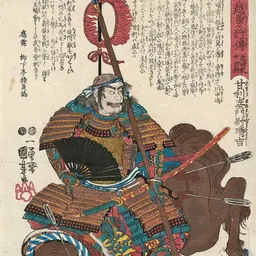
Contemporaries
People whose lives overlapped Yagyū Munetoshi's

Frequently asked questions
Who was Yagyū Munetoshi?
samurai in Japan’s Sengoku period
When was Yagyū Munetoshi born?
Yagyū Munetoshi was born in 1529 in Nara.
When did Yagyū Munetoshi die?
Yagyū Munetoshi died on 25 May 1606 in Yagyū.
What was Yagyū Munetoshi's occupation?
Yagyū Munetoshi was a military commander.
What nationality was Yagyū Munetoshi?
Yagyū Munetoshi was Japanese.
Sources & further reading
Cite this page
APA: Biography.guide. (2026). Yagyū Munetoshi. https://biography.guide/yagyu-munetoshi/
MLA: "Yagyū Munetoshi." Biography.guide, https://biography.guide/yagyu-munetoshi/.
Chicago: "Yagyū Munetoshi." Biography.guide. https://biography.guide/yagyu-munetoshi/.
Data last updated: 2026-09-20 · Spot an error? Report a correction.
Page generated 2026-09-27 05:30 UTC