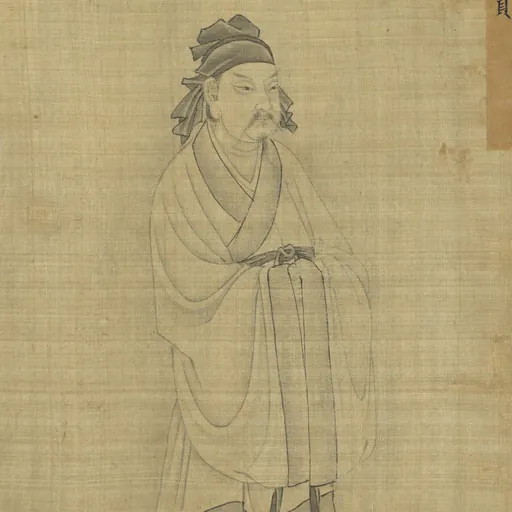
Wu Zixu
Chinese Wu kingdom general and politician (died 484 BC)
About Wu Zixu
Lived 526 BC – 483 BC (aged 42–43). Wu Zixu was a politician, soldier, writer and philosopher.
Note: names are in simplified characters followed by traditional and Pinyin transliteration.
Wu Yun (died 484 BC), better known by his courtesy name Zixu, was a Chinese military general and politician of the Wu kingdom in the Spring and Autumn period (722–481 BC). Since his death, he has evolved into a model of loyalty in Chinese culture. He is the best known historical figure with the Chinese family name "Wu" . All branches of the Wu clan claim that he was their "first ancestor".
Classical sources The historical records of Wu are found in the famous Chinese classics: Records of the Grand Historian (史記; Shǐjì) by Sima Qian, The Art of War by Sun Tzu and The Annals of Lü Buwei. He is also mentioned in Guliang Zhuan and Gongyang Zhuan. The accounts differ, showing the significant influence of folklore on his historical character.
Life
Early life Wu Zixu was the second son of Wu She, the Grand Tutor of the crown prince Jian of the state of Chu. In 522 BC, Fei Wuji, a corrupt official was sent to Qin to select a bride for the prince. King Ping of Chu received a princess from the state of Qin as a bride for his son, but decided to keep her for himself upon seeing her beauty. Fei Wuji, having gained favour from the King, convinced King Ping that Wu She and the crown prince himself would start a rebellion due to the bride being from Qin, and persuaded the king to execute Wu She. Before his death, Wu She was forced, under duress, to send a letter to his sons, Wu Shang and Wu Zixu, which asked them to join him in the capital. While both realized that this was a trap, Wu Shang decided to go to the capital to die with his father. Wu Zixu, promising revenge, fled to the state of Wu.
Escape Huai River moon — Wu Zixu, from Yoshitoshi's series One Hundred Aspects of the Moon, depicting Wu Zixu's escape from Chu on the Huai River. Wu Zixu, along with Prince Jian's son, Prince Sheng, hoped to flee to the state of Wu. Wu Zixu, however, was a wanted man. He and the young prince were constantly pursued by soldiers. King Ping also ordered a very tight controls over the state's borders to catch Wu Zixu. As Wu Zixu approached Zhaoguan , the last pass to the state of Wu, he sought the help of the physician Donggao Gong , who recognized him as Wu She's son. Donggao Gong felt deep sympathy for Wu Zixu's plight and offered to help him escape across the border.
According to legend, Donggao Gong gave refuge to Wu Zixu in his home for a week. Under enormous stress, Wu Zixu's hair turned completely white and his facial features aged greatly. The change was a blessing in disguise as Wu Zixu's changed appearance helped him to escape and head to the state of Wu.
Campaign against the state of Chu
In the state of Wu, Wu Zixu became a trusted advisor of Prince Guang and helped him assassinate his uncle (or cousin, according to Records of the Grand Historian) King Liao of Wu. Prince Guang ascended the throne and was known as King Helü of Wu.
In 506 BCE, during the reign of King Zhao of Chu, King Helü decided to invade Chu. The king personally led the army, along with his younger brother Fugai, Wu Zixu, as well as Sun Tzu, author of The Art of War. Although Chu had a strong army led by Nang Wa and Shen Yinshu, it suffered a heavy defeat at the Battle of Boju. King Zhao of Chu fled to Sui and the Wu army captured Ying, Chu's capital. After entering Ying, Wu Zixu exhumed King Ping's corpse, and gave it 300 lashes to exact vengeance. He was also long considered the god of the tidal bore of the Qiantang River near Hangzhou and continues to be worshipped, particularly by Taiwanese Taoists, as one of the five Kings of the Water Immortals.
Double Fifth festival Some Chinese believe that the Dragon Boat Festival (the Double-Fifth festival celebrated on the fifth day of the fifth lunar month) usually associated with the suicide of the poet Qu Yuan (d. 278 BC) originally commemorated the death of Wu Zixu (484 BC), whose body was thrown into a river after his forced suicide. However, there are caveats. First of all, the practice of venerating Wu Zixu as a water deity can only be traced to the time of the Han dynasty (202 BC–220 AD).Refn|The 6th century source (, "Record of the Year and Seasons of Jing-Chu") claims "[Wu] Zixu is the correct antecedent", citing a pseudo-Han Period documentary evidence ("Stele Inscription on the Filial Daughter Maiden [Cao E]").
Don’t just read it —
keep it.
Full-length biographies made to live with: read them, listen on the way to work, watch them tonight.
- E-book
- Audio
- Video
Instant download · yours to keep · every purchase keeps this site free
Important facts
People in Wu Zixu's life
Named in this biography and alive at the same time


Related people
Same field, nearest in time




Contemporaries
People whose lives overlapped Wu Zixu's

Frequently asked questions
Who was Wu Zixu?
Chinese Wu kingdom general and politician (died 484 BC)
When was Wu Zixu born?
Wu Zixu was born in 526 BC in Jianli.
When did Wu Zixu die?
Wu Zixu died in 483 BC in Wu.
What was Wu Zixu's occupation?
Wu Zixu was a politician, soldier, writer and philosopher.
What nationality was Wu Zixu?
Wu Zixu's recorded nationality: Wu.
Sources & further reading
Cite this page
APA: Biography.guide. (2026). Wu Zixu. https://biography.guide/wu-zixu/
MLA: "Wu Zixu." Biography.guide, https://biography.guide/wu-zixu/.
Chicago: "Wu Zixu." Biography.guide. https://biography.guide/wu-zixu/.
Data last updated: 2026-09-20 · Spot an error? Report a correction.
Portrait: Wikimedia Commons · author & licence
Page generated 2026-09-27 04:57 UTC