
About Wolrad IV of Waldeck-Eisenberg
Lived 1588 – 1640 (aged 52). Wolrad IV of Waldeck-Eisenberg was a German aristocrat.
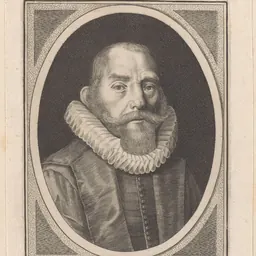
Count Wolrad IV 'the Pious' of Waldeck-Eisenberg (7 July 1588 – 6 October 1640), , official titles: Graf zu Waldeck und Pyrmont, was since 1588 Count of Waldeck-Eisenberg. He founded of the new line of Waldeck-Eisenberg.
Never before was the independence of the County of Waldeck more threatened by Hesse than during the reign of Count Wolrad IV. Together with his elder brother Christian, however, he later successfully continued the sovereignty-oriented territorial policy of their father Josias I. They made use of the legal possibilities and chose during the for Waldeck disastrous Thirty Years' War the for them favourable side of Sweden. However, neither count lived to see the end of the war and with it the conflict with Hesse.
Biography
Wolrad was born at Eisenberg Castle on 7 July 1588 as the second son of Count Josias I of Waldeck-Eisenberg and Countess Mary of Barby and Mühlingen. He was baptised at Eisenberg Castle on 4 August. In that same year the County of Waldeck was divided up again. For although Wolrad and Christian clearly acted jointly in government, they are said to have quarrelled regularly.
From the beginning of their reigns in 1607 and 1604 respectively, Wolrad and Christian followed their father's policy entirely. After the long years of regency and thus the lack of an active policy adapted to the needs of the time, this would turn out to be very unpleasant for the young counts. Due to the long period of political stagnation, the now revived attempts to reorganise the country internally and at the same time the limitation of the feudal rights externally acted as a sharp caesura for the County of Waldeck.
Both counts had their imperial immediacy confirmed shortly after Matthias' coronation as Emperor on 20 January 1612, at which Christian was present. But this did not secure the county's sovereignty. From 1610 onwards Wolrad and Christian had continued their father's efforts to control the largest and most influential city in the county. The controversial question of the highest jurisdiction in Waldeck, which the counts had answered in their favour, led initially to the Reichskammergericht. The judicial mills grinded slowly. the situation had become so intense that Landgrave Maurice occupied the county – with the exception of and Arolsen. The county was to be annexed by Hesse. Waldeck was in danger of losing its independence more than ever before. The two Counts of Waldeck did not give up. The Wetterauer Grafenverein had sent soldiers to Waldeck, who were trapped in the castle together with Count John VII 'the Middle'. whose life Christian had saved during a hunt. The policy of Landgrave Maurice did not go unnoticed in the Holy Roman Empire, despite the fact that the Bohemian-Palatinate War was of greater importance. Under pressure from the Emperor and others and threats of disadvantages, the landgrave ended the occupation of Waldeck in the summer of 1621.
After the acute threat to the county had been averted, Wolrad and Christian did not give up and tried, through the Reichskammergericht and the Reichshofrat, to get legally closer to their goal. Moreover, they demanded compensation for the damage that the soldiers of the Hessian landgrave had caused in Waldeck during the occupation. After lengthy negotiations, Emperor Ferdinand II obliged Landgrave Maurice in 1630 to pay. The negotiations ended in a settlement in Kassel in 1632.
In contrast to the favourable developments for the counts, there were the devastating consequences of the Thirty Years' War. The acquisition of the County of Pyrmont, which lies almost 90 kilometres north of the County of Waldeck, proved to be difficult, because, as in previous years, the Prince-Bishopric of Paderborn laid claim to it. Prince-bishop Ferdinand I had the county occupied in 1629 and besieged Pyrmont Castle, forcing its surrender after ten months. However, in 1631 Christian met King Gustavus II Adolphus of Sweden, changed sides during the war and secured the county's support from the great power. After Sweden's victory over the imperial forces in June 1633 at the Battle of Oldendorf, Pyrmont was also taken a short time later and returned to Sweden's ally Waldeck. Mary Elisabeth (Eisenberg Castle, 2 September 1608 – Basel, 19 February 1643), was since 2 October 1620 Stiftsfrau in Gandersheim Abbey, became deaconess on 30 March 1626. Was since 1623 also Abbess of . Married at Karlsburg Castle on 12 January 1634 to Margrave Frederick V of Baden-Durlach (Sulzburg, 6 July 1594 – Karlsburg Castle, 8 September 1659). Josias Floris (Arolsen, 23 juli 1612 – , 1 February 1613). Count Philip Theodor (2 November 1614 – Korbach, 7 December 1645), succeeded his father in 1640. Married in Culemborg on 25 August 1639 to Countess Mary Magdalene of Nassau-Siegen (, 21 October 1622 – Spa, 20/30 August 1647 to Countess Elisabeth Charlotte of Nassau-Siegen (Emmerich, 11 March 1626 ("Born on 11-2-1626 at Europäische Stammtafeln I, 117; on 8-2-1626 at Europäische Stammtafeln I, 139 and on 11-3-1626 at Dek (1970).) The latter date is confirmed by a notification preserved in the State Archives Marburg (115, Waldeck, 2) and dated Emmerik 12-3-1626: «gestriges tagks umb zwo Uhren vormittags»." Great-great-grandparents
Gebhard VII of Mansfeld-Hinterort(1478–1558)⚭ 1510Margaretha of Gleichen(ca. 1495–1567)
Great-grandparents
Grandparents
Parents
Literature
Don’t just read it —
keep it.
Full-length biographies made to live with: read them, listen on the way to work, watch them tonight.
- E-book
- Audio
- Video
Instant download · yours to keep · every purchase keeps this site free
Important facts
Related people
Same field, nearest in time






Contemporaries
People whose lives overlapped Wolrad IV of Waldeck-Eisenberg's




Frequently asked questions
Who was Wolrad IV of Waldeck-Eisenberg?
German count
When was Wolrad IV of Waldeck-Eisenberg born?
Wolrad IV of Waldeck-Eisenberg was born on 7 July 1588 in Korbach.
When did Wolrad IV of Waldeck-Eisenberg die?
Wolrad IV of Waldeck-Eisenberg died on 6 October 1640 in Bad Arolsen.
What was Wolrad IV of Waldeck-Eisenberg's occupation?
Wolrad IV of Waldeck-Eisenberg was an aristocrat.
What nationality was Wolrad IV of Waldeck-Eisenberg?
Wolrad IV of Waldeck-Eisenberg was German.
Sources & further reading
· Wikipedia: Wolrad IV of Waldeck-Eisenberg
· DBpedia: Wolrad IV of Waldeck-Eisenberg
Cite this page
APA: Biography.guide. (2026). Wolrad IV of Waldeck-Eisenberg. https://biography.guide/wolrad-iv-of-waldeck-eisenberg/
MLA: "Wolrad IV of Waldeck-Eisenberg." Biography.guide, https://biography.guide/wolrad-iv-of-waldeck-eisenberg/.
Chicago: "Wolrad IV of Waldeck-Eisenberg." Biography.guide. https://biography.guide/wolrad-iv-of-waldeck-eisenberg/.
Data last updated: 2026-09-20 · Spot an error? Report a correction.
Page generated 2026-09-27 05:01 UTC