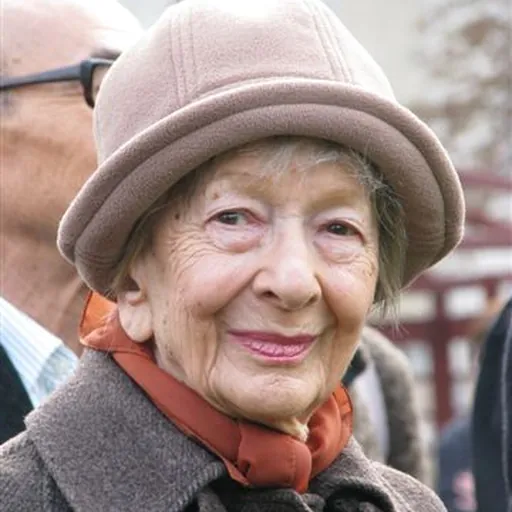
About Wisława Szymborska
Lived 1923 – 2012 (aged 88). Wisława Szymborska was a Polish poet, writer, translator, essayist, mechanic and literary critic.
Maria Wisława Anna Szymborska (; 2 July 1923 – 1 February 2012) was a Polish poet, essayist, translator, and recipient of the 1996 Nobel Prize in Literature. Born in Prowent (now part of Kórnik in west-central Poland), she resided in Kraków until the end of her life.
Szymborska was awarded the 1996 Nobel Prize in Literature "for poetry that with ironic precision allows the historical and biological context to come to light in fragments of human reality". She became better known internationally as a result. Her work has been translated into many European languages, as well as into Arabic, Hebrew, Japanese, Persian and Chinese.
Life
Wisława Szymborska was born on 2 July 1923 in Prowent, the second daughter of Wincenty Szymborski and Anna (née Rottermund) Szymborska. Her father was, at that time, the steward of Count Władysław Zamoyski, a Polish patriot and charitable patron. After Zamoyski's death in 1924, her family moved to Toruń, and in 1931 to Kraków, where she lived and worked until her death in early 2012.
Szymborska adhered to the People's Republic of Poland's (PRL) official ideology early in her career. For example, during the Polish anti-religious campaign, she signed an infamous 1953 political petition condemning Polish priests accused of treason in a Kraków show trial. Her early work supported socialist themes, as seen in her debut collection Dlatego żyjemy (That is what we are living for), containing the poems "Lenin" and "Młodzieży budującej Nową Hutę" ("For the Youth who are building Nowa Huta"), about the construction of a Stalinist industrial town near Kraków.
Although initially close to the official party line, as the Polish Communist Party shifted from the Stalinist communists to "national" communists, Szymborska grew estranged from socialist ideology and renounced her earlier political work.
In 1953, Szymborska joined the staff of the literary review magazine Życie Literackie (Literary Life), where she continued to work until 1981 and from 1968 had a book review column, Lektury Nadobowiązkowe. She was working on new poetry at the time of her death, but was unable to arrange her final poems for publication in the way she wanted. Her last poetry was published later in 2012. In 2013, the Wisława Szymborska Award was established in honour of her legacy.
In 2024, the Wisława Szymborska Foundation president Michał Rusinek signed an agreement with Polskie Radio's OFF Radio Krakow for the rights to use her voice recordings for generated speech to be used for an interview-like programme. The programme, broadcast on 29 October that year, was swiftly condemned by both Polish audiences and media producers.
Themes Szymborska frequently employed literary devices such as ironic precision, paradox, contradiction, and understatement to illuminate philosophical themes and obsessions. Many of her poems feature war and terrorism. She wrote from unusual points of view, such as a cat in the newly empty apartment of its dead owner.
Her poem "Love at First Sight" was used in the film Turn Left, Turn Right, starring Takeshi Kaneshiro and Gigi Leung. Krzysztof Kieślowski's film Three Colors: Red was also inspired by "Love at First Sight".
In her last year, Szymborska collaborated with Polish jazz trumpeter Tomasz Stańko, who dedicated his record Wisława (ECM, 2013) to her memory, taking inspiration from their collaboration and her poetry.
Szymborska's poem "People on the Bridge" was made into a film by Beata Poźniak. It was shown worldwide and at a New Delhi film festival. As an award, it was screened 36 more times in 18 Indian cities.
The poem Nothing Twice (Nic dwa razy) has inspired multiple musical adaptations, including Łucja Prus's performance at the 1965 Sopot International Song Festival and Maanam's song Nic dwa razy, from their 1994 album Róża. In 2022, Sanah adapted the poem into a song as part of her project based on Polish poetry, Sanah śpiewa Poezyje.
Major works Wisława Szymborska and President Bronisław Komorowski at the Order of the White Eagle award ceremony in January 2011.
1952: Dlatego żyjemy ("That's Why We Are All Alive") 1954: Pytania zadawane sobie ("Questioning Yourself") 1957: Wołanie do Yeti ("Calling Out to Yeti") 1962: Sól ("Salt") 1966: 101 wierszy ("101 Poems") 1967: Sto pociech ("No End of Fun") 1967: Poezje wybrane ("Selected Poetry") 1972: Wszelki wypadek ("Could Have") 1976: Wielka liczba ("A Large Number") 1986: Ludzie na moście ("People on the Bridge") 1989: Poezje. Poems, bilingual Polish-English edition 1992: Lektury nadobowiązkowe ("Non-required Reading") 1993: Koniec i początek ("The End and the Beginning") 1996: Widok z ziarnkiem piasku ("View with a Grain of Sand") 1997: Sto wierszy – sto pociech ("100 Poems – 100 Happinesses") 2002: Chwila ("Moment") 2003: Rymowanki dla dużych dzieci ("Rhymes for Big Kids") 2005: Dwukropek ("Colon") 2005: Monolog psa zaplątanego w dzieje ("Monologue of a Dog Ensnared in History") 2009: Tutaj ("Here") 2012: Wystarczy ("Enough") 2013: Błysk rewolwru ("The Glimmer of a Revolver")
Prizes and awards
1954: The City of Kraków Prize for Literature 1963: The Polish Ministry of Culture Prize 1974: Knight's Cross of the Order of Polonia Restituta 1990: Kościelski Award 1991: Goethe Prize 1995: Herder Prize 1995: Honorary Degree of the Adam Mickiewicz University (Poznań) 1996: The Polish PEN Club prize 1996: Nobel Prize in Literature 1996: Person of the Year by Wprost 1997: Honorary Resident of the Royal Capital City of Kraków 2005: Gold Medal for Merit to Culture - Gloria Artis 2011: Order of the White Eagle
Reviews 1998 Boston Review: Poems – New and Collected 1957–1997 by Frances Padorr Brent 2001 The New Republic: "Miracle Fair: Selected Poems of Wislawa Szymborska" by Ruth Franklin 2006 The Christian Science Monitor: A fascinating journey with two women poets by Elizabeth Lund 2006 Moondance magazine: Stories/Poems. Plain and Simple. – Mapping the Words of Wislawa Szymborska on Her Latest Book, Monologue of a Dog by Lys Anzia 2006 Sarmatian Review: Wislawa Szymborska's 'Conversation With a Stone' – An Interpretation by Mary Ann Furno 2006 Words Without Borders: Monologue of a Dog – New Poems of Wislawa Szymborska by W. Martin 2015 All roads will lead you home Poetic Alchemy: Wislawa Szymborska's Map: Collected and Last Poems by Wally Swist [vacpoetry.org/journal/]
Don’t just read it —
keep it.
Full-length biographies made to live with: read them, listen on the way to work, watch them tonight.
- E-book
- Audio
- Video
Instant download · yours to keep · every purchase keeps this site free
Important facts
People in Wisława Szymborska's life
Named in this biography and alive at the same time






Related people
Same field, nearest in time

Contemporaries
People whose lives overlapped Wisława Szymborska's

Frequently asked questions
Who was Wisława Szymborska?
Polish poet, Nobel Prize winner (1923–2012)
When was Wisława Szymborska born?
Wisława Szymborska was born on 2 July 1923 in Prowent.
When did Wisława Szymborska die?
Wisława Szymborska died on 1 February 2012 in Kraków.
What was Wisława Szymborska's occupation?
Wisława Szymborska was a poet, writer, translator, essayist, mechanic and literary critic.
What nationality was Wisława Szymborska?
Wisława Szymborska was Polish.
Sources & further reading
· Wikipedia: Wisława Szymborska
Cite this page
APA: Biography.guide. (2026). Wisława Szymborska. https://biography.guide/wislawa-szymborska/
MLA: "Wisława Szymborska." Biography.guide, https://biography.guide/wislawa-szymborska/.
Chicago: "Wisława Szymborska." Biography.guide. https://biography.guide/wislawa-szymborska/.
Data last updated: 2026-09-20 · Spot an error? Report a correction.
Portrait: Wikimedia Commons · author & licence
Page generated 2026-09-27 05:27 UTC