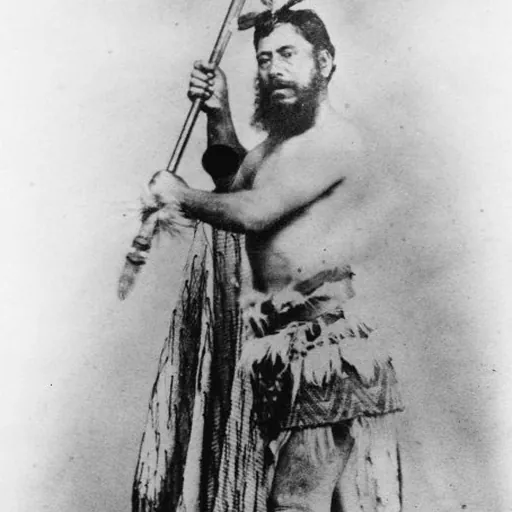
Wiremu Te Rangikāheke
Ngati Rangiwewehi leader, scholar, public servant
About Wiremu Te Rangikāheke
Lived 1850 – 1896 (aged 45–46). Wiremu Te Rangikāheke was a New Zealand.
Te Rangikāheke (ca. 1815-1896), also known as Wiremu Maihi (William Marsh) by his baptismal name or Wī Maihi Te Rangikāheke was a New Zealand Māori tribal leader, and a writer, speaker, politician and, for many years, an employee of the early New Zealand government. He descended from the iwi (tribe) of Ngāti Rangiwewehi from Awahou on the northern shores of Lake Rotorua in New Zealand. Born around 1815 in the Bay of Plenty region, he played a crucial role in the preservation and documentation of Māori oral traditions and history.
Early life and education Little is known about Te Rangikāheke's early life and education in Māori lore and tradition, but in 1835, Thomas and Anne Chapman set up a Church Missionary Society mission at Te Koutu in Rotorua where Te Rangikāheke learnt to read and write in English. These would become some of the most important skills in his life.
Career Te Rangikāheke became a pivotal figure in recording Māori lore, traditions, and historical narratives. His collaboration with Sir George Grey, the Governor of New Zealand, was particularly significant. Between 1849 and 1854, Te Rangikāheke worked closely with Grey, who had a keen interest in Māori culture and history. During this period, Te Rangikāheke wrote numerous manuscripts that provided detailed accounts of Māori mythology, customs, and social structures. Te Rangikāheke authored over 800 pages of Māori manuscripts, covering language, genealogies, legends, traditions, contemporary history, political commentary, customs, proverbs, songs, literary critique, and autobiography. His manuscripts provided most of the prose for the appendices in Sir George Grey’s works: Ko Nga Moteatea me Nga Hakirara Maori (1853), Ko Nga Mahinga a Nga Tupuna Maori (1854), and its translation, Polynesian Mythology (1855). Consequently, Te Rangikāheke's writings form a significant part of the earliest records of Māori history and culture. Te Rangikāheke made his first visits to Auckland, the capital, in 1842 and 1843, recorded by Lady Martin, the wife of the then Chief Justice, on whom he called. Letters Te Rangikāheke wrote to Grey on 13 May and 13 June 1851 indicate that Mere Pinepire was with him and their children during his work with Grey. Te Rangikāheke also married Tīrangi Repora, who had previously been Hataraka's wife. Te Rangikāheke produced the earliest literature on Māori leadership, Te Tikanga o Tēnei Mea te Rangatiratanga o te Tangata Māori (1850). This helped to inform the development of contemporary literature on Māori leadership like Te Kai a te Rangatira – Leadership from the Māori world (2020).
Selected works/publications Te Rangikāhke. (1849). Tupuna : [Address to the inhabitants of Hawaiki]. Grey New Zealand Collection. Te Rangikāheke. (1949). Maori religious beliefs and observances : genealogy : accounts of the Ancestors : waiata and whakatauki]. Grey New Zealand Collection. Te Rangikāheke. (1850). Te Tikanga o Tēnei Mea te Rangatiratanga o te Tangata Māori. Te Rangikāheke. (1854). Description of the ceremonies observed on the occasion of tattooing a chief and the method of performing the operation. Grey New Zealand Collection. Te Rangikāheke. (1992). The story of Māui. University of Canterbury.
Further information Jenifer Mary Curnow - Wiremu Maihi Te Rangikaheke : His life and work. (n.d.). Auckland War Memorial Museum. Retrieved May 19, 2024, from https://www.aucklandmuseum.com/collection/object/am_library-manuscriptsandarchives-2379 Kupu_TV. (2022, June 14). Wiremu Maihi Te Rangikāheke - Rethinking Oral History | Tarimano Marae, Awahou | Kupu Festival 2022. YouTube. https://www.youtube.com/watch?v=_H0N_KL-snk National Library of New Zealand. (2024). Te Rangikaheke, Wiremu Maihi, - 1896. https://natlib.govt.nz/records/22356611 Loader, A.M. (2008). Haere mai me tuhituhi he pukapuka; Muri iho ka whaiwhai ai tātou; Reading Te Rangikāheke [Master's thesis, Victoria University of Wellington]. Te Waharoa. https://openaccess.wgtn.ac.nz/articles/thesis/Haere_Mai_Me_Tuhituhi_He_Pukapuka_Muri_Iho_Ka_Whawhai_Ai_Tatou_Reading_Te_Rangikaheke/16967293/1
Don’t just read it —
keep it.
Full-length biographies made to live with: read them, listen on the way to work, watch them tonight.
- E-book
- Audio
- Video
Instant download · yours to keep · every purchase keeps this site free
Important facts
People in Wiremu Te Rangikāheke's life
Named in this biography and alive at the same time




Contemporaries
People whose lives overlapped Wiremu Te Rangikāheke's



Frequently asked questions
Who was Wiremu Te Rangikāheke?
Ngati Rangiwewehi leader, scholar, public servant
When was Wiremu Te Rangikāheke born?
Wiremu Te Rangikāheke was born in 1850.
When did Wiremu Te Rangikāheke die?
Wiremu Te Rangikāheke died in 1896.
What nationality was Wiremu Te Rangikāheke?
Wiremu Te Rangikāheke was New Zealand.
Sources & further reading
· Wikipedia: Wiremu Te Rangikāheke
Cite this page
APA: Biography.guide. (2026). Wiremu Te Rangikāheke. https://biography.guide/wiremu-te-rangikaheke/
MLA: "Wiremu Te Rangikāheke." Biography.guide, https://biography.guide/wiremu-te-rangikaheke/.
Chicago: "Wiremu Te Rangikāheke." Biography.guide. https://biography.guide/wiremu-te-rangikaheke/.
Data last updated: 2026-09-21 · Spot an error? Report a correction.
Portrait: Wikimedia Commons · author & licence
Page generated 2026-09-27 05:00 UTC