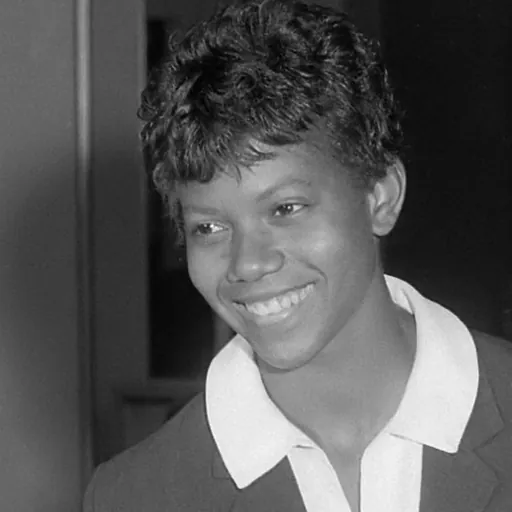
About Wilma Rudolph
Lived 1940 – 1994 (aged 54). Wilma Rudolph was an American sprinter.
Early life and education Wilma Rudolph was born prematurely to Blanche Rudolph at on June 23, 1940, in Saint Bethlehem, Tennessee (now part of Clarksville). She was the 20th of 22 children from her father Ed Rudolph's two marriages. Shortly after Wilma's birth, her family moved to Clarksville, Tennessee,
Rudolph had several early childhood illnesses, including pneumonia and scarlet fever, and she contracted infantile paralysis (caused by the poliovirus) at age five. Rudolph recovered from polio but lost strength in her left leg and foot. Physically disabled for much of her early life, Rudolph wore a leg brace until she was 12 years old. Because there was little medical care available to African American residents of Clarksville in the 1940s, Rudolph's parents sought treatment for her at the historically black Meharry Medical College (now Nashville General Hospital at Meharry) in Nashville, Tennessee, about from Clarksville.
For two years, Rudolph and her mother made weekly bus trips to Nashville for treatments to regain the use of her weakened leg. Because of the treatments she received at Meharry and the daily massages from her family members, Rudolph was able to overcome the debilitating effects of polio and learned to walk without a leg brace or orthopedic shoe for support by the time she was 12 years old. In college, Rudolph continued to compete in track. She also became a member of the Delta Sigma Theta sorority. In 1963, Rudolph graduated from Tennessee State with a bachelor's degree in education. Her college education was paid by her participation in a work-study scholarship program that required Rudolph to work on the TSU campus for two hours a day. As a high school sophomore, Rudolph competed at Alabama's Tuskegee Institute in her first major track event. Although she lost the race, Rudolph was determined to continue competing and win.
Rudolph was defeated in a preliminary heat of the 200-meter race at the Melbourne Olympic Games but ran the third leg of the 4 × 100 m relay. The American team of Rudolph, Isabelle Daniels, Mae Faggs, and Margaret Matthews, all of whom were TSU Tigerbelles, won the bronze medal, matching the world-record time of 44.9 seconds. The British team won the silver medal. The Australian team, with the 100- and 200-meter gold medalist Betty Cuthbert as their anchor leg, won the gold medal in a time of 44.5 seconds.
Rudolph was one of the most popular athletes of the 1960 Rome Olympics and emerged from the Olympic Games as "The Tornado, the fastest woman on earth." The Italians nicknamed her "La Gazzella Nera" ("The Black Gazelle"). The French called her "La Perle Noire" ("The Black Pearl"), as well as "La Chattanooga Choo-Choo." Along with other 1960 Olympic athletes such as Cassius Clay (later known as Muhammad Ali), Oscar Robertson, and Rafer Johnson, Rudolph became an international star due to the first worldwide television coverage of the Olympics that year. The 1960 Rome Olympics launched her into the public spotlight and the media cast her as America's athletic "leading lady" and a "queen," with praises of Rudolph's athletic accomplishments as well as her feminine beauty and poise.
Post-Olympic career
Rudolph returned home to Clarksville after completing a post-games European tour, where she and her Olympic teammates competed in meets in London, West Germany, the Netherlands, and at other venues in Europe. Rudolph's hometown of Clarksville celebrated "Welcome Wilma Day" on October 4, 1960, with a full day of festivities. Governor Buford Ellington had created these plans to welcome Rudolph home with a parade. Ellington was elected because he had old fashioned segregationist beliefs. This was the complete opposite of what Rudolph stood for. Rudolph heard this and refused to attend her own celebration because of it being segregated. Due to the concern of Rudolph not attending her own event, the parade was changed to be integrated. She made everlasting history by standing up for what she believed in as this parade marked the first ever integrated event in her hometown of Clarksville, Tennessee. An estimated 1,100 attended the banquet in Rudolph's honor and thousands lined the city streets to watch the parade.
Rudolph's gold-medal victories in Rome also "propelled her to become one of the most highly visible black women across the United States and around the world." Her Olympic star status also "gave an enormous boost to the indoor track circuit in the months following the Olympic Games in Rome." In 1961, Rudolph competed in the prestigious, Los Angeles Invitational indoor track meet, where thousands turned out to watch her run. Besides this event, Rudolph was invited to compete in New York Athletic Club track events and became the first woman invited to compete at the Millrose Games. She was also invited to compete at the Penn Relays and the Drake Relays, among others.
Following Rudolph's Olympic victories, the United States Information Agency made a 10-minute documentary film, Wilma Rudolph: Olympic Champion (1961), to highlight her accomplishments on the track. Rudolph's appearance in 1960 on To Tell the Truth, an American television game show, and later as a guest on The Ed Sullivan Show also helped promote her status as an iconic sports star.
In 1961, Rudolph married William Ward, a North Carolina College at Durham track team member; In the interim, Rudolph retired from track competition at age 22, following victories in the 100-meter and 4 × 100-meter-relay races at the U.S.–Soviet meet at Stanford University in 1962. At the time of her retirement, Rudolph was still the world record-holder in the 100-meter (11.2 seconds set on July 19, 1961), 200-meter (22.9 seconds set on July 9, 1960), and 4 × 100-meter-relay events. She had also won seven national AAU sprint titles and set the women's indoor track record of 6.9 seconds in the 60-yard dash. As Rudolph explained it, she retired at the peak of her athletic career because Rudolph wanted to leave the sport while still at her best. As such, Rudolph did not compete at the 1964 Summer Olympic Games in Tokyo, Japan,
In May 1963, a few weeks after returning from Africa, Rudolph participated in a civil rights protest in her hometown of Clarksville to desegregate one of the city's restaurants. Within a short time, the mayor announced that the city's public facilities, including its restaurants, would become fully integrated. Rudolph also married Robert Eldridge, who had fathered her child when she was in high school, later that year. The couple had three additional children,
In addition to teaching, Rudolph worked for nonprofit organizations and government-sponsored projects that supported athletic development among American children. In Boston, Massachusetts, she became involved in the federal Job Corps program, and Rudolph served as a track specialist for Operation Champion in 1967.
Rudolph went on to host a local television show in Indianapolis. She was also a publicist for Universal Studios as well as a television sports commentator for ABC Sports during the 1984 Summer Olympics in Los Angeles, California, and lit the cauldron to open the Pan American Games in Indianapolis in 1987 in front of 80,000 spectators at the Indianapolis Motor Speedway. In 1992, two years before her untimely death, Rudolph became a vice president at Nashville's Baptist Hospital. They divorced in May 1963. After her graduation from Tennessee State in 1963, Rudolph married Robert Eldridge, her high school sweetheart, with whom she already had a daughter, Yolanda, born in 1958. Rudolph and Eldridge had four children: two daughters (Yolanda, born in 1958, and Djuanna, born in 1964) and two sons (Robert Jr., born in 1965, and Xurry, born in 1971 and died in 2025). They divorced in 1980.
Death and legacy In July 1994 (shortly after her mother's death), Rudolph was diagnosed with brain cancer. She also had been diagnosed with throat cancer. Her condition deteriorated rapidly, and Rudolph died on November 12, 1994, at her home in Brentwood, a suburb of Nashville, Tennessee; she was only 54 years old.
Rudolph's legacy lies in her efforts to overcome obstacles that included childhood illnesses and a physical disability to become the fastest woman runner in the world in 1960. At the 1960 Rome Olympics, Rudolph became the first American woman to win three gold medals in a single Olympiad. Rudolph was one of the first role models for black and female athletes. Her Olympic success "gave a tremendous boost to women's track in the United States." In 2015, Positive Edge Education Ltd. commissioned Pixel Revolution Films, a United Kingdom-based film company, to produce three short inspiration dramas to be screened in schools, including one about Rudolph's life. Unlimited (2015) was written and directed by Ian and Dominic Higgins. A children's book on her life was distributed by McDonald's in 2025-26.
Awards and honors
Rudolph was named United Press International Athlete of the Year (1960) and Associated Press Woman Athlete of the Year (1960 and 1961). She was also the recipient of the James E. Sullivan Award (1960) for the top amateur athlete in the United States and the Babe Didrikson Zaharias Award (1962). In addition, Rudolph had a private meeting with President John F. Kennedy in the Oval Office. Rudolph was also honored with the National Sports Award (1993). National Black Sports and Entertainment Hall of Fame (2001)
In 1984, the Women's Sports Foundation selected Rudolph as one of the five greatest women athletes in the United States. In 1996, the foundation presented its first Wilma Rudolph Courage Award to Jackie Joyner-Kersee.
In 1994, a portion of U.S. Route 79 was named Wilma Rudolph Boulevard, extending from Interstate 24, exit 4, in Clarksville to the Red River (Lynnwood-Tarpley) bridge near the Kraft Street intersection. On November 21, 1995, the Wilma Rudolph Memorial Commission placed a black marble marker at her grave site in Edgefield Missionary Baptist Church.
In 2012, the city of Clarksville, Tennessee built the Wilma Rudolph Event Center, located at Liberty Park on Cumberland Drive. The life-size bronze statue was moved there from its previous location at Riverside Drive, and stands near the entrance of the building.
On December 2, 1980, Tennessee State University named its indoor track in Rudolph's honor. ESPN ranked Rudolph forty-first in its listing of the twentieth century's greatest athletes.
On July 14, 2004, the U.S. Postal Service issued a 23-cent postage stamp, the fifth in its Distinguished Americans series, in recognition of Rudolph's accomplishments.
Don’t just read it —
keep it.
Full-length biographies made to live with: read them, listen on the way to work, watch them tonight.
- E-book
- Audio
- Video
Instant download · yours to keep · every purchase keeps this site free
Important facts
People in Wilma Rudolph's life
Named in this biography and alive at the same time




Related people
Same field, nearest in time



Contemporaries
People whose lives overlapped Wilma Rudolph's



Frequently asked questions
Who was Wilma Rudolph?
American athlete (1940–1994)
When was Wilma Rudolph born?
Wilma Rudolph was born on 23 June 1940 in Clarksville, Tennessee.
When did Wilma Rudolph die?
Wilma Rudolph died on 12 November 1994 in Brentwood.
What was Wilma Rudolph's occupation?
Wilma Rudolph was a sprinter.
What nationality was Wilma Rudolph?
Wilma Rudolph was American.
Sources & further reading
Cite this page
APA: Biography.guide. (2026). Wilma Rudolph. https://biography.guide/wilma-rudolph/
MLA: "Wilma Rudolph." Biography.guide, https://biography.guide/wilma-rudolph/.
Chicago: "Wilma Rudolph." Biography.guide. https://biography.guide/wilma-rudolph/.
Data last updated: 2026-09-22 · Spot an error? Report a correction.
Portrait: Wikimedia Commons · author & licence
Page generated 2026-09-27 05:04 UTC