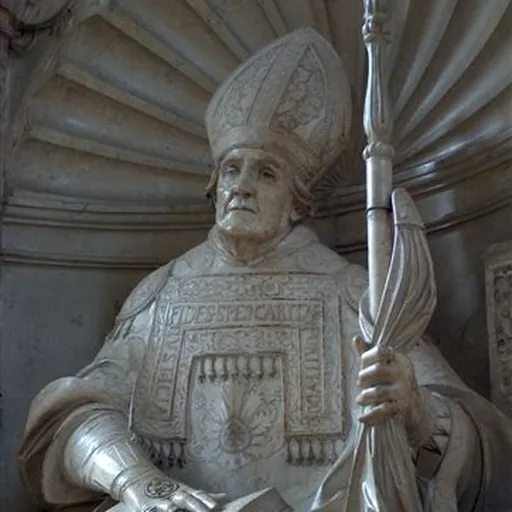
About Willibald
Lived 700 – 786. Willibald was a catholic priest, catholic bishop, missionary, bishop and monk.
Willibald (; c. 700 – c.787) was an 8th-century bishop of Eichstätt in Bavaria.
Information about his life is largely drawn from the Hodoeporicon of Willibald, a text written in the 8th century by Huneberc, an Anglo-Saxon nun from Heidenheim am Hahnenkamm who knew Willibald and his brother personally. The text of the Hodoeporicon ("Itinerary") was dictated to Huneberc by Willibald shortly before he died.
Willibald's father was Richard the Pilgrim, and his mother Wuna of Wessex. His brother was Winibald and his sister was Walburga.
Willibald was well-travelled and the first known Englishman to visit the Holy Land. His shrine is at the Eichstätt Cathedral in Germany, where his body and relics from his journeys are preserved.
His feast day is 7 July.
Early life Willibald was born in Wessex on 21 October around the year 700. His mother, Wuna of Wessex, was reportedly a sister of Boniface. His father, Richard the Pilgrim, was a chieftain of Wessex. At the age of three, Willibald suffered from a violent illness. His parents prayed to God, vowing to commit Willibald to a monastic life if he was to be spared. Willibald survived and at the age of five entered the Benedictine monastery at Waldheim and was educated by Abbot Egwald. At the monastery he became accustomed to the Irish and Anglo-Saxon monastic ideal of peregrinatio religiosa, or pious rootlessness.
Travels In 721 Willibald set out on a pilgrimage to Rome with his father and brother. After departing by ship the group arrived in Rouen, France visiting shrines and spending much of their time in prayer. Eventually they arrived in Lucca, a city in northern Italy. It was here that Willibald's father became gravely ill and died. After burying their father Willibald and Winibald continued on their journey, travelling through Italy until they reached Rome. Here they visited the Lateran Basilica and St. Peter's. They spent some time in Italy, strengthening in devotion and discipline, but soon the two brothers became ill with the Black Plague (although Mershman says it was malaria).
Willibald left Rome in 724, heading for Naples. From there, accompanied by two unnamed companions and brother, he departed by sea, visited Sicily and Greece along the way, and eventually arrived in Asia Minor. Winnebald had, after the departure of his brother for Palestine, lived in a monastery at Rome. where he arrived on 11 November 725. The pilgrimage continued to Bethlehem and the Church of the Nativity, Thecua, the Great Lavra of St Sabbas, the church at the spot where Philip the Evangelist baptised the Ethiopian eunuch, the port city of Gaza, Hebron, Saint George's hometown of Lydda, Joppa, Tyre and Sidon, Sebaste and other places in Samaria, Ptolemais, and again reached Tyre by way of the Ladder of Tyre.
Return voyage After waiting for some time in Tyre, Willibald was able to sail to Constantinople. He remained in Constantinople for some two years (c. 726/27–729) and was provided with a small room in an annex of the Church of the Holy Apostles. He spent part of this time in Nicaea, visiting a church and studying documents from the First Council of Nicaea that was arranged by Emperor Constantine. He left Constantinople and sailed for Sicily arriving in Naples approximately seven years after he had left Italy.
Monte Cassino Willibald and his remaining companion, Tidbercht, joined the Benedictine community at Monte Cassino. Here Willibald taught the community about his travels. He would spend over ten years (c. 729–739) at Monte Cassino and another local Benedictine monastery where he served roles as, "sacrist, dean, and porter." According to David Farmer, his new-found monasticism was drastically shaped by his experiences in both England and Palestine, allowing him to play a major role in the reformation and future prosperity of the monastery.
It happened that in 738 Boniface, coming to Rome, asked of Pope Gregory III that Willibald might be sent to assist him in his missions in Germany. The pope desired to see the monk, and was much delighted with the history of his travels, and acquainted him of Boniface's request. In 746 Boniface consecrated Willibald bishop of Eichstätt. Wilibald served as the bishop of the region in Franconia for over four decades, living in the monastery and entertaining visitors throughout Europe who would come to hear of his journey and monasticism.
Don’t just read it —
keep it.
Full-length biographies made to live with: read them, listen on the way to work, watch them tonight.
- E-book
- Audio
- Video
Instant download · yours to keep · every purchase keeps this site free
Important facts
People in Willibald's life
Named in this biography and alive at the same time

Related people
Same field, nearest in time



Contemporaries
People whose lives overlapped Willibald's

Frequently asked questions
Who was Willibald?
8th century bishop and saint
When was Willibald born?
Willibald was born in 700 in Kingdom of Wessex.
When did Willibald die?
Willibald died on 7 July 786 in Eichstätt.
What was Willibald's occupation?
Willibald was a catholic priest, catholic bishop, missionary, bishop and monk.
What nationality was Willibald?
Willibald's recorded nationality: Kingdom of Wessex.
Sources & further reading
Cite this page
APA: Biography.guide. (2026). Willibald. https://biography.guide/willibald/
MLA: "Willibald." Biography.guide, https://biography.guide/willibald/.
Chicago: "Willibald." Biography.guide. https://biography.guide/willibald/.
Data last updated: 2026-09-22 · Spot an error? Report a correction.
Portrait: Wikimedia Commons · author & licence
Page generated 2026-09-27 05:01 UTC