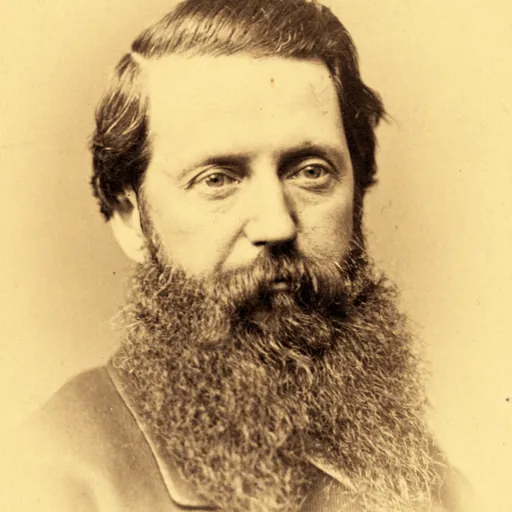
William Wierman Wright
American civil engineer
About William Wierman Wright
Lived 1824 – 1882 (aged 57–58).
William Wierman Wright (July 27, 1824 – March 9, 1882) was a well known nineteenth century American railroad engineer and civil engineer. He was born in York Springs, Pennsylvania.
Early life and career Wright was born in York Springs, Pennsylvania on July 27, 1824, being the son of William Wright (1788–1865) and Phoebe Wierman (1790–1873), one of six children. Wright's family were well-known Quakers in Adams county and he finished his education at the academy at Gettysburg, under the charge of Herman Haupt.
Pennsylvania railroad In 1847, Wright joined the corps of engineers working on the Pennsylvania railroad and remained until 1854. He started under chief engineer Samuel W. Mifflin (1805–1885) who was in charge of the mountain division, extending from Jack's narrows to the Allegheny summit. Mifflin at that time was one of five principal assistants to William B.Foster, Associate Engineer in charge of the Eastern Division. The names of the other assistants were Edward Tilghman, A. Worral, Strickland Kneass, and Thomas T. Wierman (1813–1887), another Adams County resident. During this period, Wright also worked for Herman Haupt as his assistant engineer.
By 1854, Wright was the principal assistant engineer in charge of the Western Division of the railroad's mainline. In 1855 he became the Chief Engineer of the Memphis & Charleston Railroad, replaced by Thomas W. Seabrook. Wright returned to the Pennsylvania railroad in 1859 and remained there until the beginning of the Civil War. to Fredericksburg, Virginia controlled by the Union army with Adna Anderson acted as chief engineer of construction. After rebuilding the bridges and wharves for the road, Wright was forced to abandon Acquia creek on September 6, 1862, due to Lee's victory at the Second Battle of Bull Run. Wright left the military railroad and returned home to Pennsylvania. The department separated its construction and transportation divisions... "(T)he transportation division had charge of transportation, maintenance, and repair of the road, and was operated under a general superintendent. He was instructed to employ the best practical talent of the country to act as superintendents of the various lines. The construction corps' duties comprised the construction of new lines and the opening of them for the use of the transportation department. This corps was under a chief engineer, who was directed to organize and equip a corps large enough for the purpose." (Swanter, 1929) In December 1863, General Daniel McCallum, Military Director and Superintendent of the United States Military Railroad was ordered to assess and evaluate the conditions of the railroad lines supplying the Union army located at that time in the vicinity of Chattanooga, Tennessee. The mission of the USMRR was to rebuild the railroad supply lines into Chattanooga from Nashville and Knoxville.McCallum's strategy was to rebuild the rail lines into Nashville and then rebuild the lines into Chattanooga.
This meant rebuilding the Nashville and Chattanooga Railroad from Nashville to Stevenson, Alabama, the Central Alabama railroad to Decatur, Alabama Memphis and Charleston Railroad, and the East Tennessee and Georgia Railroad that ran between Chattanooga and Knoxville. The segment of the M&C railroad between Bridgeport, Alabama and Chattanooga had suffered much damage at the hands of the retreating Confederates, two major bridges had been destroyed, the first over 1,500 foot in length at the Tennessee River and the second at 800 feet and 95 feet high at Running Water, Tennessee.
In December 1863, Wright rejoined the U.S. Military Railroad construction corps. Over the next four months, Wright mobilized a workforce of two thousand men and numerous military engineer units such as the Virginia Construction Corps of three hundred men, 1st Regiment Missouri Volunteer Engineers under Colonel Henry Flad, 1st Regiment Michigan Volunteer Engineers and Mechanics under Colonel William Power Innes, and the 12th and 13th regiments of the United States Colored Troops.
Reconstruction of railroads into Chattanooga In general, these railways were torn up by the retreating Confederates, and bridges and stations were burned. As fast as the Union army occupied new territory, the railroads had to be reconstructed and opened for use, and they were always subject to constant guerrilla raids. Frequently the army was driven back and the line was lost, which made necessary a second rebuilding after the next advance. An example of this was the Buell campaign of 1863 the road was opened as far as Stevenson, Alabama but it was lost when Buell retreated in the late fall. It was recaptured by Rosecrans late in 1863 and was rebuilt to Chattanooga. Wright reopened the line into Chattanooga in January 1864 and the Union army was able to issue full rations to the soldiers for the first time since they took Chattanooga in early December 1863. On June 14, 1864, Mussey was appointed colonel of the 100th U.S. Colored Infantry.
Atlanta Campaign
In February 1864, Grant appointed McCallum as general manager of all military railways in the West and he immediately appointed Wright chief engineer of the construction corps. Wright rebuilt the Oostenaula River bridge in seventy-two hours and started the rebuild while the bridge was still burning. He rebuilt the 600-foot bridge over the Etowah River in five days. Much of this work was supervised by Eben C. Smeed, one of Herman Haupt's assistants from Virginia.
Mays Landing & Egg Harbor City Railroad Wright was appointed chief engineer by the Pennsylvania railroad to locate the line in May 1871.
Later life
When Wright returned to the U.S., his bright career seemed to take a downward turn. In his years abroad, he had become an alcoholic. He took lodgings in a room on Walnut Street in Philadelphia and subsisted by cleaning offices. The night before he died, Wright had been arrested for drunken behavior in public. He was sent to Moyamensing Prison in Philadelphia and was found dead the next morning, March 9, 1882. He was buried beside his parents in Adams County. Wright never married.
Don’t just read it —
keep it.
Full-length biographies made to live with: read them, listen on the way to work, watch them tonight.
- E-book
- Audio
- Video
Instant download · yours to keep · every purchase keeps this site free
Important facts
People in William Wierman Wright's life
Named in this biography and alive at the same time




Contemporaries
People whose lives overlapped William Wierman Wright's





Frequently asked questions
Who was William Wierman Wright?
American civil engineer (1824 - 1882)
When was William Wierman Wright born?
William Wierman Wright was born on 27 July 1824 in York Springs.
When did William Wierman Wright die?
William Wierman Wright died in 1882.
Sources & further reading
· Wikipedia: William Wierman Wright
· DBpedia: William Wierman Wright
Cite this page
APA: Biography.guide. (2026). William Wierman Wright. https://biography.guide/william-wierman-wright/
MLA: "William Wierman Wright." Biography.guide, https://biography.guide/william-wierman-wright/.
Chicago: "William Wierman Wright." Biography.guide. https://biography.guide/william-wierman-wright/.
Data last updated: 2026-09-20 · Spot an error? Report a correction.
Portrait: Wikimedia Commons · author & licence
Page generated 2026-09-27 04:57 UTC