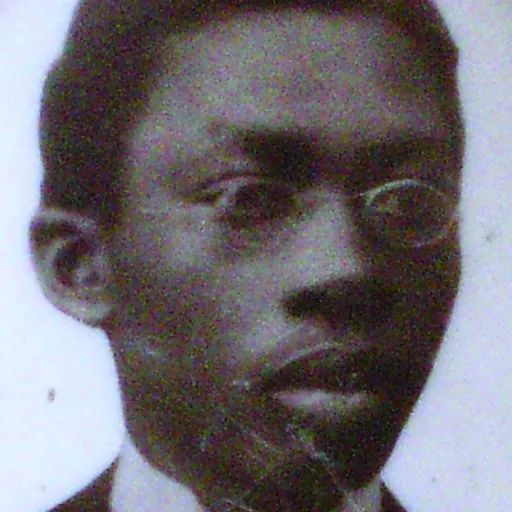
About William Vivour
William Vivour was a businessperson.
William Allen Vivour (fl. 1830–1890) was the single most successful 19th-century planter in Africa due to his substantial and flourishing cocoa plantation in Fernando Po (Equatorial Guinea). He was the son of a recaptive from present day Lagos
Family A branch of the family trace the name Vivour to a transliteration of the name Viavo. A name indigenous to Badagry area of Lagos, where their ancestor was kidnapped. Some have postulated that Vivour is a contraction of the word Survivor, which is related to the circumstances that led to his father's arrival at Sierra Leone,
Most likely the origin of the name comes both circumstances.
William Allen Vivour was born in Sierra Leone and had four siblings (two brothers and two sisters) which included Sally Vivour (grandmother to Robert Wellesley Cole) and Jacob Vivour.
By 1855, William Allen Vivour migrated from Sierra Leone to set up his base in Nigeria and Fernando Po. was enrolled as a pupil at Monkton Combe School in Somerset from 1879 to 1881, before going on to study law at Christ Church, Oxford University. He obtained his law degree in 1887, then went to Edinburgh where he studied medicine, qualified as a doctor in 1895, and returned to Nigeria where he set up his practice in Eastern Nigeria.
The following year Holt's assistant W. J. Jones wrote that the black merchant was thriving:
W. A. Vivour's interest in palm oil grew so significant that it brought him into direct conflict with King Jaja of Opobo in the time leading up to the Jaja-Ibeno War.
At the time, Vivour was trading directly with Liverpool and had established trading factories on the Kwa Ibo; to achieve this, he had agreements with the Ibeno hierarchy. Ibeno sovereignty was independent of Jaja's Opobo. Jaja himself knew this and said, "Although I had no claim to the territory near the mouth of the Qua Eboe River, Mr. Vivour would still have no right to trade there, for any oil which he could get would either be bought in or drawn from my markets".
At last dialogue between the Opobo and the Ibeno failed. Jaja did not take it kindly to see the same Liverpool traders whom he sent away from Opobo because of their free trade policy, establishing trading factories on the Kwa Ibo. About twenty eight of them including George Watts, Henry Watts, Holt and Vivour had agreements with the Ibeno hierarchy. Nevertheless, Jaja's threat for war was ignored by the Ibeno. European traders told Ibeno chiefs not to exercise any fear that ‘Whatever rights Jaja has at Opobo were conferred by Her Majesty’s Consul and no rights whatever were given to him over the Qua Iboe people’. The British granted the first concessions around Clarence to 'original settlers' in the late 1820s." The Spaniards thought it politic to recognize existing property rights as long as there were signs that plots had been cultivated in some way. Of the land grants listed in 1891, 32 appear to have belonged to Creoles, judging by the names. Vivour was the Fernandino with the most land, 202 hectares in all
The combined effort of the Creole and the Spaniards so quickened the pace of agricultural development in Fernando Po that by 1909, the island was the tenth-largest producer of cocoa in the world. By the 1890s the presence of the Creoles in Fernando Po was so pervasive that a Catholic missionary complained that: quote|The island of Fernando Po above all, has been captured by the English blacks of Sierra Leone.... and this, the major part of the island is in the hands of the English blacks. By 1887, when he accompanied Catholic missionaries on their first trip to the western side of the island, Vivour had acquired several cocoa plantations. At the end of the 1880s, few agriculturalists were trading directly with the Manchester trading houses, among them Vivour. By the mid-1880s, he was the largest landowner on the island, and employed a massive labor force of men from diverse ethnic origins recruited from the Biafra and beyond. They were from Loango; the lower Guinea coast; Accra; and Grebo Kruboys (migrant laborers) from Cape Palmas and the Windward Coast. Vivour also recruited ethnic Bassa and ethnic Bubi. He employed artisans from Accra who served as coopers, carpenters and smiths.
His success in cocoa cultivation was so noteworthy that the following was remarked during the proceedings of the Royal Geographic Society in England.
Personal life W. A. Vivour married Amelia Barleycorn, a member of one of the prominent Fernandino families. They had several children, one of which was Garnet Vivour, father to both RAF pilot Bankole Vivour and Justice R.W.A Rhodes-Vivour.
In relation to the complexities of making a living and settling on land that was in contention by both the British and Spanish, the British agreed to recognize only about one-tenth of the population of Clarence as British subjects on the eve of effective Spanish occupation in 1888, including a few Britons. The rest of the resident Creole population became Spanish by default." William Allen Vivour, a wealthy Creole planter born in Sierra Leone, greeted the Austrian explorer Oscar Baumann in Korth West Bay (San Carlos, Luba) in 1886 as the local representative of the Spanish crown.
Vivours notable descendants include, Retired Justice of the Supreme Court Olabode Rhodes-Vivour as well as the politician Chief Gbadebo Rhodes-Vivour.
Death In the 1890s, after Vivour's death, a visiting African-American noted that the opulence of his tomb bore testimony to his business success:
Don’t just read it —
keep it.
Full-length biographies made to live with: read them, listen on the way to work, watch them tonight.
- E-book
- Audio
- Video
Instant download · yours to keep · every purchase keeps this site free
Important facts
Related people
Same field, nearest in time




Frequently asked questions
Who was William Vivour?
Equatoguinean planter
What was William Vivour's occupation?
William Vivour was a businessperson.
Sources & further reading
Cite this page
APA: Biography.guide. (2026). William Vivour. https://biography.guide/william-vivour/
MLA: "William Vivour." Biography.guide, https://biography.guide/william-vivour/.
Chicago: "William Vivour." Biography.guide. https://biography.guide/william-vivour/.
Data last updated: 2026-09-22 · Spot an error? Report a correction.
Portrait: Wikimedia Commons · author & licence
Page generated 2026-09-27 05:04 UTC