
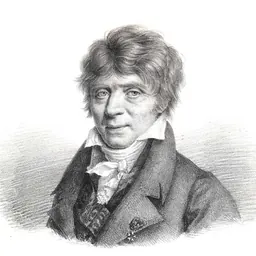
William "Tiger" Dunlop
Military physician, author, woodsman, army officer, politician
About William "Tiger" Dunlop
Lived 1792 – 1848 (aged 55). William "Tiger" Dunlop was a Canadian writer.
William Dunlop (19 November 1792 – 29 June 1848) also known as Tiger Dunlop, was an army officer, surgeon, Canada Company official, author, justice of the peace, militia officer, politician, and office holder. He is notable for his contributions to the War of 1812 in Canada and his work in the Canada Company, helping to develop and populate a large part of Southern Ontario (the Huron Tract). He was later elected as a Member of Parliament for the Huron riding in the 1st Parliament of the Province of Canada, Canada West.
Early life and education Tiger Dunlop was born 19 November 1792 in Greenock, Scotland, the third son of a local banker Alexander Dunlop and Janet Graham. He pursued his medical studies at the University of Glasgow and in London.
British Army In January 1813 Dunlop joined the army as a hospital mate. A month later he was posted as an assistant surgeon in the 89th Regiment of Foot. He was first posted to the Isle of Wight, later leaving for Quebec in August 1813. He remained with the Army until 1828, although after the end of the Napoleonic Wars much of that time he was on half-pay and not serving.
From 1815 to 1820 Dunlop was in India, as a journalist and possibly other commercial activities. On returning to Britain, he taught medical jurisprudence at the University of Edinburgh, and also was in London.
Life in Canada
War of 1812
The 89th Regiment left Britain on 4 February 1813, with Dunlop appointed assistant surgeon. The regiment was posted to Upper Canada during the War of 1812 in time to participate in the Battle of Crysler's Farm and the Battle of Lundy's Lane.
Like other war doctors, Dunlop was faced with seemingly impossible tasks. After the Battle of Chippawa, Dunlop worked alone on 220 men from both armies because no other surgeons were available. The story continues that Dunlop worked alone for more than two full days, barely sitting down and stopping only to eat and change clothes. He played a more active role in the assault on Fort Erie on 15 August 1814, carrying about a dozen injured men out of the range of fire and providing survivors with basic necessities. He served with a road-cutting party near Penetanguishene in the spring of 1815. As was the custom of the day, positions such as that held by Dunlop were personal appointments; he was in some danger of losing his position, but managed to keep it. In 1833 he was appointed the General Superintendent of the Huron Tract. It was at this time that Dunlop published Statistical Sketches of Upper Canada to encourage young people to come to Canada. The Company's enterprise was later called "the most important single attempt at settlement in Canadian history".
Dunlop left the Canada Company in 1838 because he refused to cease military activities as ordered by the Company.
Rebellions of 1837
During the Rebellions of 1837, Dunlop formed and commanded the Huron Regiment in Upper Canada nicknamed The Bloody Useless. He took the seat and participated in the initial proceedings of the First Parliament.
Dunlop lodged a controverted election petition with the Legislative Assembly. Colonel John Prince, the member for the neighbouring riding of Essex, acted for Dunlop in moving the matter through the Assembly. Dunlop sat as member for Huron for the duration of the first Parliament.
Legislative role Despite his flamboyant character and occasional radical stances, in the legislature Dunlop took a moderate Tory position. He became notable for his humour. On one occasion, when the Assembly was debating whether to impose new taxes. Dunlop was speaking in favour and was interrupted by another member, who asked: "Would the honourable member advocate placing a tax on bachelors, as such?" The unmarried Dunlop immediately replied: "Certainly. I believe all luxuries should be taxed." Secular university to replace the Anglican King's College; later known as the University of Toronto. Voted yes. Choice of Speaker of the House 1844 – Voted for a bilingual member to take the position. Should magistrates be lawyers? – Voted no. The lawful use of corpses to facilitate the study of anatomy – Voted yes. Customs union with the British West Indies – Voted yes. Dunlop was uniquely qualified for this work. However, his methods often left questions in the minds of those around him and he was replaced in 1846.
Regiment of the Bloody Useless During the Rebellions of 1837, William Dunlop, who had become a Colonel, was requested to raise a militia unit that would become known as the 1st Regiment Huron Militia. The Regiment consisted of some 600 badly outfitted and ill-equipped men. The Regiment experienced great difficulty obtaining even the most rudimentary supplies according to the Memorial by Lieutenant-Colonel Taylor 1st Regiment Huron Militia to the House of Assembly of the Province of Upper Canada in Provincial Parliament Assembled. Dunlop nicknamed the militia unit "The Bloody Useless."
Crossing the US border Dunlop was fond of snuff, a tobacco product. Like any other consumable, Dunlop enjoyed snuff in large quantities. The box in which he carried his snuff, he called The Coffin. Crossing the Canada/US border, a US inspector found it doubtful that the amount of snuff carried with him was just for personal use. Dunlop is said to have tossed a handful of snuff in the air, then snorting it as it fell around him. He said: "There, that's what I want it for; that's the way I use it".
Dunlop wrote his own will, assigning different mementos to his various family members, with humorous comments on their characters and personal idiosyncrasies. When he asked a friend to review it, the friend cautioned that it might be invalid because it treated such a serious subject with levity. Dunlop consulted his friend, Colonel Prince, a lawyer, who wrote back: "I have perused the above Will. It is eccentric, but it is not in that sense illegal or informal. To a mind who knows the mind of the testator it will remain a relict of his perfect indifference (an indifference to be commended, in my opinion), to what is called Fashion, even in testamentary matters."
Recollections of the American war, 1812-14 by Dr. Dunlop; with a biographical sketch of the author, by A.H.U. Colquhoun (Toronto : Historical Publishing Co., 1905). Statistical sketches of Upper Canada : for the use of emigrants, by a backwoodsman (London: J. Murray, 1832). Two and twenty years ago : a tale of the Canadian Rebellion, by a backwoodsman (Toronto : Cleland's Book and Job Printing House, 1859). Statistical sketches of Upper Canada : for the use of emigrants, by a backwoodsman, 3rd ed. (London: J. Murray, 1833). The Vagary, or, The last labors of a great mind, compiled from original documents; with an appendix ...; adapted to the times by a backwoodsman (Conneautville, Pa.: A.J. Mason, 1856). Lands in the Huron district (Toronto : Rowsells & Thompson, 1843). An address delivered to the York Mechanics' Institution, March, 1832, by Dr. Dunlop. Printed for the Mechanics' Institution at the Guardian Office (York: W.J. Coates, 1832). To the freeholders of the county of Huron : my friends and neighbours, it was only yesterday that I saw by accident, in an obscure print, the name of which I never before heard, an attack upon me by Mr. Morgan Hamilton (Upper Canada, 1841) Upper Canada, by a backwoodsman (London: John Murray, 1832).
In addition to these known works, there has been some discussion whether Dunlop was involved in some way in the creation of the Canadian Boat Song.
Don’t just read it —
keep it.
Full-length biographies made to live with: read them, listen on the way to work, watch them tonight.
- E-book
- Audio
- Video
Instant download · yours to keep · every purchase keeps this site free
Important facts
People in William "Tiger" Dunlop's life
Named in this biography and alive at the same time


Related people
Same field, nearest in time



Contemporaries
People whose lives overlapped William "Tiger" Dunlop's


Frequently asked questions
Who was William "Tiger" Dunlop?
military physician, author, woodsman, army officer, politician (1792–1848)
When was William "Tiger" Dunlop born?
William "Tiger" Dunlop was born on 19 November 1792 in Greenock.
When did William "Tiger" Dunlop die?
William "Tiger" Dunlop died on 29 June 1848 in Lachine.
What was William "Tiger" Dunlop's occupation?
William "Tiger" Dunlop was a writer.
What nationality was William "Tiger" Dunlop?
William "Tiger" Dunlop was Canadian.
Sources & further reading
· Wikipedia: William "Tiger" Dunlop
· DBpedia: William "Tiger" Dunlop
Cite this page
APA: Biography.guide. (2026). William "Tiger" Dunlop. https://biography.guide/william-tiger-dunlop/
MLA: "William "Tiger" Dunlop." Biography.guide, https://biography.guide/william-tiger-dunlop/.
Chicago: "William "Tiger" Dunlop." Biography.guide. https://biography.guide/william-tiger-dunlop/.
Data last updated: 2026-09-20 · Spot an error? Report a correction.
Page generated 2026-09-27 05:22 UTC