
About William Rankins
Lived 1565 – 1609 (aged 43–44). William Rankins was an English playwright, satirist, pamphleteer and poet.
William Rankins (fl. 1587) was an English writer. He was classed by Francis Meres in his Palladis Tamia as one of the three leading contemporary satirists, with Joseph Hall and John Marston.
Life Baptised 1565, Rankins was the elder son of Henry Rankyn, master of the Barber–Surgeons' Company in 1587, and Mary Robynson. His father's will of 1597 favoured his younger brother, Henry.
Rankins is regarded as a professional writer. Indeed, while his anti-theatrical Mirrour of 1587 apparently allied him with Puritan criticisms, he was involved in some fashion with the theatre beforehand and afterwards. It has been suggested that he was insincere, and that, as a hack writer, he was paid for the pamphlet by the City of London corporation.
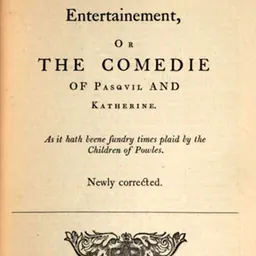
Rankins died in 1609. It may have been a literary exercise in an established genre; in any case within a few years Rankins was a playwright. Mulmutius Dunwallow, a play bought by Philip Henslowe in 1598, likely an adaptation; the subject was Dyfnwal Moelmud, and possible sources the Historia Regum Britanniae and Holinshed's Chronicles. Hannibal and Scipio, play written for Henslowe with Richard Hathway, and based on Livy; the same team produced c.1600 a comic play, and The Conquest of Spain by John of Gaunt. None of these plays are extant. Works dedicated to Sir Christopher Hatton, The English Ape, the Italian imitation, the Foote-steppes of Fraunce. Wherein is explained the wilfull blindnesse of subtill mischiefe, the striuing for Starres, the catching of Mooneshine, and the Secrete Sounde of many hollowe heartes (1588), against the imitation of foreign fashions, and My Roughcast Conceit of Hell. Dedicated to John Salisbury of Lleweni, Seaven Satyres applyed to the weeke, including the worlds ridiculous follyes. True felicity described in the Phœnix. Maulgre. Whereunto is annexed the wandring Satyre (1598), publisher Edward Allde. True felicity described in the Phœnix, a religious poem, is with seven satires, in seven-line stanzas.
Before the Belvedere (1600) by John Bodenham are three seven-line stanzas, "A Sonnet to the Muse's Garden" by Rankins; who also contributed anonymously to the anthology Plato's Cap of 1604.
Don’t just read it —
keep it.
Full-length biographies made to live with: read them, listen on the way to work, watch them tonight.
- E-book
- Audio
- Video
Instant download · yours to keep · every purchase keeps this site free
Important facts
People in William Rankins's life
Named in this biography and alive at the same time






Related people
Same field, nearest in time




Contemporaries
People whose lives overlapped William Rankins's


Frequently asked questions
Who was William Rankins?
English pamphleteer and playwright
When was William Rankins born?
William Rankins was born in 1565.
When did William Rankins die?
William Rankins died in 1609.
What was William Rankins's occupation?
William Rankins was a playwright, satirist, pamphleteer and poet.
What nationality was William Rankins?
William Rankins was English.
Sources & further reading
Cite this page
APA: Biography.guide. (2026). William Rankins. https://biography.guide/william-rankins/
MLA: "William Rankins." Biography.guide, https://biography.guide/william-rankins/.
Chicago: "William Rankins." Biography.guide. https://biography.guide/william-rankins/.
Data last updated: 2026-09-20 · Spot an error? Report a correction.
Page generated 2026-09-27 05:03 UTC