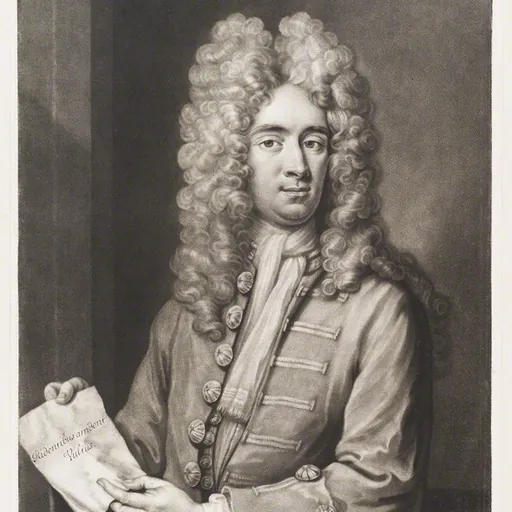
About William Pinkethman
William Pinkethman was a British actor.
William Pinkethman (also Penkethman, Pinkeman, Pinkerman, etc.; nicknamed Pinkey, c.1660–1725) was an English comic actor, a low comedian with a droll style, and theatre manager. He was considered an imitator of Anthony Leigh.
Starting in the 1690s Penkethman performed with the United Company at Drury Lane. He largely played small roles, then became known for his delivery of prologues and epilogues in plays. He was known for performing riding a donkey. He later opened a theatre at Richmond.
Rising actor Pinkethman overcame a weakness for overacting and playing to the crowd to become a steady performer. He is first heard of at the Theatre Royal, in 1692, in Thomas Shadwell's The Volunteers, in which he played Stitchum the tailor, an original part of six lines. After the departure in 1695 of Thomas Betterton and his associates, Pinkethman was promoted to a better line of parts. In 1702 he was the original Old Mirabel in George Farquhar's The Inconstant. He also recited what was known as "Pinkethman's Epilogue". He was known for his ad libs. It was at this period that Charles Gildon, in his Comparison between Two Stages, spoke of him as "a fellow that overdoes everything, and spoils many a part with his own stuff." After the merger of the Haymarket and Drury Lane companies in 1708, fewer original characters came to Pinkethman, who, however, was assigned important parts in standard plays. On 4 April 1707, for his benefit, he spoke with Jubilee Dicky (Henry Norris) a new epilogue. The two actors represented the figures of Somebody and Nobody. At the Haymarket Theatre he created, on 12 December 1709, Clinch in Susannah Centlivre's Man's Bewitched, and on 1 May 1710 Faschinetti in Charles Johnson's Love in a Chest.
On 15 June 1710 Pinkethman opened a theatre in Greenwich, where he played comedy and tragedy. It lasted until September 1711.
Last years On 19 February 1718 Pinkethman was, at Drury Lane, the first Ringwood in John Breval's The Play is the Plot. On 14 February 1721 he was the original Sir Gilbert Wrangle in Cibber's The Refusal. This appears to have been practically his last original part. On 9 January 1723 he was Pyramus in the burlesque scene from Midsummer Night's Dream fitted into Love in a Forest, an alteration of As you like it. On 23 May 1724 he appeared in Epsom Wells (Thomas Shadwell), for his benefit. At an uncertain date he played Judge Tutchin in Lodowick Barry's Ram Alley, or Merry Tricks.
Family Pinkethman, described as a bachelor of St. Paul's, Covent Garden, married, on 22 November 1714, at Bow Church, Middlesex, Elizabeth Hill, of St. Paul's, Shadwell. Pinkethman's booth was handed on to his son, who also acted. At the opening of Covent Garden Theatre, 7 Dec. 1732, he played Waitwell in The Way of the World, was Antonio in Chances at Drury Lane, 23 November 1739, and died 15 May 1740.
Don’t just read it —
keep it.
Full-length biographies made to live with: read them, listen on the way to work, watch them tonight.
- E-book
- Audio
- Video
Instant download · yours to keep · every purchase keeps this site free
Important facts
Related people
Same field, nearest in time



Frequently asked questions
Who was William Pinkethman?
British actor
When did William Pinkethman die?
William Pinkethman died in 1725.
What was William Pinkethman's occupation?
William Pinkethman was an actor.
What nationality was William Pinkethman?
William Pinkethman was British.
Sources & further reading
· Wikipedia: William Pinkethman
Cite this page
APA: Biography.guide. (2026). William Pinkethman. https://biography.guide/william-pinkethman/
MLA: "William Pinkethman." Biography.guide, https://biography.guide/william-pinkethman/.
Chicago: "William Pinkethman." Biography.guide. https://biography.guide/william-pinkethman/.
Data last updated: 2026-09-24 · Spot an error? Report a correction.
Portrait: Wikimedia Commons · author & licence
Page generated 2026-09-27 05:08 UTC