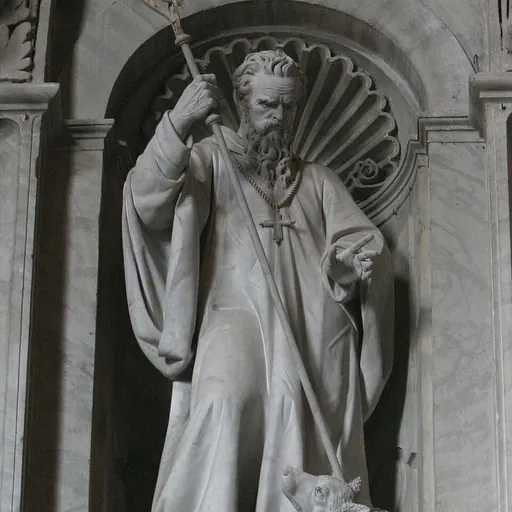
William of Montevergine
Italian noble and saint
About William of Montevergine
Lived 1085 – 1142 (aged 56–57). William of Montevergine was a monastery founder and latin Catholic monk.
William of Montevergine, or William of Vercelli, (1085 – 25 June 1142), also known as William the Abbot, was a Catholic hermit and the founder of the Congregation of Monte Vergine, or "Williamites". He is venerated as a saint by the Roman Catholic Church.
Life He was born in 1085 into a noble family of Vercelli in northwest Italy and was brought up by a relation after the death of his parents. He undertook a pilgrimage to Santiago de Compostela. On his pilgrimage to Compostela, William asked a blacksmith to make an iron implement that would encircle his body and increase his suffering, and he wore it throughout the pilgrimage.
After he returned to Italy, he intended to go to Jerusalem and for this purpose, he reached Southern Italy, but he was beaten up and robbed by thieves. William considered this misfortune a sign of God's will to stay in South Italy and spread the message of Christ. Because of this, he decided not to travel to Jerusalem anymore and to settle in Southern Italy, on the summit of Monte Vergine (then known as Monte Vergiliana) between Nola and Benevento, where he lived as a hermit. Here he attracted a number of followers and founded the Monastery of Montevergine.
While at Montevergine, William of Vercelli is stated as having performed miracles. Therefore, he left Montevergine in 1128 and settled on the plains in Goleto, in the territory of Sant'Angelo dei Lombardi, between Campania and Basilicata, where he founded the Abbey of San Guglielmo al Goleto.
Subsequently, he founded several other monasteries of the same rule but mostly remained in Goleto except for some trips to Apulia. Eventually, he died in Goleto on June 25, 1142. His remains were buried in Goleto, where they stayed until they were transferred to Montevergine on September 2, 1807, as ordered by the king of Naples Gioacchino Murat. Some of his relics are also located in other cathedrals (Benevento) and Italian churches. Catholic tradition states that William foresaw his own imminent death "by special revelation". The remaining later sources contain corrupt or even invented accounts on his life, therefore they are unreliable although not necessarily false, as primary sources may have been lost.
The miracle of the wolf According to all the sources, including the earliest source, Legenda de vita et obitu sancti Guilielmi Confessoris et heremitae, all of which are close to Catholicism, he performed many miracles. The best-known miracle was and still is the "Miracle of the Wolf" (1591). Because of this, he is often depicted in company with a "domesticated" wolf, even in the monastery of Montevergine. One day a wolf hunted and killed a donkey the saint used for towing and other tasks. The saint then turned to the wolf and ordered the beast to offer himself to do all the donkey's previous tasks. The wild beast reportedly became tame, and the people who met the saint were astonished to see such a docile wolf.
At King Roger II's court Hagiographer Tommaso Costo (1591) wrote that king Roger II of Sicily had heard about William of Montevergine, and thus he wanted to meet him. The king reportedly was living in Salerno at that time. Reportedly, while visiting the king, a prostitute wanted to prove the genuineness of his faith, and, complicit with the king, tried to get into William of Montevergine's bed who, in response, put burning embers on his bed and there he lay down, inviting the prostitute to follow his example. Reportedly the woman repented of her mistake and switched to a more religious life.
Posthumous sources add further details, stating that the prostitute had been called Agnes and that, after conversion, she had built a monastery in Venosa, where she led a monastic life with other women, being called "Blessed Agnes of Venosa".
Don’t just read it —
keep it.
Full-length biographies made to live with: read them, listen on the way to work, watch them tonight.
- E-book
- Audio
- Video
Instant download · yours to keep · every purchase keeps this site free
Important facts
Related people
Same field, nearest in time

Contemporaries
People whose lives overlapped William of Montevergine's



Frequently asked questions
Who was William of Montevergine?
Italian noble and saint
When was William of Montevergine born?
William of Montevergine was born in 1085 in Vercelli.
When did William of Montevergine die?
William of Montevergine died on 25 June 1142 in Sant'Angelo dei Lombardi.
What was William of Montevergine's occupation?
William of Montevergine was a monastery founder and latin Catholic monk.
Sources & further reading
· Wikipedia: William of Montevergine
· DBpedia: William of Montevergine
Cite this page
APA: Biography.guide. (2026). William of Montevergine. https://biography.guide/william-of-montevergine/
MLA: "William of Montevergine." Biography.guide, https://biography.guide/william-of-montevergine/.
Chicago: "William of Montevergine." Biography.guide. https://biography.guide/william-of-montevergine/.
Data last updated: 2026-09-21 · Spot an error? Report a correction.
Portrait: Wikimedia Commons · author & licence
Page generated 2026-09-27 04:59 UTC