
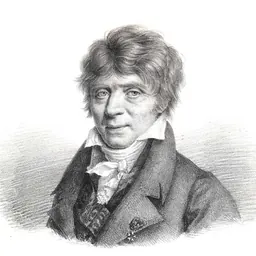
William Nicol Burns
Son of the poet Robert Burns
About William Nicol Burns
Lived 1791 – 1872 (aged 80–81).
Life and family William was born at Ellisland Farm in Nithsdale on 9 April 1791, between 3am and 4am as recorded in the family register in the Burns family Bible. The family later moved from Ellisland Farm to the 'Stinking Vennel' in Dumfries on 11 November 1791. In late spring 1793 they made the move to a larger house in Millhole Brae (now Burns Street), where William's mother lived for the remainder of her life following his father's death in 1796. Nine days previous to William's birth an illegitimate daughter, Elizabeth 'Betty' Burns was born to Robert Burns and Ann Park.
In May 1795, Burns wrote to George Thomson and explained why he had called his son after the Edinburgh schoolmaster William Nicol, "from that propensity to witty wickedness and manfu' mischief, which even at twa days auld I foresaw would form the striking feature of his disposition."
William's siblings were Robert Burns Junior (b. 3 March 1788); Jean (b. 3 March 1788); James Glencairn (b. 12 August 1794); Elizabeth Riddell (b. 21 November 1792); Francis Wallace (b. 1789) and Maxwell (b. 25 July 1796). Short lived unnamed twin girls (b. 3 March 1788). It was William that on 9 April 1867 added details on behalf of his deceased father of Maxwell's birth into the family birth register in the Burns family bible, Maxwell having been born on the very day of Robert Burns's funeral.
Robert informed Mrs Frances Dunlop that his new son, William, was "a fine boy, rather stouter but not so handsome as your God-son at his time of life was. Indeed I look on your little Namesake to be my chief d'oeuvre in that species of manufacture, as I look on "Tam o' Shanter" to be my standard performance in the Poetical line".
Jean Armour left the portrait by Alexander Nasmyth to William Nicol Burns and in due course he bequeathed it to the National Portrait Gallery of Scotland in Edinburgh. In his Memorial of His Times, Lord Cockburn commented on Nicol's "constant and indiscriminate harshness" that was "very hurtful to all his pupils". However an Edinburgh lawyer and writer to the signet, Alexander Young of Harburn, regarded Nicol as "one of the greatest Latin scholars of the age".
Education Educated at Dumfries Grammar School, William later studied at a Charity school, The Bluecoat School, Christ's Hospital, Horsham.
The Marchioness of Hastings and Sir John Reid also assisted James's career. William entered the East India Company Military Seminary at Addiscombe, Surrey where he trained to become an officer in the company's army.
Career
After William had completed his education at Christ's Hospital he sailed as a midshipman aged 16 to India.
Marriage and family William Nicol married Catherine Adelaide Crone, daughter of R.Crone, Esq of Dublin, in Bangalore, in 1824. They had no children and Catherine died at Kulludghev in India on 29 June 1841.
On 15 August 1844 William Nicol and his brother James Glencairn were entertained in the Kings Arms Hotel, High Street, Irvine by the Irvine Burns Club.
William Nicol died in Cheltenham, Gloucestershire on 21 February 1872 and was buried in the Burns Mausoleum in the churchyard of St Michael's in Dumfries, Scotland. and, as stated, her son Robert Thomson was rejected upon trying to greet his grandfather's sons, his uncles, at the Ayr Festival.
In 1859 William gave the reply to the 'Immortal Memory' at the Centenary Banquet held in the City Hall in Glasgow at which there were twenty-three toasts and fifteen replies. He spoke at several other events that year in commemoration of the centenary of his father's birth.
Burns House, Dumfries In 1851 William purchased the family's last home in Millhole Street, later Burns Street, Dumfries in order to ensure the survival of the house in which his father had died and the Burns family had resided. In 1858 William placed the house in the care of the Dumfries and Maxwellton Education Society and for a number of years it served as a 'Ragged School' where children were taught a trade if they came from destitute or neglected backgrounds. After the school moved to other premises the Dumfries and Galloway Royal Infirmary directors restored the house as a memorial to Robert Burns and from 25 January 1935 it was opened to the public. Jean Armour Burns Brown, William's great-niece, performed the opening ceremony.
Don’t just read it —
keep it.
Full-length biographies made to live with: read them, listen on the way to work, watch them tonight.
- E-book
- Audio
- Video
Instant download · yours to keep · every purchase keeps this site free
Important facts
Family & relationships
People in William Nicol Burns's life
Named in this biography and alive at the same time



Contemporaries
People whose lives overlapped William Nicol Burns's


Frequently asked questions
Who was William Nicol Burns?
son of the poet Robert Burns
When was William Nicol Burns born?
William Nicol Burns was born on 9 April 1791 in Dumfries, Nithsdale.
When did William Nicol Burns die?
William Nicol Burns died in 1872 in Cheltenham.
Sources & further reading
· Wikipedia: William Nicol Burns
· DBpedia: William Nicol Burns
Cite this page
APA: Biography.guide. (2026). William Nicol Burns. https://biography.guide/william-nicol-burns/
MLA: "William Nicol Burns." Biography.guide, https://biography.guide/william-nicol-burns/.
Chicago: "William Nicol Burns." Biography.guide. https://biography.guide/william-nicol-burns/.
Data last updated: 2026-09-22 · Spot an error? Report a correction.
Page generated 2026-09-27 05:25 UTC