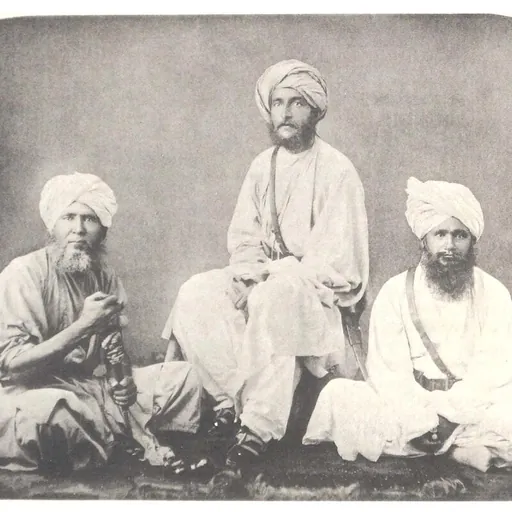
About William McNair
Lived 1849 – 1889 (aged 39). William McNair was a British surveyor, explorer and geographer.
William Watts McNair (13 September 1849 – 13 August 1889) was a British surveyor, the first British explorer of Kafiristan (now Nuristan).
Early life
Details of McNair's life up to the time of his 1883 journey are sketchy. According to John Keay, he was "country bred" (born and educated in India). He joined the Survey of India on 1 September 1867, just before his 18th birthday, and was posted to the Rajputana Topographical Party. "The first twelve years of his service were passed on topographical duty with this party under Major G. Strahan, R.E., and in the Mysore Party under Majors G. Strahan and H. R. Thuillier, R.E."
J. E. Howard, who compiled a memoir of McNair, mentioned his "ardent, buoyant, somewhat impulsive early manhood" and fondness for cricket. Howard made no comment about McNair's father, but did note that he had a sister and two younger brothers, John (who worked for the Indian Government's Finance Department before dying in his early twenties of small-pox contracted at Lahore), and George (who became a solicitor in Calcutta). In later years William lived with his mother and sister in Mussoorie. "A more united or more tenderly-knit family, of strong religious feeling, I have never known", Howard wrote.
"McNair possessed the rare faculty of commanding the confidence of natives", wrote Holdich. "He was not a specially good linguist, but he understood local idiosyncrasies." He made his day trips over the border into Afghanistan under the protection of "Mani Khan, a well-known Darwesh Khel chief of gigantic stature" with whom he maintained "a great friendship."
Journey to Kafiristan
The idea for McNair's 1883 journey into Kafiristan came from a pundit associate known as "the Saiad."
McNair's surveying in Afghanistan had been limited to day trips since, as Holdich noted, "strict orders had been issued that on no account was any European officer or assistant to sleep on the wrong side of the frontier line."
On 23 May, McNair left Chitral in the morning of and by evening had arrived at Balankaru, in the Rumbur Valley. "The people are the Kalash section of the Kafirs, inferior in appearance, manner, and disposition to their neighbours situated westwards; they pay a small tribute in kind to Chitral, and are allowed to retain their own manners and customs. To Daras Karu, in the Bamburath Vale, famed for its pears, I next proceeded; here also are Kalash Kafirs, and some Bashgali settlers. The valley is very narrow, and the cultivation restricted principally to terraced fields on the hill-slopes. Kakar was the next march; beyond it no trace of habitation. ..head of the pass (the difference in elevation between our night's encampment and the crest was 7,000 feet)... The view on the Kotal as the sun was rising was a sight never to be forgotten." In the heavy snow, McNair and his companions entered the valley by "adopting a sort of 'tobogging' system." "At the Ludhe villages" they "were well received." They returned to India via Kashmir.
An early report of the trip, published in The Pioneer, was summarised by The Athenaeum in London on 15 September 1883:
After his return, McNair submitted a confidential report. He was also invited to present his findings to the Royal Geographical Society in London.
Royal Geographical Society lecture McNair's 10 December 1883 lecture attracted considerable interest and discussion. "Colonel Yule said he had for thirty or forty years looked with intense interest at the dark spot of Kafiristan on the map of Asia, and had therefore listened with great pleasure to Mr. McNair's modest account of one of the most adventurous journeys that had ever been described before the Society." He "rejoiced that had lived to see Kafiristan partially revealed by an Englishman and not by a Russian."
"A very serious horse accident" in the summer of 1888 was the beginning of a series of health troubles. When his request for leave was finally sanctioned in July 1889, he left Quetta, arriving in early August at his mountain home in Mussoorie. His mother and sister "had no knowledge of the dangerous character of the fever from which he had been suffering for nearly a fortnight before he started from Quetta", which was soon discovered to be typhoid. His brother George, a solicitor, was called from Calcutta, but arrived after the burial.
George Scott Robertson stated that McNair "never entered the real Kafir country at all; he only succeeded in reaching some of the Kalash villages of Chitral, which he mistook for the true Kafiristan. The Kalash referred to are an idol-worshipping tribe, slaves to the Mehtar of Chitral, and must not be confounded with the independent mountaineers of Kafiristan, from whom they differ in language, dress, manners, and customs."
Keay suggests that Robertson's comments were probably motivated by "professional pique" and explains that "much importance was attached to the distinction between the Kalash, who came under the administration of Chitral, and the true Kati Kafirs of what had been independent Kafiristan. In MacNair's day the distinction was less noteworthy, and he might well have crossed the Shawal without appreciating the extent to which it was a political and ethnological watershed."
McNair's vagueness regarding the Kafir villages is also difficult to explain. "Though he speaks of 'Ludhe villages' referring to Bragamatal in the upper Bashgal valley", Schuyler Jones notes, "he does not describe or name the village or villages he visited"
McNair and Kipling
McNair's story has been proposed as a model for some of Rudyard Kipling's stories, including "The Man Who Would Be King" (1888), and less frequently, Kim (1901).
In 1882 Kipling returned to India to help edit Lahore's Civil and Military Gazette, a newspaper affiliated with The Pioneer in Allahabad, where Kipling worked from 1887 to early 1889. McNair's expedition was covered by both papers. As noted above, the Pioneer'''s early article on the expedition was summarised in The Athenaeum in September 1883. And "in 1883 and 1884, there were at least two reports in the CMG of journeys to Kafiristan, one by 'Mr. McNair, of the survey department,' disguised as a native hakim." McNair's lengthy obituary in The Pioneer (reprinted in Howard's Memoir''), showed the editors' familiarity with McNair's accomplishments.
In a 1988 reprint of "The Man Who Would Be King", Hugh Haughton wrote, "There was in fact one precedent for the duo's daredevil journey, and in composing the story I suspect that Kipling may have drawn upon the account of a visit to Kafiristan made by W. W. McNair, which was read to the Royal Geographical Society in December 1883. McNair, an officer in the Indian Survey, disobeyed government orders forbidding Europeans to cross the frontier without permission, and made his way to Kafiristan disguised as a Muhammedan hakim, or native doctor."
"The conditions of McNair's journey", Edward Marx argued, "exhibit some striking similarities to those of Kipling's story, and certain details in McNair's account, as well, might have suggested ideas to Kipling, such as the 'antique seal' McNair brought to the Society's meeting, which he was inclined to think Egyptian." McNair noted that "the men shave the whole of the head, except a circular patch on the crown, where the hair is allowed to grow"; Dravot "shaved his head into patterns." Kipling's story follows McNair's description of the Kafirs as "incessantly engaged in petty warfare with the Mahommedans" but "exceedingly well disposed towards the British." "As regards their religion", McNair writes, "one Supreme Being (Imbra) is universally acknowledged. . . . Priests preside at their temples, in which stones are set up, but to neither priests nor idols is undue reverence paid." In Kipling's story the men encounter "half a dozen big stone idols . . . the biggest—a fellow they call Imbra." McNair's account, "give or take a few chiefs, is entirely consistent with the depiction of the Kafirs' arms and military abilities in Kipling's story, down to the matchlocks", Marx argued. "A final resemblance between McNair's account and Kipling's story is his abrupt departure from the country, precipitated by the arrival of an informant who was likely to alert authorities to McNair's identity, an eventuality that, as he had noted earlier, would likely have resulted in his death."
Don’t just read it —
keep it.
Full-length biographies made to live with: read them, listen on the way to work, watch them tonight.
- E-book
- Audio
- Video
Instant download · yours to keep · every purchase keeps this site free
Important facts
People in William McNair's life
Named in this biography and alive at the same time


Related people
Same field, nearest in time



Contemporaries
People whose lives overlapped William McNair's




Frequently asked questions
Who was William McNair?
British surveyor and explorer
When was William McNair born?
William McNair was born on 13 September 1849.
When did William McNair die?
William McNair died on 13 August 1889 in Mussoorie.
What was William McNair's occupation?
William McNair was a surveyor, explorer and geographer.
What nationality was William McNair?
William McNair was British.
Sources & further reading
· DBpedia: William Watts McNair
Cite this page
APA: Biography.guide. (2026). William McNair. https://biography.guide/william-mcnair/
MLA: "William McNair." Biography.guide, https://biography.guide/william-mcnair/.
Chicago: "William McNair." Biography.guide. https://biography.guide/william-mcnair/.
Data last updated: 2026-09-23 · Spot an error? Report a correction.
Portrait: Wikimedia Commons · author & licence
Page generated 2026-09-27 05:07 UTC