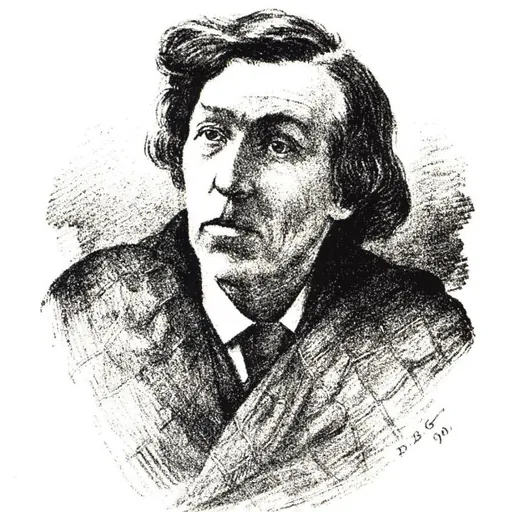
About William McGonagall
Lived 1825 – 1902 (aged 76–77). William McGonagall was a British weaver, poet, performing artist, writer, actor and stage actor.
Origins and early life William McGonagall's parents, Charles and Margaret, were Irish. His Irish surname is a variation on Mag Congail, a popular name in County Donegal. Throughout his adult life he claimed to have been born in Edinburgh, giving his year of birth variously as 1825 or 1830, but his entry in the 1841 Census gives his place of birth, like his parents', as "Ireland". Biographer Norman Watson suggests that McGonagall may have falsified his place of birth, as a native-born Scotsman would be better treated under the Poor Law of 1845 than one born in Ireland. By looking at census, marriage and death records, David Phillips identifies 1825 as the more likely birth date.
The McGonagall family moved several times in search of work, possibly spending time in Glasgow and on South Ronaldsay McGonagall married Jean King, a fellow mill worker from Stirling. Together they had five sons and two daughters. Despite the Industrial Revolution slowly making weavers obsolete, McGonagall apparently prospered, as there was still need for skilled workers to perform tasks of great complexity.
Whilst working at the loom, McGonagall would entertain his shopmates with recitations from Shakespeare. On one occasion, they paid a local theatre owner to allow him to appear in the title role in a production of Macbeth. Convinced that the actor playing Macduff was envious of him, McGonagall refused to die in the final act. For this performance, The Book of Heroic Failures awarded him the title of "worst Macbeth" as well as "worst British poet".
Career
The turning point in McGonagall's life came in June 1877. After his eldest daughter shamed the family by giving birth to an illegitimate child, work as a weaver become more difficult to find. At this point, McGonagall was seized with a new inspiration:
I seemed to feel as it were a strange kind of feeling stealing over me, and remained so for about five minutes. A flame, as Lord Byron has said, seemed to kindle up my entire frame, along with a strong desire to write poetry; and I felt so happy, so happy, that I was inclined to dance, then I began to pace backwards and forwards in the room, trying to shake off all thought of writing poetry; but the more I tried, the more strong the sensation became. It was so strong, I imagined that a pen was in my right hand, and a voice crying, "Write! Write!" McGonagall told the man that "it was so very bad that Her Majesty had thanked McGonagall for what the Chief Templar had condemned."
The letter gave McGonagall confidence in his "poetic abilities", and he felt his reputation could be enhanced if he were to give a live performance before the Queen. In July 1878, he walked from Dundee to Balmoral, a distance of about over mountainous terrain and through a violent thunderstorm to perform for Queen Victoria. When he arrived, he announced himself as "The Queen's Poet". The guards informed him "You're not the Queen's poet! Tennyson is the Queen's poet!" At that time, Alfred, Lord Tennyson was the Poet Laureate. McGonagall presented the letter but was refused entry and had to return home.
McGonagall's performances quickly gained a reputation for leading to raucous audience reception, frequently being interrupted and drowned out during his recitations, being pelted with food, and on some occasions being forcefully carried out of the venue and paraded on attendees' shoulders in the streets. Despite this, in an April 1880 interview, McGonagall seemed convinced of his own poetic prowess, declaring to the reporter that he was "more versatile than Shakespeare" and that the only man that could match McGonagall was Edmund Kean. Three months later, McGonagall sustained injuries to his head and left arm when a crowd, either accidentally or purposefully, dropped him onto the street while carrying him on their shoulders following a performance: he reportedly attributed his survival to his "good thick felt hat, [his] long and thick Bohemian locks, and above all, the 'genius of poetry.'"
In 1883 he celebrated the official opening of University College, Dundee with the poem "The Inauguration of University College Dundee" which opens with the stanza:
McGonagall always struggled financially and earned money by selling his poems in the streets or reciting them in halls, theatres, and public houses. When he dealt with financial insecurity, his friends supported him with donations. In 1880, he sailed to London to seek his fortune, and in 1887 to New York. In both instances, he returned unsuccessful.
In 1885, McGonagall aided in distributing a supposed autobiography of him entitled "The Book of the Lamentations of the Poet Macgonagall", which had been written following a collaboration with a reporter named John Willocks. McGonagall was met with confusion when the proctor of a local school closed the book with contempt after reading one of the first sentences. McGonagall himself had not read the book prior to selling it, which had the phrase "dedicated to himself, knowing none greater" inscribed on the front cover. The supposed autobiography had portrayed him as a pompous man with an overly obscure vocabulary who constantly looked down on others in his life, while also frequently being subject to his domineering wife: the opening sentence that caused the most issue read:
McGonagall initially believed that the word "bibulous" referred to his parents being devoted to Christianity even in hard times, but was enraged once the proctor explained that the word actually referred to being drunkards. After he threatened to sue Willocks, the latter withdrew the book from publication and wrote him a letter of apology. However, in 1905, three years after McGonagall's death, Willocks did republish the book.
In 1890, McGonagall was in dire financial straits. To help him, his friends funded the publication of a collection of his work, Poetic Gems. The proceeds provided McGonagall with enough money to live on for a time. By 1893, he was annoyed by his mistreatment at the hands of the public and wrote an angry poem threatening to leave Dundee. One newspaper quipped that he would probably stay for another year once he realised "that Dundee rhymes with 1893". Though he tried his hand at writing prose and endorsements for local businesses for a short time, he and his wife were forced to move to Perth in 1894. Soon after, he received a letter purporting to be from representatives of King Thibaw Min of Burma. In it, he was informed that the King had knighted him as "Topaz McGonagall, Grand Knight of the Holy Order of the White Elephant Burmah". Despite the fact that this was a fairly transparent hoax, McGonagall would refer to himself as "Sir William Topaz McGonagall, Knight of the White Elephant, Burmah" in his advertising for the rest of his life.
In 1895, McGonagall and his wife moved to Edinburgh. Here, he met with some success, briefly developing a cult following and being in great demand. This state of affairs did not last long, and by 1900 he was once again destitute, as well as now old and sickly. Though he was now too frail to walk the streets selling his poems, donations from friends continued to keep him afloat.
McGonagall died penniless in 1902, above what is now The Captain's Bar in Edinburgh's South College Street, and was buried in an unmarked grave in Greyfriars Kirkyard in Edinburgh. A wall-mounted memorial installed to his memory in 1999 is inscribed:
Additionally, a plaque above 5 South College Street in Edinburgh shows an image of McGonagall, and bears the inscription:
Tay Bridge Disaster
Original Tay Bridge (from the south) the day after the disaster.
McGonagall's 1880 lament "The Tay Bridge Disaster" has been widely reproduced. It recounts the events of the evening of 28 December 1879, when, during a severe gale, the Tay Rail Bridge near Dundee collapsed as a train was passing over it. It begins:
(Modern sources give the death toll as 75.)
And finishes:
More than a year before the disaster, McGonagall had written a poem in praise of the Tay Bridge: "The Railway Bridge of the Silvery Tay", in which he specifically expressed a desire:
Honours and memorials
McGonagall's home city of Dundee maintains several reminders of his life:
The William Topaz McGonagall Appreciation Society held a McGonagall Supper on board the frigate Unicorn on 12 June 1997, during which the courses were allegedly served in reverse order, starting with the coffee and ending with the starters. A short play was performed by local actors. Beginning in 2004, the Dundee Science Centre Education Outreach has hosted an annual Charity McGonagall Gala Dinner, in which guests eat their meal backwards from dessert to starter and hear the welcome address as they depart, "combining traditional and unconventional entertainment, with four-course dinner, complimentary wine and whisky". There is a McGonagall Square in the West End of Dundee. A number of inscriptions of his poetry have been made, most notably along the side of the River Tay on the pavement of Riverside Drive in Dundee. This monument contains a deliberate spelling mistake reading, railway bridge of the silv'ry Tay". Dundee Central Library maintains a William McGonagall Collection of his works.
Poems
Don’t just read it —
keep it.
Full-length biographies made to live with: read them, listen on the way to work, watch them tonight.
- E-book
- Audio
- Video
Instant download · yours to keep · every purchase keeps this site free
Important facts
People in William McGonagall's life
Named in this biography and alive at the same time




Related people
Same field, nearest in time



Contemporaries
People whose lives overlapped William McGonagall's



Frequently asked questions
Who was William McGonagall?
Scottish weaver, actor, poet (1825–1902)
When was William McGonagall born?
William McGonagall was born in 1825 in Edinburgh, County Donegal.
When did William McGonagall die?
William McGonagall died on 29 September 1902 in Edinburgh.
What was William McGonagall's occupation?
William McGonagall was a weaver, poet, performing artist, writer, actor and stage actor.
What nationality was William McGonagall?
William McGonagall was British.
Sources & further reading
· Wikipedia: William McGonagall
Cite this page
APA: Biography.guide. (2026). William McGonagall. https://biography.guide/william-mcgonagall/
MLA: "William McGonagall." Biography.guide, https://biography.guide/william-mcgonagall/.
Chicago: "William McGonagall." Biography.guide. https://biography.guide/william-mcgonagall/.
Data last updated: 2026-09-22 · Spot an error? Report a correction.
Portrait: Wikimedia Commons · author & licence
Page generated 2026-09-27 05:04 UTC