
William Marwick
2 May 1833 - 2 Apr 1925
About William Marwick
Lived 1833 – 1925 (aged 91–92).
William Marwick (1833-1925) was a settler who came from England in 1852 as an 18-year-old boy, to York, Western Australia, and "by sheer industry, perseverance and enterprise" built up a large carting and fodder business, and amassed large land holdings. He was closely involved in the opening up of the goldfields in the 1880s and 1890s.
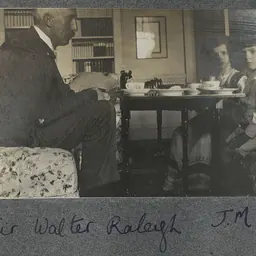
Early years Marwick was born in Emneth near Ely, England on 2 May 1833. At the age of 17, he left for Australia on the Sir Walter Raleigh along with a number of others from his district. On board the ship, he was chosen as constable to supervise 26 other young men during the voyage. "It was my job to see they kept the place clean and tidy". Marwick turned 18 during the voyage. The ship arrived in Fremantle on 31 May 1852. On 14 July 1852, Marwick left Perth to travel 100 kilometres on foot to Tipperary, near York, to work for Samuel Evans Burges. According to family stories, he walked the distance in one day.
At this time, because of the arrival of convicts in Western Australia, there was plenty of work available, "wages were low and men were plentiful". "There were hundreds of friendly natives in the locality, but for four months at a time I never saw a white man."
Sandalwood trade After a period when he was leasing land from Samuel Evans Burges, which he cleared and farmed, in about 1858, Marwick became a sandalwood cutter and sub-let his farm. He arranged a deal with Burges to cut and deliver three tons of sandalwood each week, provided he had the exclusive right to cut sandalwood for himself on Burges's government leases.
Marwick and the Mongers In about 1861, there was a crash in the price of sandalwood. Marwick was rescued from financial difficulties by John Henry Monger Snr. who still had confidence in the sandalwood trade.:
As a result, Marwick was able to continue to work throughout the slump and keep his teams of cutters. On Monger's advice, Marwick began to buy land in and around York, and built himself a house...... Monger bought up 25 grants at Red Swamp Hill in the York area and sold them to Marwick for the same price he had paid for them.
Several letters were written complaining about Marwick, one claiming he was semi-literate and under the influence of a former convict.
Marwick's Shed was built in about 1876.
On behalf of Monger, Marwick bought new breeds of pig and cattle to improve breeding in the York district.
In 1884, he went to Albany with Edward Keane, railway contractor,for whom Marwick had selected, stocked and superintended about 14,000 acres of pastoral land in the Avon Valley
Opening up the goldfields Following the discovery of gold in the Yilgarn in 1887, in Marwick's words: I left York along Hunt's track, and afterwards branched off and established a track to Golden Valley. I opened up this road by despatching teams from York, and in 1888, accompanied by Messrs Monger and Luke, left York for the purpose of looking for pastoral country to the east. We came close to the Londonderry along Hunt's track, and on behalf of the late Mr J H Monger and myself took up 100,000 acres at Mount Monger, 50,000 acres at Mount Burgess, and 40,000 acres at Woolgangie. 1888 was a good season, there being plenty of food and water obtainable throughout the trip. On returning to what is known as Southern Cross we met the prospectors (Risely and party) who had only discovered it a few days before. I afterwards opened a direct road from York to Southern Cross, and on behalf of the Government excavated tanks and dams along the route. I sent the first teams to Southern Cross, and in 1892 when Barley rode in with the gold and reported his great find, I despatched the first teams that ever arrived in Coolgardie with provisions, consigned to Messrs Wisdom; Counsel, Tobias and other pioneer firms. He returned to Australia and toured the Eastern States, and in 1905 married Mary Ann in York. He returned to England to live in Wisbech, not far from his birthplace. He returned to Western Australia again in 1914, visiting his old friend Frank Craig in Balingup and touring the South-West. He died in 1925 aged 91, and Mary Ann died the following year in York. By the time of his death he had amassed considerable wealth.
Don’t just read it —
keep it.
Full-length biographies made to live with: read them, listen on the way to work, watch them tonight.
- E-book
- Audio
- Video
Instant download · yours to keep · every purchase keeps this site free
Important facts
People in William Marwick's life
Named in this biography and alive at the same time




Contemporaries
People whose lives overlapped William Marwick's




Frequently asked questions
Who was William Marwick?
2 May 1833 - 2 Apr 1925
When was William Marwick born?
William Marwick was born in 1833.
When did William Marwick die?
William Marwick died in 1925.
Sources & further reading
Cite this page
APA: Biography.guide. (2026). William Marwick. https://biography.guide/william-marwick/
MLA: "William Marwick." Biography.guide, https://biography.guide/william-marwick/.
Chicago: "William Marwick." Biography.guide. https://biography.guide/william-marwick/.
Data last updated: 2026-09-20 · Spot an error? Report a correction.
Page generated 2026-09-27 05:14 UTC