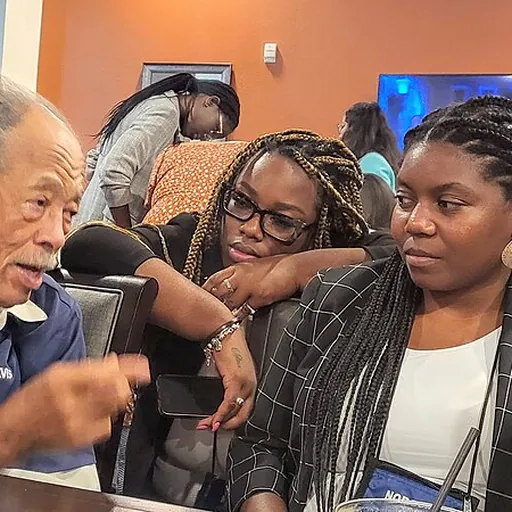
About William M. Jackson
Born 1936. William M. Jackson is an American chemist, known for Astrochemistry, Free radicals and NOBCChE.
William Morgan Jackson (born September 24, 1936) is a Distinguished Research and Emeritus Professor of Chemistry at University of California, Davis and pioneer in the field of astrochemistry. His work considers cometary astrochemistry and the development of laser photochemistry to understand planetary atmospheres. He is a Fellow of the American Association for the Advancement of Science, the American Physical Society and the American Chemical Society. In addition to contributing research work, he is notable as a mentor and advocate for increasing minority participation in science, and was one of the founders of the National Organization for the Professional Advancement of Black Chemists and Chemical Engineers (NOBCChE).
In 2019, he was awarded the Astronomical Society of the Pacific Arthur B.C. Walker II Award for his research and commitment to promoting diversity. In 2021, he was awarded the American Physical Society Julius Edgar Lilienfeld Prize for outstanding contributions to fundamental chemical physics and spectroscopy associated with asteroids and comets, and for exemplary teaching at both the undergraduate and graduate levels, as well as lifelong service and inspiration to a diverse community.
Early life Jackson was born in Birmingham, Alabama to William Morgan and Claudia H. Jackson on September 24, 1936. He grew up in a segregated society and spent part of his childhood in Dynamite Hill, an area in Birmingham that the Ku Klux Klan frequently bombed during the Civil rights movement. His father, a Tuskegee University graduate, owned the Apex Cab Company and also taught auto mechanics at Parker High School, whilst his mother, a graduate of Santa Barbara Junior College, worked for the US government. He was awarded a full scholarship. During his doctoral studies, he worked in the Harry Diamond Laboratories, where he studied molten salt compounds. He returned to the National Institute of Standards and Technology as a postdoctoral researcher, studying how radiant energy impacted chemical structures. He joined the faculty at the University of Pittsburgh in 1969, where he spent a year researching and teaching. At the University of Pittsburgh, he worked with Wade Fite and Ted Brackman on the detection of electron impact on molecules using mass spectrometry. He primarily studied comets using satellites ground-based telescopes, using experimental data and theoretical predictions to establish how the free radicals inside comets form. Despite having left Goddard Space Flight Center, Jackson served as team leader for the International Ultraviolet Explorer telescope, which observed Halley's Comet. His laser systems exploit resonant four-wave mixing, which allows them to photodissociate gases observed in planetary atmospheres. He served as Chair of the Department of Chemistry at University of California, Davis in 2000.
Academic service and advocacy Jackson has campaigned for equity, diversity and inclusion in science since he started his career. He has served in various capacities for the NOBCChE, attending every annual meeting other than one (San Diego, 1999) in protest of the 1996 California Proposition 209. 1989 Guggenheim Fellow 1991 Catholic University of America Alumni Award 1996 Alexander von Humboldt Foundation Research Award 2002, 2003 Sigma Xi Distinguished Lecturer 2004 Elected Fellow of the American Association for the Advancement of Science 2015 University of California, Davis Emeritus Award 2021 American Physical Society Julius Edgar Lilienfeld Prize
Selected publications His publications include;
Don’t just read it —
keep it.
Full-length biographies made to live with: read them, listen on the way to work, watch them tonight.
- E-book
- Audio
- Video
Instant download · yours to keep · every purchase keeps this site free
Important facts
People in William M. Jackson's life
Named in this biography and alive at the same time




Related people
Same field, nearest in time




Contemporaries
People whose lives overlapped William M. Jackson's





Frequently asked questions
Who is William M. Jackson?
chemistry researcher
When was William M. Jackson born?
William M. Jackson was born on 24 September 1936 in Birmingham.
What is William M. Jackson's occupation?
William M. Jackson is a chemist.
What is William M. Jackson known for?
William M. Jackson is known for Astrochemistry, Free radicals and NOBCChE.
What nationality is William M. Jackson?
William M. Jackson is American.
Sources & further reading
· Wikipedia: William M. Jackson
· DBpedia: William M. Jackson (chemist)
Cite this page
APA: Biography.guide. (2026). William M. Jackson. https://biography.guide/william-m-jackson-chemist/
MLA: "William M. Jackson." Biography.guide, https://biography.guide/william-m-jackson-chemist/.
Chicago: "William M. Jackson." Biography.guide. https://biography.guide/william-m-jackson-chemist/.
Data last updated: 2026-09-23 · Spot an error? Report a correction.
Portrait: Wikimedia Commons · author & licence
Page generated 2026-09-27 05:05 UTC