About William Langland
Lived 1332 – 1386 (aged 53–54). William Langland was an English and British writer and poet.
William Langland (; ; ) is the presumed author of a work of Middle English alliterative verse generally known as Piers Plowman, an allegory with a complex variety of religious themes. The poem translated the language and concepts of the cloister into symbols and images that could be understood by a layman.
Life Little is known of Langland himself. It seems that he was born in the West Midlands of England around 1330, according to internal evidence in Piers Plowman. The narrator in Piers Plowman receives his first vision while sleeping in the Malvern Hills (between Herefordshire and Worcestershire), which suggests some connection to the area. The dialect of the poem is also consistent with this part of the country. Piers Plowman was written c. 1377, as the character's imagination says he has followed him for "five and forty winters."
A fifteenth-century note in the Dublin manuscript of Piers Plowman says that Langland was the son of Stacy de Rokayle.
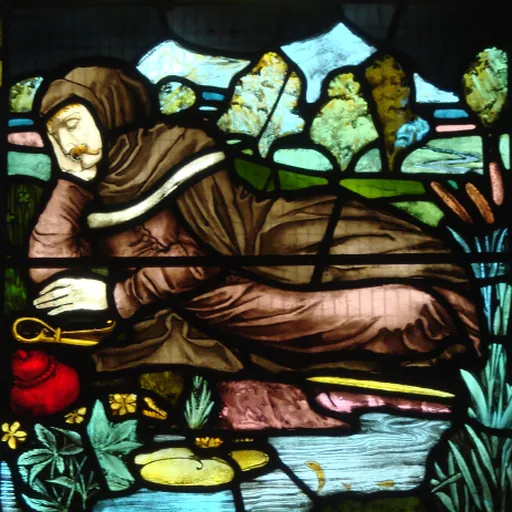
Langland is believed to have been born in Cleobury Mortimer, Shropshire, although Ledbury, Herefordshire, and Great Malvern, Worcestershire also have strong claims to being his birthplace. There is a plaque to that effect in the porch of Cleobury Mortimer's parish church, which also contains a memorial window, placed in 1875, depicting the Piers Plowman vision. Langland is thought to have been a novice of Woodhouse Friary located nearby.
There are strong indications that Langland died in 1385 or 1386. A note written by "Iohan but" (John But) in a fourteenth-century manuscript of the poem (Rawlinson 137) makes direct reference to the death of its author: "whan this werke was wrouyt, ere Wille myte aspie/ Deth delt him a dent and drof him to the erthe/ And is closed vnder clom" ("once this work was made, before Will was aware/ Death struck him a blow and knocked him to the ground/ And now he is buried under the soil"). According to Edith Rickert, John But himself seems to have died in 1387, indicating that Langland died shortly before this date. Nonetheless some scholars believe Langland was the author of a 1399 work, Richard the Redeless. It also suggests that he was well above average height and made a living reciting prayers for the dead in chantries at St Paul's Cathedral.
Attribution The attribution of Piers Plowman to Langland rests principally on the evidence of a manuscript held at Trinity College, Dublin (MS 212). This manuscript ascribes Piers Plowman to Willielmi de Langland, son of Stacy de Rokayle, "who died in Shipton-under-Wychwood, a tenant of the Lord Spenser in the county of Oxfordshire". Other manuscripts name the author as Robert or William Langland, or Wilhelms W. (most likely shorthand for William of Wychwood).
The poem itself also seems to point to Langland's authorship. At one point, the narrator remarks: "I have lived in londe [...] my name is longe wille" (B XV.152). This can be taken as a coded reference to the poet's name, in the style of much late-medieval literature (see, for instance, Villon's acrostics in Le Testament). However, it has also been suggested that medieval scribes and readers may have understood this line as referring to a "William Longwille", the pseudonym used by a Norfolk rebel in 1381.
Although there is little other evidence, Langland's authorship has been widely accepted since the 1920s. It is not, however, entirely beyond dispute, as 21st century work by Stella Pates and C. David Benson has demonstrated.
Don’t just read it —
keep it.
Full-length biographies made to live with: read them, listen on the way to work, watch them tonight.
- E-book
- Audio
- Video
Instant download · yours to keep · every purchase keeps this site free
Important facts
People in William Langland's life
Named in this biography and alive at the same time

Related people
Same field, nearest in time



Contemporaries
People whose lives overlapped William Langland's

Frequently asked questions
Who was William Langland?
English writer
When was William Langland born?
William Langland was born in 1332 in West Midlands.
When did William Langland die?
William Langland died in 1386.
What was William Langland's occupation?
William Langland was a writer and poet.
What nationality was William Langland?
William Langland was English and British.
Sources & further reading
Cite this page
APA: Biography.guide. (2026). William Langland. https://biography.guide/william-langland/
MLA: "William Langland." Biography.guide, https://biography.guide/william-langland/.
Chicago: "William Langland." Biography.guide. https://biography.guide/william-langland/.
Data last updated: 2026-09-21 · Spot an error? Report a correction.
Portrait: Wikimedia Commons · author & licence
Page generated 2026-09-27 05:00 UTC