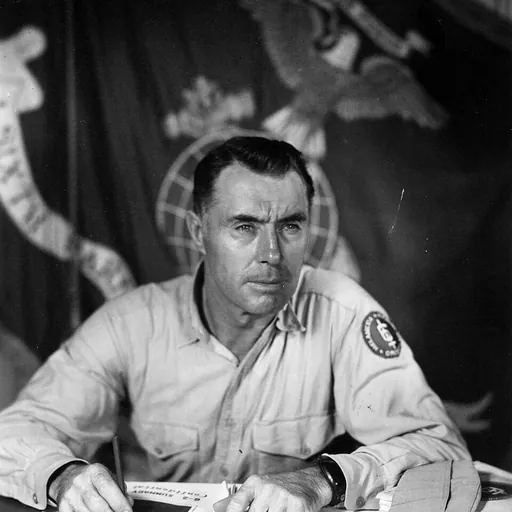
About William J. Whaling
Lived 1894 – 1989 (aged 95). William J. Whaling was an American sport shooter.
William John Whaling (February 26, 1894 – November 20, 1989) was a highly decorated Major general in the United States Marine Corps and an expert in jungle warfare during the Pacific War. He also competed as a sport shooter in the 1924 Summer Olympics, where he finished in 12th place in the 25 m rapid fire pistol competition.
He began his Marine Corps career as an Enlisted Man and received field commission during World War I. Whaling remained in the Marine Corps and commanded a battalion at Guadalcanal and regiment at Cape Gloucester and Okinawa, where he earned the Navy Cross for gallantry in action. During the Korean War, he served as assistant division commander, 1st Marine Division and later as commanding general, Marine Corps Recruit Depot San Diego.
Early career
William J. Whaling was born on February 26, 1894, in St. Cloud, Minnesota, as the son of Canadian immigrants. Following the United States entry into World War I, he enlisted in the Marine Corps in May 1917. Whaling completed boot camp at Parris Island and then joined the newly organized 1st Battalion, 6th Marines. Following several months of intensive training, he embarked for France, where he spent the next several months with more training and the unloading of the ships.
The 6th Marine Regiment was ordered to the trenches in the Verdun sector in March 1918 and Whaling then took part in the Battle of Belleau Wood in June that year, where he was gassed. He was hospitalized for the next two months and was commissioned as a second lieutenant in August 1918. Whaling was subsequently attached to the headquarters of the 6th Marine Regiment under Colonel Harry Lee and participated in the Battle of Saint-Mihiel in September 1918. He distinguished himself during combat near Thiaucourt and received a Silver Star citation for gallantry in action.
Whaling was transferred to the West Coast in October 1924 and attached to the headquarters, Department of the Pacific in San Francisco under Major General Wendell C. Neville. He did not remain there for long and in December that year, he embarked for expeditionary duty in China. Whaling was attached to the Marine detachment with the American Legation in Peking and served there until December 1926.
World War II
Whaling was attached to the Marine barracks at Pearl Harbor Navy Yard under Colonel Gilder D. Jackson Jr. and was present there at the time of Japanese attack on Pearl Harbor in the morning on December 7 that year. Whaling was sleeping at his quarters when he was awakened by bombs blasts. He rushed to the parade ground, where he witnessed tens of incoming Japanese fighters and bombers attacking Hickam Field and Navy Yard.
Guadalcanal
He was promoted to the capacity of executive officer, 5th Marine Regiment under Colonel LeRoy P. Hunt at the end of March 1942 and spent following months with intensive training in order to prepare his unit for combat deployment to South Pacific. Unfortunately, Whaling was known as a Marine of legendary field skills but little administrative ability. Also, Colonel Hunt was known as a charismatic, valiant troop leader, but no organizer, no planner. Thus, the wisdom of Hunt–Whaling team was doubted by some from the divisional staff, including Whaling's old friend, now Divisional operations officer, Colonel Gerald C. Thomas. Whaling was promoted to the temporary rank of colonel on May 21, 1942.
Whaling embarked with 5th Marine Regiment for New Zealand during June 1942 and after one month of training near Wellington, they sailed for Guadalcanal, Solomon Islands. He went ashore on August 7, 1942, and although the regiment had initial success in combat, its advance began slowing. Commanding General of 1st Marine Division, Alexander Vandegrift, realized that some changes must be done within the 5th Marines command and relieved Colonel Hunt on September 25, 1942. Whaling was relieved of command four days later, but unlike Hunt, he was not ordered back to the United States.
New Britain
While in Australia, Whaling was appointed commanding officer, 1st Marine Regiment and supervised the rebuilding of regiment and intensive training until December 1943. He then embarked with his regiment to New Britain, where he was tasked with the capture of Cape Gloucester and its two airfields, which could be used in the future for allied offensive air operations.
Whaling took part in the main landing on December 26, 1943, and in cooperation with John T. Selden's 5th Marines and Julian N. Frisbie's 7th Marines, he captured the airfield on December 29. His regiment then participated in the mopping-up operations against scattered remnants of the Japanese garrison until the end of January 1944. Whaling was succeeded in command of 1st Marines by Colonel Chesty Puller on February 28, 1944, and ordered to the United States under rotation policy. For his service at Cape Gloucester, Whaling was decorated with his second Legion of Merit.
Okinawa Colonel Whaling as Commanding officer of 29th Marine Regiment. Following his return to the United States in April 1944, Whaling briefly served at the Headquarters Marine Corps in Washington, D.C., before he was ordered to Camp Pendleton, California. He was appointed commanding officer of the 2nd Training Regiment there and was responsible for the training of new recruits, who later served as replacements for combat units serving overseas until March 1945.
Whaling then embarked for the Pacific area and joined the headquarters of 6th Marine Division under Major General Lemuel C. Shepherd Jr., whom he knew from his service at New Britain. The Sixth Marine Division embarked for Okinawa at the beginning of April 1945 and general Shepherd quickly found an appropriate assignment for Whaling. The division's 29th Marine Regiment was not advancing fast enough to Shepherd's expectations. Shepherd relieved commanding officer of the regiment, Victor Bleasdale and replaced him with Whaling on April 14, 1945.
Death
Upon his retirement from the Marine Corps, Whaling settled in Lyons, New Jersey, where he died on November 20, 1989, aged 95. He was buried beside his wife, Vona C. Whaling, with full military honors at Arlington National Cemetery in Virginia. They had two sons, William John Whaling Jr., who died at the age of 3. and Robert W. Whaling died at the age of 31.
Decorations
Here is the ribbon bar of Major General Whaling:
Navy Cross citation Citation:
The President of the United States of America takes pleasure in presenting the Navy Cross to Colonel William J. Whaling (MCSN: 0-1049), United States Marine Corps, for extraordinary heroism as Commanding Officer of the Twenty-Ninth Marines, SIXTH Marine Division in action against the enemy Japanese forces on Okinawa, Ryukyu Islands, from 15 April to 21 June 1945. Assuming command of a regiment committed to extensive operations over an exceptionally broad zone of action on Motobu Peninsula, Colonel Whaling skillfully maneuvered elements of his command through rugged and precipitous mountain terrain to aid in driving the enemy to a final defensive position on Mount Yaetake. Though his forces were widely dispersed during this phase of the campaign, he unhesitatingly exposed himself to direct hostile fire among the most advanced elements of his Regiment, thereby obtaining maximum coordination which resulted in crushing the last enemy resistance. By his conspicuous bravery in personally directing assault units, Colonel Whaling contributed materially to the seizure of the desperately defended Sugar Loaf Hill. His aggressive and inspiring leadership during the subsequent landing on Oroku Peninsula was an important factor in the successful reduction of one of the most heavily fortified Japanese strongholds encountered. Colonel Whaling's gallant conduct throughout was in keeping with the highest traditions of the United States Naval Service.
Don’t just read it —
keep it.
Full-length biographies made to live with: read them, listen on the way to work, watch them tonight.
- E-book
- Audio
- Video
Instant download · yours to keep · every purchase keeps this site free
Important facts
People in William J. Whaling's life
Named in this biography and alive at the same time


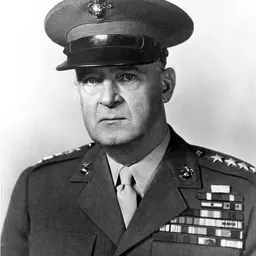

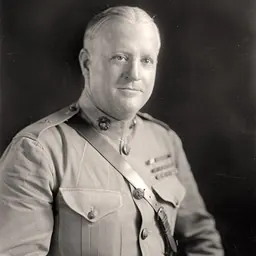
Related people
Same field, nearest in time


Contemporaries
People whose lives overlapped William J. Whaling's


Frequently asked questions
Who was William J. Whaling?
Major General of the United States Marine Corps
When was William J. Whaling born?
William J. Whaling was born on 26 February 1894 in St. Cloud.
When did William J. Whaling die?
William J. Whaling died on 20 November 1989 in Philadelphia.
What was William J. Whaling's occupation?
William J. Whaling was a sport shooter.
What nationality was William J. Whaling?
William J. Whaling was American.
Sources & further reading
· Wikipedia: William J. Whaling
Cite this page
APA: Biography.guide. (2026). William J. Whaling. https://biography.guide/william-j-whaling/
MLA: "William J. Whaling." Biography.guide, https://biography.guide/william-j-whaling/.
Chicago: "William J. Whaling." Biography.guide. https://biography.guide/william-j-whaling/.
Data last updated: 2026-09-23 · Spot an error? Report a correction.
Portrait: Wikimedia Commons · author & licence
Page generated 2026-09-27 05:07 UTC