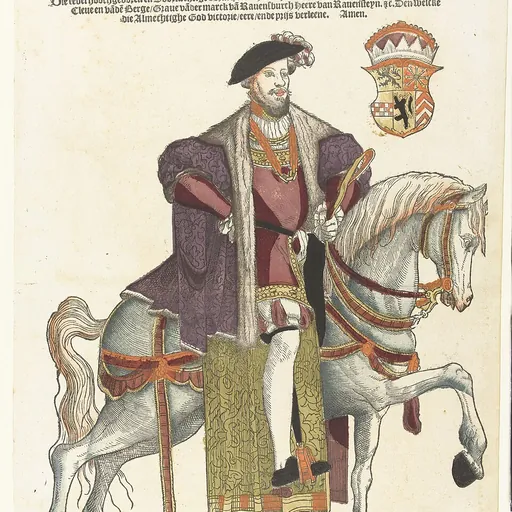
About William I of Guelders and Jülich
Lived 1364 – 1402 (aged 37). William I of Guelders and Jülich was a German aristocrat.
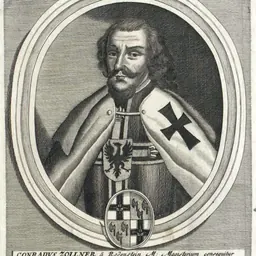
William (5 March 1364 – 16 February 1402, Arnhem) was Duke of Guelders, as William I, from 1377 and Duke of Jülich, as William III, from 1393. William was known for his military activities, participating in the Prussian crusade five times and battling with neighbors in France and Brabant throughout his rule. His allies included Holy Roman Emperors, Charles IV and Wenceslaus, Richard II of England, and Conrad Zöllner von Rothenstein, the Grand Master of the Teutonic Knights. During his reign the duchies of Guelders and Jülich were temporarily unified.
Childhood and accession
William was the eldest son of William II, Duke of Jülich and Maria of Guelders, half-sister of Reginald III, Duke of Guelders and Edward, Duke of Guelders. The brothers Edward and Reginald disputed the Duchy, with Edward taking control in 1361, imprisoning his brother. In 1366, Edward violated a peace made with Charles IV, Holy Roman Emperor and Wenceslaus I, Duke of Luxembourg (who was Duke of Brabant by marriage to Joanna, Duchess of Brabant) by not protecting Brabant merchants in the land between the Rhine and the Meuse who were under threat by armed men involved in the English-French wars. Wenceslaus's army then invaded and engaged in the Battle of Baesweiler in August 1371. Duke Edward, who was about to marry Katherine of Bavaria, daughter of Albert I, Duke of Bavaria, joined the battle and captured Duke Wenceslaus, but was wounded by an arrow and died. Reginald was immediately released, but died of ill health in three months, neither leaving heirs. This led to internal dissent over succession. Edward and Reginald were the only children of Reginald II, Duke of Guelders and Eleanor of Woodstock, daughter of Edward II of England, and Reginald's only male heirs. Reginald II's first marriage was to Sophia Berthout, Lady of Mechelen, which led to four daughters. Two daughters, Maria and Mathilde, then made claim to the title. Mathilde's claim was based on her position as eldest daughter. Maria based her claim on William, who was seven at the time, being the only male representative of the blood of Guelders. Mathilde quickly married John II, Count of Blois, and this grievance precipitated into the War of the Succession of Guelders. William's father, William II, Duke of Jülich, was granted the right to administer the duchy by Emperor Charles IV during his son's minority. At this time a marriage was arranged between the young William and Katherine of Bavaria, who had been betrothed to his uncle Edward. However, as part of the reconciliation between the houses of Blois and Jülich, some of Guelders remained under the control of Mathilde, and the upper district was under control of Jülich.
In 1377, upon the boys majority, Emperor Charles IV granted Guelders and Zutphen to William, the son of William II, but it took two more years to consolidate his authority over the entire duchy. He immediately received homage from Arnhem, Nijmegen, and the upper district. However, William did not recognize all of the municipal privileges granted by his half-uncle, Duke Reginald. His rule was opposed by some areas, notably Betuwe and Veluwe, and by nobles led by Frederik van Heeckeren van der Eze, who had supported Mathilde (and Reginald) in comparison to nobles led by Gijsbert V van Bronckhorst, Heer van Bronckhorst who had supported Edward and Maria. William consolidated control after besieging a number of castles of Hekeren nobles. His father accompanied him in a victory over the lord of Voorst near Gennep and Reginald van Brederede van Gennep, the chief leader of the Hekerens. With this, Mathilde and John of Blois renounced all claim to Guelders and Zutphen on 24 March 1379. That fall William married Catherine.
Wars and rule William's rule is cited as an example of the chivalry of that time in France and the Netherlands. He put on many tournaments and sports at arms, and has been called an ideal knight. He participated in crusades against the Lithuanians in East Prussia in the territories of the Teutonic Order with William of Holland, first in 1383, and later in 1388–89 and 1393. He was an ally of the English in the Hundred Years' War. And continuing the enmity from the War of the Succession of Guelders, he fought successfully in 1386–1388 with his father against the Duchy of Brabant, which was allied with France and Burgundy. William's army advanced far into Brabant, although his army was stalled in a battle near Grave, North Brabant in July 1388. His actions and alliance with England have been seen as reckless, and raised the ire of Charles VI of France, who advanced on Guelders with an army of 100,000. William narrowly escaped disaster with an apology, but his stand against the French made him famous throughout Europe. Reginald was less warlike, although tensions continued with Cleves over Lymers and Zevenaar, and the town of Emmerich was ceded to Cleves. Upon the death of Reginald, also without issue, the Duchy of Jülich went to Adolf, Duke of Jülich-Berg, son of William VII of Jülich, 1st Duke of Berg, and grandson of Gerhard VI of Jülich, Count of Berg and Ravensberg, brother of William's father. The Duchy of Guelders-Zutphen went to Arnold of Egmond, son of Maria van Arkel, daughter of William's sister, Joanna, and John V, Lord of Arkel. In 1396, during a visit to the English king, the cooks entered a cooking contest against their English counterparts led by then head cook, Crumken.
William kept many physicians. In 1388/89, three physicians are mentioned: Arnt van Auwel, Clais, and Peter, as well as a healer of wounds, Jan van Asperen. Later, Peter van Orten and Giesbert van Berg were separately brought into William's household after serving as professors of Medicine at the University of Cologne. Giesbert managed to work as a physician to Duchess Johanna and Antoine, Duke of Brabant, enemies of Guelders. When sick in 1401 and 1402, other doctors were called: Derich Distel, Volpart, Evert vander Eze, and an English physician, Thomas. Johan of Guelders, son of Mechtild van Brackel, married Hadewig van Sinderen Maria of Jülich, married Johan van Buren, and had issue.
Don’t just read it —
keep it.
Full-length biographies made to live with: read them, listen on the way to work, watch them tonight.
- E-book
- Audio
- Video
Instant download · yours to keep · every purchase keeps this site free
Important facts
Family & relationships
People in William I of Guelders and Jülich's life
Named in this biography and alive at the same time

Related people
Same field, nearest in time

Contemporaries
People whose lives overlapped William I of Guelders and Jülich's




Frequently asked questions
Who was William I of Guelders and Jülich?
Duke of Guelders
When was William I of Guelders and Jülich born?
William I of Guelders and Jülich was born on 5 March 1364.
When did William I of Guelders and Jülich die?
William I of Guelders and Jülich died on 16 February 1402 in Arnhem.
What was William I of Guelders and Jülich's occupation?
William I of Guelders and Jülich was an aristocrat.
What nationality was William I of Guelders and Jülich?
William I of Guelders and Jülich was German.
Sources & further reading
· Wikipedia: William I of Guelders and Jülich
· DBpedia: William I of Guelders and Jülich
Cite this page
APA: Biography.guide. (2026). William I of Guelders and Jülich. https://biography.guide/william-i-of-guelders-and-julich/
MLA: "William I of Guelders and Jülich." Biography.guide, https://biography.guide/william-i-of-guelders-and-julich/.
Chicago: "William I of Guelders and Jülich." Biography.guide. https://biography.guide/william-i-of-guelders-and-julich/.
Data last updated: 2026-09-22 · Spot an error? Report a correction.
Portrait: Wikimedia Commons · author & licence
Page generated 2026-09-27 05:04 UTC