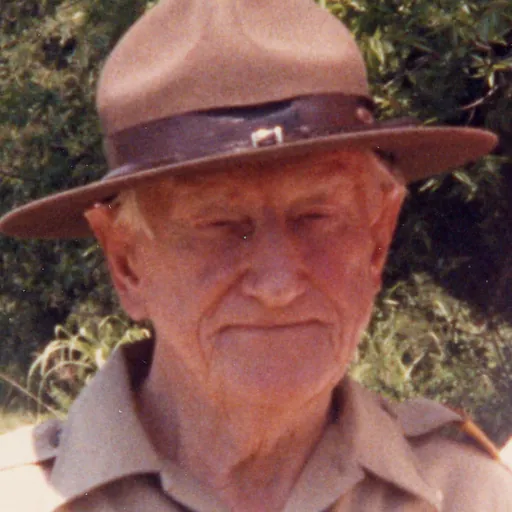
About William Hillcourt
Lived 1900 – 1992 (aged 92). William Hillcourt was an American educator, writer and scout leader, known for Boy Scout Handbook, Boys' Life and Scouting (magazine).
William Hillcourt (born Vilhelm Hans Bjerregaard Jensen; August 6, 1900 – November 9, 1992), was a Danish-American scouting leader. Known within the Scouting movement as "Green Bar Bill", he was an influential leader in the Boy Scouts of America (BSA) organization from 1927 to 1992. Hillcourt was a prolific writer and teacher in the areas of woodcraft, troop and patrol structure, and training; his written works include three editions of the BSA's official Boy Scout Handbook, with over 12.6 million copies printed, other Scouting-related books and numerous magazine articles. Hillcourt developed and promoted the American adaptation of the Wood Badge adult Scout leader training program.
Hillcourt was Danish-born and moved to the United States as a young adult. From his start in Danish Scouting in 1910 until his death in 1992, he was continuously active in Scouting. He traveled all over the world teaching and training both Scouts and Scouters, earning many of Scouting's highest honors. His legacy and influence can still be seen today in the BSA program and in Scouting training manuals and methods for both youth and adults.
Personal life Hillcourt was born in 1900 in Aarhus, Denmark, and was the youngest of three sons of a building contractor. He was given the name Vilhelm Hans Bjerregaard Jensen. Around 1930, he changed his name by anglicizing "Vilhelm", translating "Bjerregaard" into "Hill-court" and dropping "Jensen". His first published work was a poem about trolls and elves, printed by an Aarhus newspaper when he was nine years old. at age 17. He was selected to represent his troop at the 1st World Scout Jamboree in Olympia in 1920 where he first met Baden-Powell, with whom he was later to work.
While Hillcourt studied pharmacy in Copenhagen, he became more involved in Scouting. As a Scout leader, he became a Scoutmaster, national instructor, writer and then the editor for the Danish Scouting journal. He wrote his first book, The Island, recounting his early Scouting experiences. He was soon hired by the BSA's national office and worked for the BSA until he retired as a professional Scouter in 1965. In 1933 Hillcourt married Grace Brown, the personal secretary of Chief Scout Executive James E. West. He then worked for the BSA Supply Division where he broke his leg when a crate fell on him. He met James West while riding in an elevator at the national office. West solicited Hillcourt's thoughts on Scouting in the U.S. Hillcourt later sent West an 18-page memo detailing issues with the lack of patrol structure and leadership. He recommended that the BSA write a handbook for patrol leaders, and that it needed to be written by someone who had been both a patrol leader and a Scoutmaster. West hired Hillcourt as a writer and editor and was later persuaded to commission Hillcourt to write the first Handbook for Patrol Leaders which was published in 1929. the BSA's national training center, so he could be in place to put his theories to a practical test. In order to do so, he founded Troop 1 of Mendham in 1935 as a unit directly chartered to the National Council of the BSA. As the Scoutmaster, he used Troop 1 to test and validate his work for 16 years.
The BSA national office moved from New York City to North Brunswick, New Jersey, in 1954, and the Hillcourts moved with it. He completed the sixth edition of the Boy Scout Handbook in time for the BSA's 50th anniversary in 1960.
Wood Badge
To encourage the creation of Rovering in the U.S., J. S. Wilson travelled from the UK to oversee a Wood Badge course in May 1936 at Schiff. Hillcourt was a participant in that first course and four days later, he was the senior patrol leader for the second course. He received his Wood Badge beads in 1939 and was appointed as the deputy camp director for Wood Badge. After World War II, Wood Badge was revived and Hillcourt was the Scoutmaster for a test course begun on July 31, 1948, at Schiff and the first standard course at Philmont Scout Ranch. As the national director of training, Hillcourt wore five Wood Badge beads, a tradition that has been discontinued in the U.K. Scout Association, however other countries still continue the use of the five Wood Badge Beads and are still worn by the National Volunteer Leader of Wood Badge Training of each country as well as by special decree of Gilwell Park today.
Later life
Hillcourt retired from the BSA on August 1, 1965. In 1971, he and Grace finally completed the world tour he had started in 1926; along the way they attended the 13th World Scout Jamboree in Fujinomiya, Japan. Grace Hillcourt died in 1973. Many of the changes were intended to expand Scouting to a broader base of youth and to make Scouting more "in tune with the times". In 1980, the BSA presented Hillcourt with their highest national honor, the Silver Buffalo Award and he was cited as "The Voice of Scouting". The World Scout Committee of the World Organization of the Scout Movement recognized him for exceptional services to world Scouting in 1985 with the Bronze Wolf Award. In the same year, an article in the Scouting magazine proclaimed Hillcourt as "the foremost influence on development of the Boy Scouting program." and Paraguay). He served as scoutmaster in the Wood Badge program for "South Explorers Leaders and Center –Leadership Course in Troop", He ended his trip to South America in Caracas, Venezuela. He also was Troop Head and Director of the Field-School "Paramacay".
To celebrate during the month of August his 85 years of age with his old friends explorers in Copenhagen, Denmark. And then, of course, in the middle of the times, he continued to camp in the different events that took place during his campaign and did not fail to make a presence with his uninterrupted record, with the Jamboree. In 1990 he also became a member of Firecrafter, an American Scouting service organization. Travel and appearances at Scouting events both local and worldwide were part of his routine until he died, for which he was referred to as Scoutmaster to the World. His writings are still used within the Scouting movement and his material continues to be reprinted in Scouting magazine. The Longhouse Council operates the William Hillcourt Scout Museum and Carson Buck Memorial Library at Camp Woodland in New York to "keep the traditions of Scouting alive" through the preservation of the history that is a foundation for today's Scouting movement.
Works Hillcourt was one of the BSA's most prolific writers. He wrote numerous articles for Boys' Life and Scouting magazines, including a column aimed at patrol leaders under the by-line of "Patrol Leader Green Bar Bill". At least 12,610,000 copies of his three editions of the Boy Scout Handbook were printed. (1925) The Island (1929) Handbook for Patrol Leaders (1933) The 1933 Scout Jamboree Book with James E. West (1936) Handbook for Scoutmasters, Third edition in two volumes (1946) Aids to Scoutmastership, World Brotherhood Edition, by Baden-Powell, revised by Hillcourt (1946) Scouting for Boys, World Brotherhood Edition, by Baden-Powell, revised by Hillcourt (1948) Scout Fieldbook, First edition, with West (1950) Handbook for Patrol Leaders; World Brotherhood Edition (1959) Boy Scout Handbook, Sixth edition biography of iconic illustrator Norman Rockwell (1979) The Official Boy Scout Handbook, Ninth edition (1980) The Official Patrol Leader Handbook, Third edition
Don’t just read it —
keep it.
Full-length biographies made to live with: read them, listen on the way to work, watch them tonight.
- E-book
- Audio
- Video
Instant download · yours to keep · every purchase keeps this site free
Important facts
People in William Hillcourt's life
Named in this biography and alive at the same time


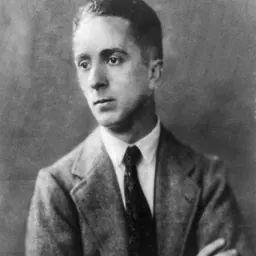
Related people
Same field, nearest in time



Contemporaries
People whose lives overlapped William Hillcourt's




Frequently asked questions
Who was William Hillcourt?
Scouting author, Scoutmaster to the world
When was William Hillcourt born?
William Hillcourt was born on 6 August 1900 in Aarhus.
When did William Hillcourt die?
William Hillcourt died on 9 November 1992 in Stockholm.
What was William Hillcourt's occupation?
William Hillcourt was an educator, writer and scout leader.
What was William Hillcourt known for?
William Hillcourt was known for Boy Scout Handbook, Boys' Life, Scouting (magazine) and Wood Badge (Boy Scouts of America).
What nationality was William Hillcourt?
William Hillcourt was American.
Sources & further reading
· Wikipedia: William Hillcourt
Cite this page
APA: Biography.guide. (2026). William Hillcourt. https://biography.guide/william-hillcourt/
MLA: "William Hillcourt." Biography.guide, https://biography.guide/william-hillcourt/.
Chicago: "William Hillcourt." Biography.guide. https://biography.guide/william-hillcourt/.
Data last updated: 2026-09-22 · Spot an error? Report a correction.
Portrait: Wikimedia Commons · author & licence
Page generated 2026-09-27 05:03 UTC