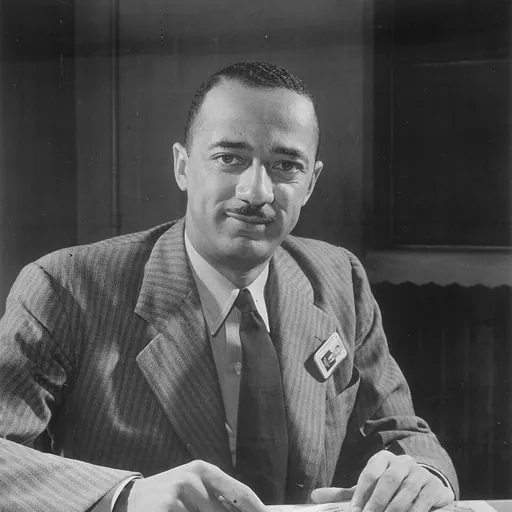
About William H. Hastie
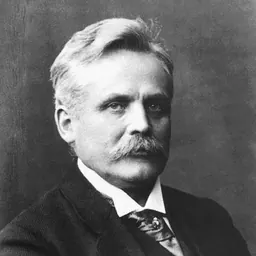
Lived 1904 – 1976 (aged 71). William H. Hastie was an American lawyer, judge, jurist, politician, university teacher and governor.
William Henry Hastie Jr. (November 17, 1904 – April 14, 1976) was an American lawyer, judge, educator, public official, and civil rights advocate. He was the first African American to serve as Governor of the United States Virgin Islands, as a federal judge, and as a federal appellate judge. He served as a United States circuit judge of the United States Court of Appeals for the Third Circuit and previously served as District Judge of the District Court of the Virgin Islands.
Early life and education
Hastie was born in Knoxville, Tennessee, the son of William Henry Hastie, Sr. and Roberta Childs. His ancestors were African American. Family tradition held that one female ancestor was a Malagasy princess. He graduated from Dunbar High School, a top academic school for black students.
Hastie attended Amherst College, Massachusetts in 1925, where he graduated first in his class, magna cum laude, and Phi Beta Kappa, receiving a Bachelor of Arts degree. He received a Bachelor of Laws from Harvard Law School in 1930, followed by a Doctor of Juridical Science from the same institution in 1933. Hastie served as a member of the informal "Black Cabinet" of President Franklin D. Roosevelt from 1933 to 1937.
In 1937, Roosevelt appointed Hastie to the District Court of the Virgin Islands, making Hastie the first African-American federal judge. This was a controversial action; Democratic United States Senator William H. King of Utah, the Chairman of the United States Senate Committee on the Judiciary called Hastie's appointment a "blunder." King opposed any nominee who supported Black equality.
In 1939, Hastie resigned from the court to become the Dean of the Howard University School of Law, where he had previously taught. One of Houston's sons became a name partner at the law firm.
World War II
During World War II, Hastie worked as a civilian aide to the United States Secretary of War Henry Stimson from 1940 to 1942.
Hastie with President Harry S. Truman at Drake's Seat, on the island of Saint Thomas in the Virgin Islands, February 22, 1948
In 1946, President Harry S. Truman appointed Hastie as Territorial Governor of the United States Virgin Islands.
Supreme Court consideration As the first African American on the Federal bench, Hastie was considered as a possible candidate to be the first African-American Justice of the Supreme Court. In an interview with Robert Penn Warren for the book Who Speaks for the Negro?, Hastie commented that as a judge, he had not been able to be "out in the hustings, and to personally sample grassroots reaction" but that for the Civil Rights Movement to succeed, both class and race must be considered.
In 1962, President John F. Kennedy considered appointing Hastie to succeed retiring Justice Charles Whittaker. Justice William O. Douglas reportedly told Robert F. Kennedy that Hastie would be "just one more vote for Frankfurter."
Legacy Hastie was an elected member of both the American Academy of Arts and Sciences and the American Philosophical Society. The Third Circuit Library in Philadelphia is named in Hastie's honor. A permanent memorial room in his honor is hosted by The Beck Cultural Exchange Center in Knoxville, Tennessee, which also houses his personal papers. In addition, an urban natural area in South Knoxville is named in his honor.
In terms of African-American history, Hastie developed from a youthful radical to a scholarly, calm, almost aloof jurist. He said the judge always ought to be in the middle, for his basic responsibility "is to maintain neutrality while giving the best objective judgment of the contest between adversaries." He served as major influence for many lawyers and jurists, Judge Solomon Oliver Jr. was among those who clerked for him, and cites Hastie as his greatest influence. As a scion of an elite black family, he reflected its integrationist viewpoint. He said, "The Negro lawyer has played and continues to play, a very important role in the American Negro's struggle for equality." When he resigned as the top aide on racial matters to the War Department in 1943, he said it was caused by "reactionary policies and discriminatory practices in the Army and Air Forces."
Hastie's daughter, Karen Hastie Williams, was a prominent lawyer, and the first woman of colour appointed clerk to a U.S. Supreme Court Justice.
Amherst Olio gallery
Don’t just read it —
keep it.
Full-length biographies made to live with: read them, listen on the way to work, watch them tonight.
- E-book
- Audio
- Video
Instant download · yours to keep · every purchase keeps this site free
Important facts
People in William H. Hastie's life
Named in this biography and alive at the same time


Related people
Same field, nearest in time


Contemporaries
People whose lives overlapped William H. Hastie's





Frequently asked questions
Who was William H. Hastie?
American politician and civil rights activist (1904-1976)
When was William H. Hastie born?
William H. Hastie was born on 17 November 1904 in Knoxville.
When did William H. Hastie die?
William H. Hastie died on 14 April 1976 in East Norriton Township, Norristown.
What was William H. Hastie's occupation?
William H. Hastie was a lawyer, judge, jurist, politician, university teacher and governor.
What nationality was William H. Hastie?
William H. Hastie was American.
Sources & further reading
· Wikipedia: William H. Hastie
Cite this page
APA: Biography.guide. (2026). William H. Hastie. https://biography.guide/william-h-hastie/
MLA: "William H. Hastie." Biography.guide, https://biography.guide/william-h-hastie/.
Chicago: "William H. Hastie." Biography.guide. https://biography.guide/william-h-hastie/.
Data last updated: 2026-09-21 · Spot an error? Report a correction.
Portrait: Wikimedia Commons · author & licence
Page generated 2026-09-27 04:59 UTC