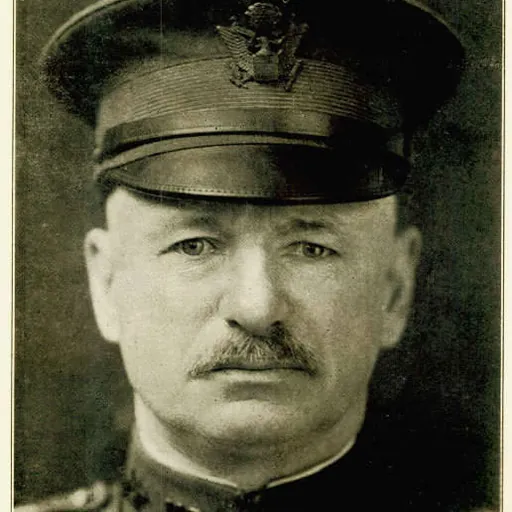
About William George Haan
Lived 1863 – 1924 (aged 61). William George Haan was an American military officer.
Major General William George Haan (October 4, 1863 – October 26, 1924) was a senior United States Army officer. He commanded the 32nd Division during the final year of World War I, and served in numerous other conflicts during his career.
Early life and education William George Haan was born on October 4, 1863, near Crown Point, Indiana, the son of German immigrants Nicholas Haan and Anna M. Haan.
Early military career He attended the United States Military Academy (USMA) at West Point, New York, from where he graduated twelfth in a class of forty-nine in June 1889, becoming a second lieutenant in the Field Artillery Branch of the United States Army. Among his fellow graduates included several men who would, like Haan himself, rise to the rank of brigadier general or higher in their later military careers. They included Charles Dudley Rhodes, Clement Flagler, Eben Eveleth Winslow, Frank Daniel Webster, Walter Augustus Bethel, Winthrop S. Wood, Chester Harding, William L. Kenly, Joseph D. Leitch, William S. Graves, George LeRoy Irwin, William Wright Harts, Edward McGlachlin Jr., Charles Crawford and William Lassiter. Charles Young was another distinguished graduate, becoming the first African American to attain the rank of colonel.
Haan was promoted to first lieutenant in August 1896. In 1905 he graduated from the United States Army War College, the same year he married, on August 16, to a woman named Margaret.
From 1903 to 1906 he served as a member of the General Staff and went to Panama for Theodore Roosevelt. As Acting Chief of Staff of the Pacific Division, he assisted with relief work after the 1906 San Francisco earthquake. For the next several years, he was responsible for several coastal defense positions. In April 1907 he became a Major and in December 1911 he was promoted to lieutenant colonel. He again served on the General Staff from 1912 to 1914, and in July 1916 was promoted to a colonel in the Coast Artillery. On August 26, 1917, Major General James Parker assumed command. Parker had previously been awarded the Medal of Honor during the Philippine–American War. Only two months later, the 32nd Division was activated in July 1917 at Camp MacArthur, Waco, Texas of National Guard units from Wisconsin and Michigan. In December 1917, Haan was promoted again to the temporary rank of major general and was commander of the division.
Major General William G. Haan, commanding the 32nd Division, along with members of his divisional staff at Camp MacArthur, January 1918.
Division leadership was switched several times between Parker and Haan before the unit arrived in France in February 1918 under Haan's leadership, becoming the sixth U.S. division to join the American Expeditionary Forces (AEF). In July, it entered the line with the French 6th Army.
32nd Division combat in France and Germany The division's men were the first American soldiers to enter cross the German border, piercing the famed and until this time invincible German Hindenburg Line of defense. Major General James Parker reassumed command on December 7, 1917, leading the unit into Alsace in May 1918, attacking in seven days.
Origin of the 32nd Division nickname During the Second Battle of the Marne, the 32nd Division captured Fismes, and during August their successful capture of Juvigny earned it the nickname "Le Terribles". A French general, impressed by their accomplishment, commented that they ""shot through every line the Germans put before it." The division was nicknamed Les Terribles, honoring them for their unrelenting and successful attacks against the Germans. The division's shoulder patch, a line shot through with a red arrow, signifies its tenacity during World War I. It was the only American unit in General Charles Mangins famous 10th French Army, it fought in the Oise-Aisne offensive.
Operations of the 32nd Division in World War I in crossing the Hindenburg Line.
The division fought continuously for 20 days during the Meuse–Argonne offensive and penetrated the last German defensive stronghold, the Kriemhilde Stellung, crossing the Meuse River. Up to this point much of the war had been a stalemate, fought from static trench lines over the same few kilometers of terrain. Their next objective was to flank the Germans at Metz. The division was the front line element of the Third U.S. Army. Members of the division marched to the Rhine River. They were the first Allied army unit to pierce the famed German Hindenburg Line of defense. There they occupied the center sector in the Colbenz bridgehead for four months, during which they held 400 square kilometers and 63 towns. From May through November 1918, they were given only 10 days of rest. The division fought in three major offensives, engaging and defeating 23 German divisions. They took 2,153 prisoners and gained , pushing back every German counterattack. Their success was remarkable.
Don’t just read it —
keep it.
Full-length biographies made to live with: read them, listen on the way to work, watch them tonight.
- E-book
- Audio
- Video
Instant download · yours to keep · every purchase keeps this site free
Important facts
People in William George Haan's life
Named in this biography and alive at the same time



Related people
Same field, nearest in time



Contemporaries
People whose lives overlapped William George Haan's



Frequently asked questions
Who was William George Haan?
United States Army general (1863-1924)
When was William George Haan born?
William George Haan was born on 4 October 1863 in Crown Point.
When did William George Haan die?
William George Haan died on 26 October 1924 in Washington, D.C..
What was William George Haan's occupation?
William George Haan was a military officer.
What nationality was William George Haan?
William George Haan was American.
Sources & further reading
· Wikipedia: William George Haan
Cite this page
APA: Biography.guide. (2026). William George Haan. https://biography.guide/william-george-haan/
MLA: "William George Haan." Biography.guide, https://biography.guide/william-george-haan/.
Chicago: "William George Haan." Biography.guide. https://biography.guide/william-george-haan/.
Data last updated: 2026-09-23 · Spot an error? Report a correction.
Portrait: Wikimedia Commons · author & licence
Page generated 2026-09-27 05:07 UTC